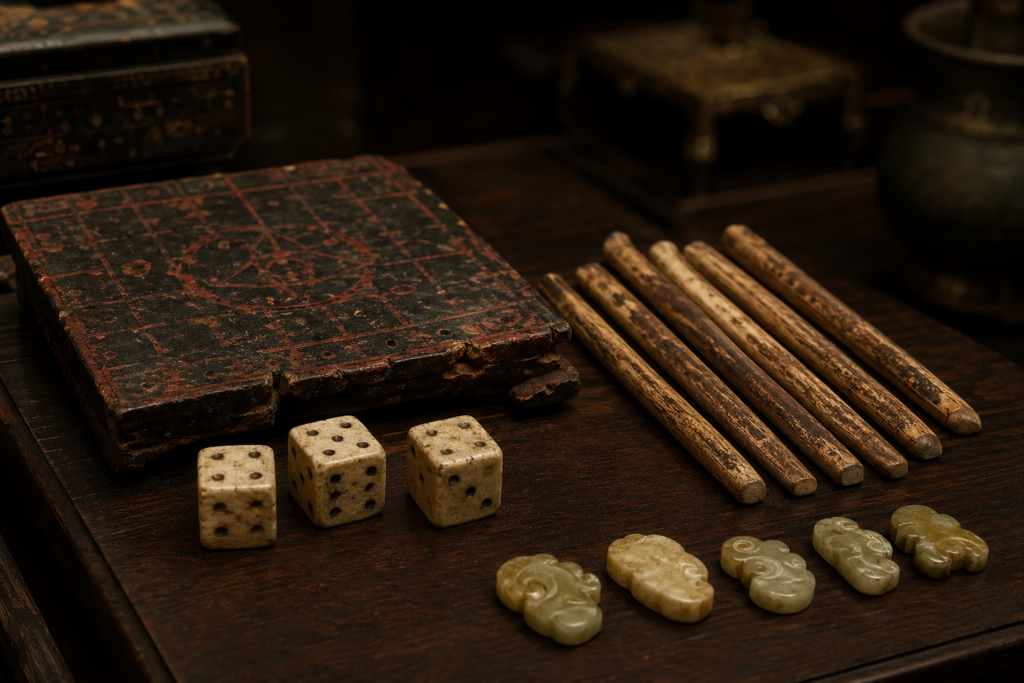

Sic Bo’s three-dice shaker is the visible end of a tradition that runs back at least two thousand years through Chinese gaming history — and the dice themselves are not even close to the oldest piece of that tradition. Long before cubic dice arrived in China from the Greco-Roman world, gambling in Han-dynasty courts ran on bone tiles, lacquered boards with cosmological grids, and a now-extinct game called Liubo that was played by emperors and apparently by the dead. This is the long story of Chinese dice and board gaming, from Shang-dynasty oracle bones to the Macau Sic Bo pit.
Before the Cube: Bone Lots and Liubo (c. 1500 BCE – 200 CE)
The earliest physical objects we can call a “Chinese board game” come from late Shang-dynasty tombs, around 1200 BCE, and they are not dice. They are pieces of inscribed bone and turtle shell that look like divinatory tools, but archaeologists recovered them in pairs and sets that suggest they were also used for gaming bets — the line between “asking the ancestors for an answer” and “rolling for a wager” was a thin one in Shang ritual culture.
By the early Han dynasty (around 200 BCE), this had matured into the game of Liubo — literally “six sticks”, named after the six bamboo throwing-sticks that drove movement on the board. Liubo was a chase-style two-player game, played on a beautifully complex 40-square layout with a cross-shaped pattern at the centre called the TLV pattern (after the shapes of the marks on it). Boards have been recovered from elite Han tombs in lacquer, jade, and bronze, often with the gaming pieces still in place — the famous Mawangdui tombs in Hunan province produced a complete Liubo set in 168 BCE that we can still play today, sort of. The rules were lost; what survived are the boards, the sticks, the pieces, and a handful of literary references that hint at what the moves might have been.
What matters for the dice tradition is the throwing sticks. Liubo’s six sticks were flat on one side and rounded on the other, and you threw them onto the board like a five-stick version of cleromancy. Each combination of flat-up and round-up sides gave a different “score” — essentially a primitive d2-based randomizer. This is the direct ancestor of the throwing-stick mechanic that survived in Chinese folk games for the next 1,500 years, even after cubic dice took over the high-stakes table.
The Arrival of Cubic Dice (c. 200 CE)
Cubic dice — the six-sided dot-marked kind we use today — show up in China during the late Han and Three Kingdoms period, almost certainly imported from the Roman world via the Silk Road. The earliest cubic Chinese dice recovered from tombs are bone or ivory, and they look essentially identical to Roman tesserae of the same century. The marking convention (dots on opposite faces summing to seven) is identical, which is strong evidence the pattern was carried over wholesale rather than independently invented.
Cubic dice did not immediately replace the throwing sticks. For roughly five centuries the two systems coexisted — sticks for traditional games like Liubo, cubic dice for the new gambling formats arriving from Central Asia. By the Tang dynasty (618-907 CE), the cubic dice had won. Tang-era poetry is full of references to dice gambling in tea houses and on river boats, often with three dice rather than two — a pattern that survived directly into modern Sic Bo.
Sic Bo’s Direct Ancestor: Tang and Song Dice Gambling (618 – 1279 CE)
By the Song dynasty (960-1279 CE), three-dice gambling games had become a fixture of urban Chinese life. The standard format used three cubic dice in a covered cup, shaken by the dealer, and revealed to a circle of bettors who placed wagers on the totals. The bet families would be familiar to any modern Sic Bo player: high vs low (the predecessor of Big/Small), specific totals, and the prized “triple” — three matching dice — which carried the highest payout. The structural blueprint of the modern Sic Bo table was essentially fixed by 1100 CE.
What distinguished Song dice gambling from earlier formats was the banker model. In Han and Tang dice games, players typically bet against each other, with the house taking a cut. Song-era gambling halls innovated the “fixed-odds against the house” structure, where the dealer paid out winning bets at posted odds and absorbed losing bets directly. This is the same model running at every modern casino table from Macau to Las Vegas. The economics of the Song banker model — a small per-roll edge applied across thousands of throws — is mathematically the same engine that drives modern casinos.
Mahjong and the Tile Tradition (Qing Dynasty, 19th Century)
Cubic dice are not the only Chinese gaming randomizer that survived to the modern day. The other great Chinese tradition is tile-based: Pai Gow tiles, dominoes, and ultimately Mahjong. Tile games trace back to Song-era domino sets, but Mahjong itself is much later — the consensus dating is mid-19th century, somewhere in the lower Yangtze around Ningbo or Shanghai. The legendary attribution to Confucius (a story popularised in the West by an enthusiastic 1920s American salesman named Joseph Babcock) is fictional. Mahjong is not 2,500 years old; it is about 170.
What Mahjong inherited from the older tradition was the structure of three-suit play (the suits come from a Song-era game called Madiao), the social arrangement of four-player gambling, and a betting structure that allows for both skill-based and luck-based outcomes. For a deeper dive into Mahjong’s actual origins, see our history of Mahjong.
Pai Gow: The Living Fossil
If Sic Bo is the modern face of Chinese dice gambling, Pai Gow is the modern face of the tile tradition. The game is played with 32 Chinese dominoes and traces directly to Song-era ya pai dominoes — making it one of the longest-surviving gambling games in continuous play anywhere in the world. Pai Gow Poker, the card-based casino version that became popular in 1980s California, is a hybrid invention that took the structural rules of Pai Gow and grafted them onto a 53-card deck. The original tile game still runs at high-stakes tables in Macau, primarily in Cantonese-speaking sections, and it preserves the slow ritualistic tile-flipping pace that characterised Chinese gambling for most of its history before the speed-up forced by 20th-century casino economics.
The Macau Acceleration (1849 – Present)
Macau is what happens when the long Chinese dice and tile traditions meet a Portuguese colonial concession with permissive gambling laws. The Portuguese legalised commercial gambling in Macau in 1849, well before Hong Kong, Shanghai, or any mainland Chinese city. For 150 years, Macau was the only place in greater China where you could gamble legally on a casino floor. The result was a unique distillation: traditional Chinese games (Sic Bo, Pai Gow, Fan Tan) sitting alongside Western imports (Roulette, Blackjack), all running under modern banker-model economics. By 2002, when the Macau gaming concession was opened to international operators, the Macau formula was already mature — and it then exported back to the West, which is why every modern Las Vegas pit has a Sic Bo table.
For the long story of Macau itself, see Macau: From Portuguese Trading Port to Asia’s Casino Capital.
What Survived
The Chinese dice and board game tradition, viewed across 3,000 years, is remarkable for what it preserved rather than what it changed. The three-dice format ran from Tang gambling halls to modern Sic Bo. The banker model invented in Song-era halls drives every casino on earth. The tile tradition that produced Mahjong and Pai Gow is still played in continuous lineage at tables that have not paused for centuries. Even the throwing sticks of Liubo persisted in folk games well into the 20th century, finally extinct only in the Cultural Revolution.
The only thing that did not survive cleanly is Liubo itself. The board lasted; the rules were lost. What remains are bronze sets in museums and a guess at the moves. The history of dice in China is, in that sense, a history of nearly-perfect transmission with one catastrophic gap at the centre.
Related Reading
- Liubo: The Lost Han Dynasty Game
- The History of Sic Bo
- The History of Mahjong
- Macau: From Trading Port to Casino Capital
- Sic Bo Rules and Bets