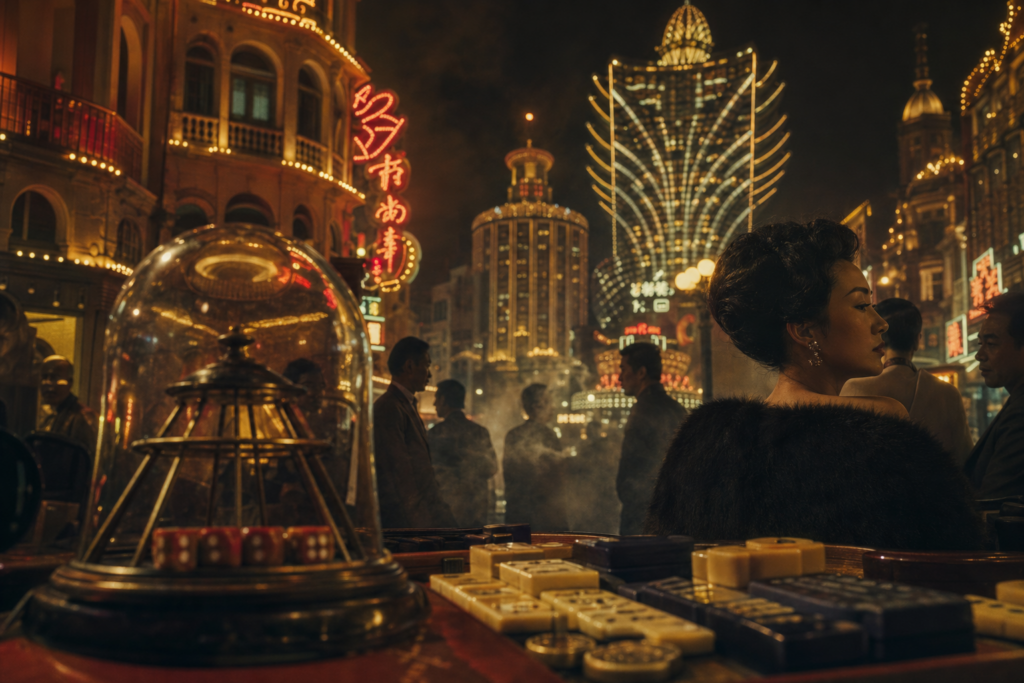

Macau is the largest gambling market in the world by gaming revenue — by a margin so wide that the second-largest market (the Las Vegas Strip) takes in less than a fifth of what Macau processes in a normal year. The reason is not chance. Macau is the only place in the Chinese-speaking world where commercial gambling has been legal continuously since the mid-19th century, and it sits one ferry ride from a population of 1.4 billion people who, until 2002, had nowhere else to go. The story of how Macau became this is a story of Portuguese colonial accident, late-Qing tolerance, mid-20th-century monopoly, and a 2002 liberalisation that rewrote the global casino industry.
The Portuguese Concession (1557 – 1849)
Portuguese traders established a permanent settlement on the small peninsula of Macau in 1557, by informal arrangement with Ming Chinese officials. For three hundred years the arrangement was a strange hybrid: Macau operated under Portuguese governance for matters concerning Portuguese residents, but the surrounding land remained nominally under Chinese sovereignty, and the Portuguese paid a ground rent to the Qing imperial administration. Macau in this period was not a casino city. It was a trading port — the only place where European merchants could legally trade with mainland China — and its economic life ran on silk, porcelain, and the silver that flowed in from Spanish-American mines.
Gambling existed in 17th and 18th-century Macau, but it was no different from the gambling that ran in Canton, Shanghai, or any other Chinese trading city: informal Fan Tan tables in the back of teahouses, dice gambling in dockyard taverns, lottery games run by neighbourhood associations. There was no concept of a licensed commercial gambling industry.
Legalisation (1849)
The shift began in 1849, when the Portuguese governor João Maria Ferreira do Amaral pushed Macau toward more formal sovereignty and, as part of a broader fiscal reform, legalised commercial gambling. The motivation was straightforwardly fiscal: the colony’s trade economy was being undercut by the rise of Hong Kong (which Britain had taken in 1842), and Amaral needed a new revenue stream. Licensing fees on gambling halls became one of the largest single sources of colonial government income.
The 1849 legalisation made Macau the only place in the Chinese-speaking world where commercial gambling could be operated openly. This was not yet a regional advantage of any consequence — Macau was small, hard to reach, and the gambling was still mostly traditional Chinese games (Fan Tan, Pai Gow, dice gambling) running in modest halls. The transformation came slowly, over the next 80 years.
The Tai Hing Monopoly Era (1934 – 1962)
By the 1930s, Macau’s gambling industry had grown enough to attract serious organisation. In 1934 the colonial government granted a monopoly concession to the Tai Hing company, which consolidated almost all licensed gambling in the territory under a single operator. Tai Hing built the first proper purpose-designed gambling halls — large rooms, organised tables, professional dealers, fixed-payout banker odds. The Sic Bo and Pai Gow tables in Tai Hing’s flagship hall on the Praia Grande set the template that every subsequent Macau operator would copy.
The Tai Hing era is also when Macau’s traditional gambling games began to acquire the modern banker structure that would later define the global industry. Sic Bo had run for centuries in Chinese gambling halls as a player-vs-player game with the house taking a percentage; under Tai Hing’s organisation it became a fixed-odds banker game, with the dealer paying out winning bets at posted odds and absorbing losing bets directly. This is the same structural model that drives every modern casino. Tai Hing did not invent it — Song-era Chinese gambling halls had the same structure — but Tai Hing was the first to apply it at industrial scale.
The STDM Monopoly (1962 – 2002)
In 1962 the gambling concession was renewed, this time with a new operator: Sociedade de Turismo e Diversões de Macau, known as STDM, headed by Stanley Ho. STDM held the Macau gambling monopoly for forty years, and during those forty years it built the architecture of modern Macau. The Hotel Lisboa, opened in 1970, became the iconic Macau casino hotel — a curved Portuguese-influenced facade hiding what was, by the 1990s, the busiest single gambling floor in the world.
STDM’s strategic insight was that Macau’s customer base was almost entirely the Chinese diaspora — Hong Kong residents who could ferry across in 75 minutes, mainland Chinese who could obtain travel permits, and the broader overseas Chinese community in Southeast Asia. Western tourists were a footnote. Stanley Ho built a casino industry tuned for Cantonese-speaking high-rollers, with Sic Bo, Baccarat, and Pai Gow as the core games rather than the Western-favoured Roulette and Blackjack. The result was a unique gambling-culture mix: traditional Chinese games running at the highest stakes anywhere on earth, in venues built to a Portuguese-colonial aesthetic, under a 19th-century-vintage colonial gambling licence.
By 2000, STDM was processing more gambling volume than the entire Las Vegas Strip. A typical Macau Saturday night handled the equivalent of $200 million in turnover at the Lisboa alone.
The 2002 Liberalisation
Macau reverted to Chinese sovereignty in 1999, becoming a Special Administrative Region under the “one country, two systems” arrangement that also governed Hong Kong. The 2002 review of the gambling concession was the first big test of how the new SAR government would handle Macau’s most distinctive economic feature. The decision was to break up STDM’s monopoly and open the market to international operators.
Six concessions and sub-concessions were granted, three to Macau-incumbent operators (SJM, Galaxy, and a hybrid arrangement) and three to American firms (Las Vegas Sands, Wynn Resorts, MGM). The American operators arrived with capital, brand recognition, and Las Vegas-style integrated-resort design — and they arrived just as mainland China was relaxing the Individual Visit Scheme that allowed Chinese citizens to travel to Macau without a tour group. The combined effect was explosive. Macau gambling revenue tripled between 2002 and 2007, then doubled again by 2013. By 2014, Macau gross gaming revenue was $44 billion, against $6.4 billion for the Las Vegas Strip.
The Macau Game Mix
What is interesting about Macau as a casino market is the game mix. In Las Vegas, slot machines generate roughly 60% of casino revenue and table games (Blackjack, Roulette, Craps) the rest. In Macau, table games dominate — and Baccarat alone is around 80% of all Macau gaming revenue. Sic Bo is the second-largest table game by stakes wagered, sitting alongside Pai Gow, Fan Tan, and three-card Cussec (a Cantonese variant of Sic Bo). Roulette and Blackjack are present but minor. Craps is barely played.
The reason is cultural. Cantonese gambling preference favours games where the player has a feeling of ritual control — the ceremonial squeezing of Baccarat cards, the slow tile-flipping of Pai Gow, the dramatic shake of the Sic Bo cage. The pace is slower than Western table games, the rituals more elaborate, the hands more theatrical. American craps, by contrast, with its loud shouting and rapid-fire side bets, is regarded by most Macau players as undignified.
This is also why, when the post-2002 American operators built their Macau properties, they all built integrated resorts that put the Chinese-favoured games front-and-centre and treated the Western games as accent decoration. Wynn Macau’s main floor is dominated by Baccarat tables and Sic Bo cages; the small Roulette section is a polite nod to international visitors.
The Junket System
The other distinctively Macau institution is the junket: licensed intermediaries who arrange travel, credit, and gambling for high-roller players from mainland China. Junkets emerged in the STDM era as a workaround for the Chinese government’s limits on individual cash transfers across the Macau border, and they grew into one of Macau’s most lucrative niches. At their peak in the early 2010s, junket operators processed roughly half of all Macau VIP gambling revenue — taking a percentage commission on every dollar wagered by the high-rollers they brought in.
The junket system has shrunk dramatically since 2014, when a Chinese government anti-corruption campaign cracked down on capital flight to Macau gambling halls. Subsequent regulatory changes have squeezed junkets further, and several major operators have shut down or repositioned. The 2020s Macau market is more reliant on broader middle-class tourism and less on the high-roller VIP segment than it was a decade earlier.
The 2022 Concession Renewal
The 2002-vintage gambling concessions expired in June 2022, and the SAR government conducted a fresh tender. Five operators were re-licensed (SJM, Galaxy, Sands China, Wynn Macau, MGM China) and one (Melco) on revised terms; the new concessions run until 2032. The terms tightened: each operator must invest a minimum committed amount in non-gaming activities (entertainment, conventions, family attractions), the junket system was further restricted, and the regulatory authority gained broader powers over operator practices. The 2022 renewal is essentially Beijing’s instruction that Macau diversify away from pure gambling toward a Macao-as-integrated-tourism-destination model. Whether that succeeds is open.
What Macau Means for the Global Industry
Macau matters to the global casino industry for two reasons. First, it is the largest single market — a third of all gambling money on earth flows through Macau in a normal year. Second, it is where the modern game mix was assembled. The combination of traditional Chinese games (Sic Bo, Baccarat, Pai Gow) running under modern banker-model economics, in integrated-resort settings with ritualised pacing, is a Macau invention. Every Asian-style integrated resort in Singapore, Manila, Vladivostok, and now in tribal compacts in California is a copy of the Macau template.
Sic Bo specifically has become a global game because of Macau. Las Vegas casinos added Sic Bo tables in the 1980s primarily to serve high-rolling Macau-conditioned visitors who expected to find them. The Live Sic Bo product that Evolution and Playtech now stream from European studios — and that every UK and Canadian online casino carries — was designed to recreate the Macau pit experience for Western players. The 180:1 Specific Triple paytable that defines a fair modern Sic Bo table was set in Macau halls in the Tai Hing era. Macau is, in a real sense, the source code.
Related Reading
- The History of Sic Bo
- Ancient Chinese Dice and Board Games
- Sic Bo Rules and Bets
- Best Sic Bo Social Casino Sites in the United States
- Best Online Sic Bo Casinos in Canada
- Best Online Sic Bo Casinos in the United Kingdom