Sic Bo Strategy and Odds: Every Bet Ranked by House Edge
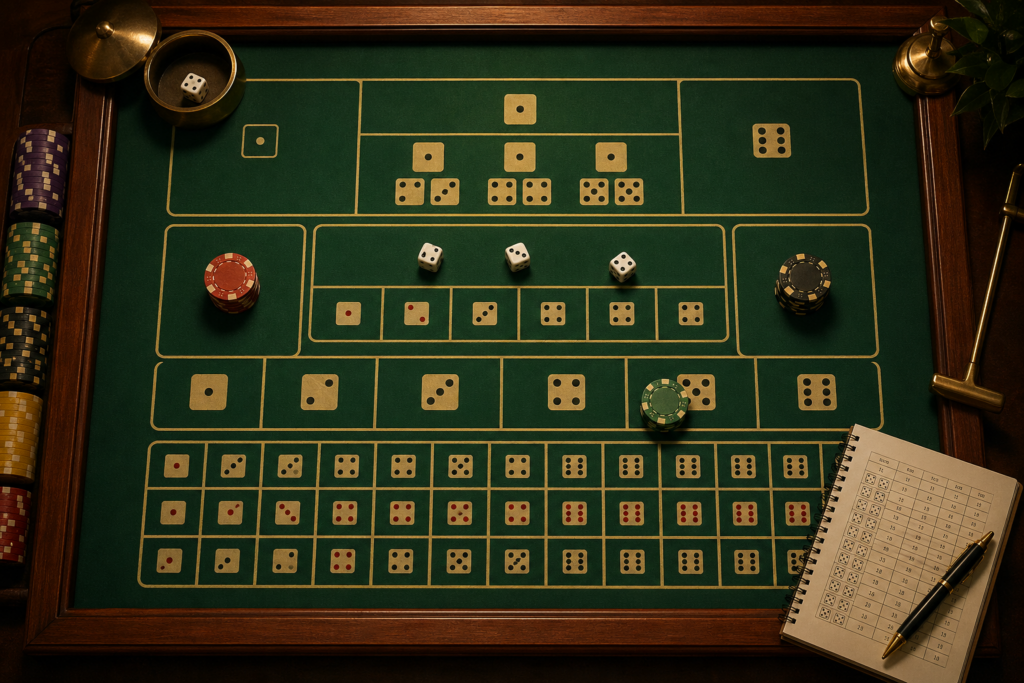
Sic Bo’s table looks busy because every possible outcome of three dice has its own betting square — and the payouts vary by a factor of 180. That spread means the difference between a smart Sic Bo session and a wasteful one is almost entirely about which squares you stake. This guide ranks every standard Sic Bo bet by house edge, walks through the three approaches that actually shift the math in your favour (a little), and explains what to ignore from the screen-side trend boards.
Every Bet, Ranked by House Edge
The numbers below assume the most common modern paytable used by Evolution and Playtech live tables. A few operators run a slightly better paytable that lifts the long-shot returns by about 15-20%, which is worth checking before you sit down.
| Bet | Pays | House Edge |
|---|---|---|
| Big or Small | 1:1 | 2.78% |
| Odd or Even | 1:1 | 2.78% |
| Single Number (1-6) | 1:1 / 2:1 / 3:1 | 7.87% |
| Specific Total: 9, 10, 11, 12 | 6:1 | ~9.7% |
| Specific Double | 10:1 | ~11.1% |
| Two-Dice Combination | 5:1 / 6:1 | 11.1% – 16.7% |
| Specific Total: 8 or 13 | 8:1 | ~12.5% |
| Specific Total: 7 or 14 | 12:1 | ~9.7% |
| Specific Total: 6 or 15 | 14:1 | ~13.9% |
| Specific Total: 5 or 16 | 18:1 | ~13.4% |
| Any Triple | 30:1 | ~13.9% |
| Specific Total: 4 or 17 | 60:1 | ~15.3% |
| Specific Triple | 180:1 | ~16.2% |
Two patterns jump out. First, the gap between the cheapest and most expensive bets on this table is enormous — Big/Small at 2.78% is comparable to a French roulette even-money bet, while Specific Triple at 16.2% sits near the worst slot machine you can find. Second, the long-shot total bets (4, 5, 16, 17) carry surprisingly steep edges despite their high payouts, because the operator under-pays the rarity of those outcomes.
The Only Three “Strategies” That Actually Help
Sic Bo is a fixed-edge game with no skill component during play — the dice care nothing for your last result. There is no betting system that turns a negative-expectation game positive. There are, however, three structural choices that meaningfully change how much money the house extracts from you over a session.
1. Stake Big/Small or Odd/Even Almost Exclusively
The two even-money bets carry a 2.78% house edge. Every other bet on the table carries somewhere between 7% and 16%. If your goal is the longest possible play time per dollar, stake Big/Small or Odd/Even and treat everything else as garnish. On a $100 bankroll wagering $5 a round, the math says you can expect to play roughly four times as long sticking to even-money bets versus an “all-over-the-table” approach.
2. Compare Paytables Before You Sit Down
Different operators run different paytables for the same bet. The Specific Triple, for example, pays 180-to-1 at most live-dealer tables but only 150-to-1 at a few legacy tables. The difference is the house edge moving from about 16% to about 30% — twice as expensive, on identical odds. The same gap exists on Two-Dice Combinations (5:1 vs 6:1) and Specific Doubles (8:1 vs 10:1). Click into the help panel before you sit down and check the paytable. If the operator hides it, walk.
3. Ignore Trend Boards
Every live Sic Bo lobby shows you a trend grid: the last 50 results, hot numbers, cold numbers, “the table hasn’t seen a Big in eight rounds.” This board is a marketing fixture, not a statistical tool. Three dice produce 216 equally probable outcomes on every shake, with no memory of previous shakes. A streak of seven Smalls in a row is exactly as informative as a streak of five reds in roulette: zero. Players who chase trend reversals systematically lose more than players who don’t, because they tend to bet larger on what they think is “due.”
Bankroll Sizing for Sic Bo
Sic Bo is high variance even on the safe bets, because triples kill your even-money wagers without warning. A 200-shake session at $5 even-money flat-staking will see roughly 28 triples (about 13% of rolls if you count edge-of-table rolls), each one taking your stake without paying anything. A reasonable rule of thumb: bring at least 60 betting units. So a $5 stake suggests a $300 session bankroll. That is conservative, but it almost guarantees you will not bust out before variance has had a chance to balance.
Side Bets and Promotions
Live-dealer Sic Bo tables (Evolution’s “Super Sic Bo” in particular) layer on a “lucky multiplier” mechanic where, before each shake, a handful of bet squares get random multipliers from 50× up to 1,000×. The unmodified bet still pays whatever the standard paytable says — the multiplier is a side-promo. The math here is genuinely interesting: on the rounds where a high multiplier lands on a low-edge bet, the side bet has positive expected value for the player. The catch is that you cannot choose which square gets the multiplier, and you usually only see it light up after you have placed a bet you would not otherwise have made. Treat it as a fun layer, not a reason to chase.
What “Optimal” Sic Bo Looks Like
If you wanted to play Sic Bo as cheaply as possible relative to the house, you would: pick a regulated operator with the better paytable, stake Big or Small flat, never deviate, and walk after a fixed time or fixed loss. That setup carries a 2.78% house edge — about the same as a single-zero roulette outside bet, half what you pay on American roulette, and a fraction of what slots cost. You will not get rich on it, but you will get a long evening for your money.
Common Mistakes
The two errors that wreck most Sic Bo sessions are well-known to dealers. First: chasing Specific Triples because someone at the table just landed one and the bell went off. The bell rings precisely because that bet is rare. Doubling up after a near-miss does not change the next shake’s probabilities. Second: oscillating between Big and Small based on the trend board. Big and Small are equally likely on every shake. Switching back and forth based on perceived patterns introduces no edge, just transaction noise — and many operators run a slightly higher minimum bet on alternate squares to make the switching itself a small house win.