Sic Bo Rules and Bets: Every Wager on the Table
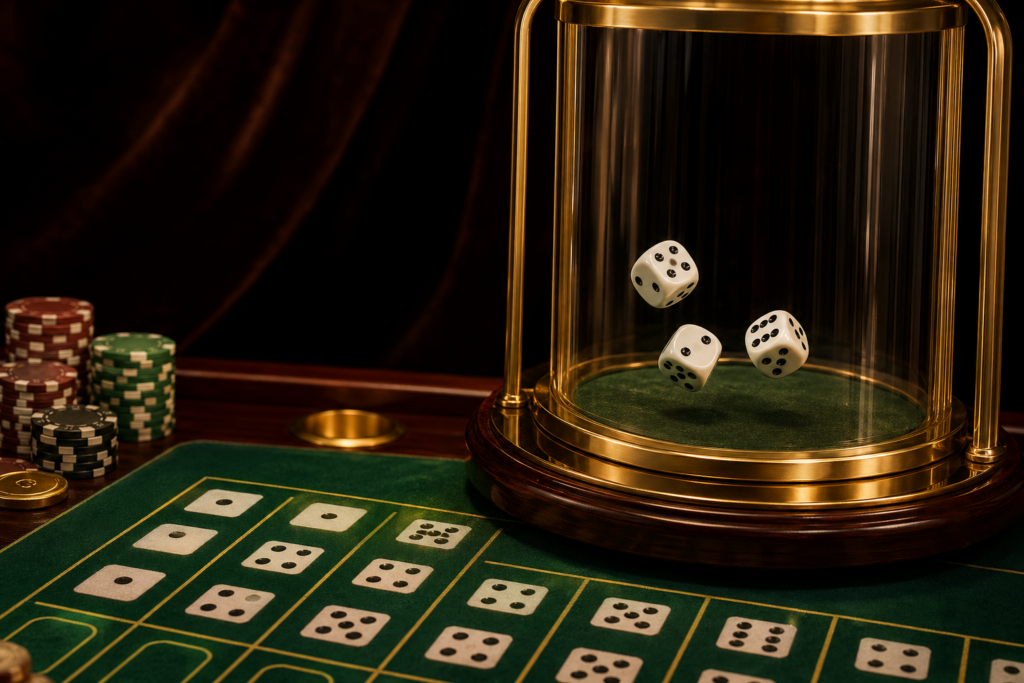
Sic Bo — literally “precious dice” — is a three-dice table game that traces back to ancient China and remains one of the most-played wagers in Macau today. The rules are simple: a dealer shakes three dice in a sealed cage, the result is revealed, and players pay or collect based on which combinations they backed. This guide covers every standard bet, what each one pays, and how the table layout works in modern online and live-dealer rooms.
How a Round Works
The dealer (or RNG, if you are playing online) shakes three six-sided dice. Before the shake, the betting table opens and players place chips on whichever combinations they like. After a short countdown, betting closes, the dice are revealed, and the dealer settles every bet on the layout in a single sweep. A new round opens immediately. There is no “playing through” multiple rolls — every shake is a self-contained event, which is what makes Sic Bo close in spirit to roulette rather than to craps.
The Bet Catalogue
Sic Bo’s table layout looks dense at first because every possible outcome of three dice has its own betting square. In practice the wagers fall into a handful of families.
Big and Small
The two outermost squares on the layout. Small wins if the three dice total between 4 and 10; Big wins if the total is between 11 and 17. Both lose if the dice land as a triple (any three matching numbers). Pays even money. House edge: 2.78%. These are the standard “low-variance entry bets” that most players use to learn the rhythm of the table.
Odd and Even
Found on most modern layouts as a complement to Big/Small. Pays even money on whether the total is odd or even, again losing on triples. House edge: 2.78%.
Specific Total
You bet that the three dice will sum to an exact number between 4 and 17. Payouts vary because some totals are far rarer than others — a sum of 4 or 17 pays 60-to-1 in the best-paying tables, while a sum of 10 or 11 pays only 6-to-1 because there are many combinations that produce it. The house edge ranges from about 9.7% on the rarest totals to roughly 12.5% on the middle ones.
Single Number
Pick any number from 1 to 6. If one of the three dice shows that number, you win 1-to-1. If two of them show it, 2-to-1. If all three show it, 3-to-1 (and on some tables, 12-to-1). Easy to grasp, but the house edge sits near 7.9% — meaningfully worse than Big/Small.
Two-Dice Combination
You pick two specific numbers (e.g., a 2 and a 5). If two of the three dice show those exact numbers, the bet pays 5-to-1 (or 6-to-1 in better-paying tables). House edge: 16.7% on the worse paytable, 11.1% on the better one. A flashy bet — fun to land, but the math is unkind.
Double
You bet on a specific pair, say “two 4s.” If at least two of the three dice come up as that number, you win — typically 8-to-1 or 10-to-1 depending on the table.
Triple (Any and Specific)
The signature long-shot bets of Sic Bo.
- Any Triple: You win if the three dice all match — any three of a kind. Pays 30-to-1. House edge: roughly 13.9%.
- Specific Triple: You name the exact number — say “three 5s.” Pays 180-to-1 (sometimes 150-to-1). House edge: 16.2%. Mathematically the worst bet on the table, but it is also the bet that puts the lights and bell on every Macau pit.
Reading a Live-Dealer Layout
Online live-dealer rooms (Evolution, Playtech, Pragmatic Live) all use the same general layout pattern: Big and Small sit at the far ends, the Specific Total bets run in two rows along the middle, the six Single Number squares occupy the front edge nearest the player, and Triples get pride of place in the centre with bright accent colours. The Odd/Even and Two-Dice Combination squares live in the corners. Camera angles cut between the betting layout, the shaker cage, and a close-up of the dice as they are revealed — exactly the workflow you see at a Wynn Macau table.
RNG vs Live Dealer
Most operators offer both formats. The RNG version is a software table — you click bets, hit Roll, and the result is decided by a certified random number generator. It is fast (you can play 200+ rounds an hour) and the minimum stakes are low. The Live-Dealer version is a real shaker streamed from a studio, with side-bet promotions and a live host. It is slower (40-50 rounds an hour) and stakes start higher, but the experience is closer to a Macau pit. The probabilities and payouts are identical — the difference is purely in pace and atmosphere.
Etiquette and Common Misconceptions
Sic Bo is often confused with craps because both use dice, but the games have very little in common. Craps has a shooter, a sequence of rolls, and bets that resolve over multiple throws. Sic Bo has no shooter, no sequence — every shake is independent, and every bet resolves on a single result. This also means you cannot “ride” a hot streak the way craps players can. Past results genuinely have zero predictive value, no matter how compelling the trend board on the screen looks.
Where Sic Bo Came From
The game’s roots run back at least 2,000 years in southern China, where dice descended from divinatory bone-tile gambling games of the Han dynasty. By the time European traders reached Macau in the 16th century the game was already a fixture in Chinese gambling halls. The version played in modern casinos was formalised in late-19th century Hong Kong and exported to Las Vegas in the 1980s. Today Sic Bo is the dominant table game in Macau by stakes wagered, sitting alongside Baccarat as the two pillars of the Asian casino floor. For a deeper history, see our History of Sic Bo.
Want to Try It?
If you want to try Sic Bo at a regulated operator, jump to the country guide that fits you: