
If you have ever played craps and wondered why the rules are so complicated — why a “shooter” rolls until something specific happens, why some numbers are “naturals” and others “craps”, why the language sounds half-medieval — the short answer is that craps is the simplified American version of an English game called Hazard, which itself is the European descendant of a game that crusaders brought back from the Middle East in the 12th century. The rules of modern craps are a sediment of seven hundred years of layered abbreviations.
This is the story of Hazard: where it came from, how it worked, why it dominated English gambling for four centuries, and how it crossed the Atlantic and turned into craps in 19th-century New Orleans.
The Crusader Origin Story
The earliest reliable account of Hazard is in Liber de Ludo Aleae, the gambling treatise written by the 13th-century English chronicler William of Tyre — except that William of Tyre actually died in 1186, so the attribution is shaky. What we do have is a cluster of Anglo-Norman references from the late 12th and early 13th centuries that describe a dice game called “hasard” or “hazart”, said to have been learned by English soldiers from Arabic-speaking opponents during the Third Crusade (1189-1192). The name itself comes from the Arabic az-zahr, meaning “the dice” — a word that also gave us the modern “hazard” in the sense of risk or peril.
The crusader story is plausible. Two-dice gambling games were already established in the Islamic world by the 12th century — the historian Al-Masudi describes them in 10th-century Baghdad — and English soldiers spending two years on the Levantine coast would certainly have picked them up. Whether the specific ruleset of Hazard was imported wholesale or developed in England from a simpler imported core is impossible to say. By 1300, English literature was full of Hazard references; Chaucer’s Pardoner’s Tale (c. 1390) features Hazard prominently as the gambling vice of three drunken louts who set out to murder Death.
The Rules of Hazard
Hazard was played with two dice. The rules look bizarre to a modern reader, but every step has a clear logical purpose — each turn is a structured sequence of probability events, layered to give the house a small edge while keeping the game continuously suspenseful.
Step 1: The caster sets a “main”. The caster is the player rolling the dice (the equivalent of the modern craps shooter). Before rolling, the caster declares a “main” — a number from 5 to 9. This is the caster’s chosen target.
Step 2: The caster rolls.
- If the roll equals the main, the caster wins immediately. This was called “throwing in” or “nicking the main”.
- If the roll is 2, 3, or sometimes 11 or 12 (depending on the main chosen), the caster loses. These were called the “crabs” — and that word is the direct ancestor of “craps”.
- If the roll is anything else, that number becomes the “chance”, and the caster keeps rolling.
Step 3: The caster keeps rolling. Until either:
- The chance comes up again — caster wins.
- The main comes up — caster loses.
This is structurally identical to the modern craps “pass line” bet, with one significant difference: the modern shooter does not get to choose the main. In craps, the main is fixed at 7 (you win immediately on 7 or 11, lose immediately on 2, 3, or 12, and any other number becomes the “point”). Hazard let the caster pick. This sounds like a player advantage, but it is not — the math of the game punishes mains that are far from 7. The optimal mains for a 17th-century Hazard caster were 7 (against a 2-dice distribution centred on 7) and a careful balance of when to pick 5, 6, 8, or 9 based on the table conditions.
The Math That Made Hazard Hard
The genius of Hazard’s design — and the reason it dominated English gambling for centuries — is that the house edge depends on which main the caster picks. Different mains produce subtly different probabilities of winning, and a sufficiently sharp player could in theory pick the optimal main for the table conditions. In practice, no 17th-century gambler could compute this on the fly. The math was finally published in full by Abraham de Moivre in his 1718 Doctrine of Chances, which gave the precise probability of each main producing a winning sequence.
De Moivre’s analysis showed that the optimal mains in pure house-edge terms are 7 (for the caster, slight advantage to the player against a setter who pays “even on the chance”) and 5 or 9 (for the setter, slight advantage to the house). The realistic spread was small — single-digit percentage points — but it was enough that 18th-century professional gamblers in London’s gambling houses could grind a living from picking the right main against amateurs.
Hazard in the 18th-Century London Gambling Houses
By the 1700s, Hazard was the headline game at every major London gambling house. White’s, Crockford’s, Watier’s, the Cocoa Tree — the great clubs of St James’s all ran Hazard tables, often into the small hours, often for stakes that wrecked aristocratic families. The 1762 Act for the More Effectual Preventing of Excessive and Deceitful Gaming targeted Hazard specifically, banning it from public houses and limiting the stakes that could be wagered. The clubs found ways around the act; the public houses largely stopped offering it; and the game’s class associations gradually shifted from “popular tavern dice” to “gentleman’s club gambling”.
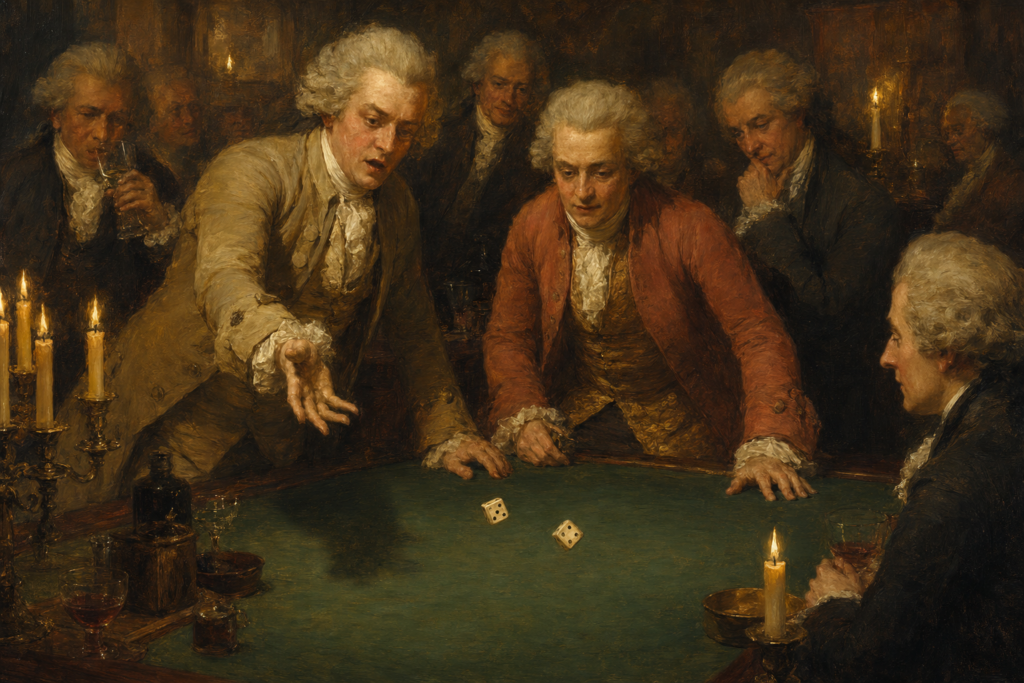
The famous passages in Edward Gibbon’s letters, in Horace Walpole’s correspondence, in the diaries of Charles James Fox, all reference Hazard as the dominant gambling format. Fox lost the equivalent of millions of pounds at Hazard tables before his thirtieth birthday. The 1778 painting The Hazard Room at Devonshire House by Thomas Rowlandson shows the scene: a circle of figures around a baize table, dice in mid-air, the caster gesturing while the setter waits to settle the bet.
Crossing the Atlantic: Hazard Becomes Craps
French settlers in early 18th-century New Orleans played a French version of Hazard called Crapaud (literally “toad”, possibly a mockery of the way English players hunched over the table). After the Louisiana Purchase in 1803 and the influx of American players into New Orleans gambling halls, the French Crapaud simplified into a game called Crabs — the same word the English Hazard players had used for the immediately-losing rolls. By the 1830s, Crabs had become Craps in American English, and by mid-century the game had spread up the Mississippi to St Louis and east to the gambling halls of New York.
The American simplification was decisive. The choice-of-main system was eliminated; the main was fixed at 7. The “crabs” rolls were standardised at 2, 3, and 12. A whole layer of side bets was added — Place bets, Field bets, the Don’t Pass bet — which gave the table its modern dense-bet-layout look. The shooter rolls until the point is made or a 7 comes up, and that core sequence (the “pass line” structure) is mathematically identical to a Hazard caster with a fixed main of 7. Modern craps is, in that sense, Hazard with all the strategic choices removed and the layout opened up for a wider menu of side bets.
What Hazard Left Behind
Hazard itself died as a popular game in the late 19th century, killed by the simpler American craps and by the rise of roulette in continental Europe. But the linguistic and structural fossils are everywhere. The word “craps” is a direct corruption of “crabs” (the Hazard losing rolls). The shooter-and-table structure of modern craps is the Hazard caster-and-setter structure. The “natural” rolls in craps (7 and 11) and the “craps” rolls (2, 3, 12) are exactly the rolls that won and lost a Hazard caster who chose a main of 7. Even the word “hazard” itself — meaning risk or chance — entered general English from the gambling game, not the other way around.
Three rooms still play Hazard regularly today, all in the United Kingdom and all as historical recreations. Crockford’s in London held a Hazard demonstration table at its 200th anniversary in 2028. The English Heritage gambling re-enactment at the Devonshire House anniversary has run a Hazard table for the past several years. Otherwise, the game survives in literary fossils — Chaucer, Walpole, Fox — and in the pass-line bet at every craps table from Las Vegas to Macau.
Related Reading
- The History of Craps
- How to Play Craps Online
- Craps Odds and Strategy
- Dice Through the Ages
- Gambling in the Ancient World