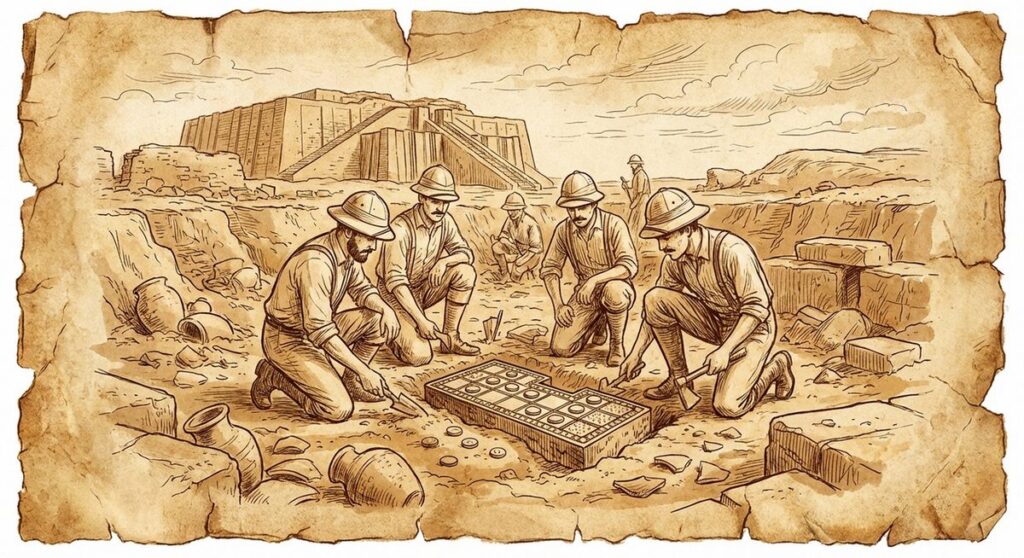

Most ancient board games are still playable today — sometimes through interactive web recreations, sometimes through downloadable mobile apps, sometimes through faithful reconstruction kits sold by museums. The tricky part is knowing which versions are historically accurate versus which are loose modern adaptations using the name. This guide covers the major ancient games we cover on this site, where to play each one online, and what compromises modern recreations make.
Senet (Ancient Egypt, c. 3100 BCE)
The world’s oldest known board game. Played on a 30-square grid with throw-sticks instead of dice.
- Where to play online: We host a free interactive Senet game on this site — see the Senet page for the playable board and historical context.
- Mobile apps: Several “Senet” titles exist on the App Store and Google Play. Quality varies — the historical-rules consensus version is Senet Deluxe; loose adaptations should be avoided if you want authenticity.
- Physical sets: The British Museum and the Brooklyn Museum gift shops both sell faithful reproductions of historic boards.
- Rule accuracy: Partially reconstructed. No surviving Egyptian rulebook exists; modern rules combine evidence from tomb paintings, surviving boards, and references in Egyptian texts. The Kendall/Bell consensus is the closest approximation.
Mehen (Ancient Egypt, c. 3000 BCE)
The “coiled serpent” game — a spiral race game with movable lion-shaped pieces and small marbles.
- Where to play online: No widely-available faithful reconstruction. Our Mehen page covers the historical context and known rules.
- Physical sets: Museum gift shops sell decorative reproductions; faithful playable sets are rare and usually custom-made.
- Rule accuracy: Highly speculative. Mehen disappears from the Egyptian record by the Middle Kingdom, and surviving game boards are vague about how play actually proceeded.
The Royal Game of Ur (Mesopotamia, c. 2600 BCE)
A race game played on a 20-square board, found in royal burials at Ur. Cuneiform rulebooks have been recovered, making this one of the few ancient games whose rules we know reasonably well.
- Where to play online: We host an interactive Royal Game of Ur on this site — see the Royal Game of Ur page.
- Physical sets: The British Museum sells a popular reproduction set with full rules. This is the gold standard — uses the same rules curator Irving Finkel reconstructed from the cuneiform tablet.
- Rule accuracy: Higher than most ancient games, thanks to the surviving Babylonian rulebook (a clay tablet from c. 177 BCE).
Nine Men’s Morris (Ancient/Medieval, c. 1400 BCE+)
One of the oldest continuously-played games still in widespread use. Played from ancient Egypt through medieval Europe to the present.
- Where to play online: We host an interactive Nine Men’s Morris on this site — see our Nine Men’s Morris page.
- Mobile apps: Many. Search “Nine Men’s Morris” or “Mill” on either platform. Most mobile versions are reasonably accurate to the medieval rules.
- Physical sets: Universally available — wooden boards in chess shops, online retailers, and museum gift shops.
- Rule accuracy: Very high. The game’s rules have been stable for at least 800 years.
Senet, Ur and the Interactive Tradition
The big advantage of digital recreations of ancient games: you can play with someone on the other side of the world. Asynchronous play (taking turns over hours or days) is particularly well-suited to slower, contemplative games like Mehen or Pachisi. The disadvantage: digital adaptations often “smooth over” the friction of physical pieces — the satisfying click of a wooden Senet pawn, the unpredictability of throwing actual sticks. Both formats have value.
What About Chess, Go, Backgammon, Mahjong?
These games are all ancient (or medieval) but never went away — they’re playable in countless online and offline forms today. Quality of online play is high across all four:
- Chess — chess.com and Lichess are the dominant platforms. Both free, both with millions of active users.
- Go — OGS (Online Go Server) is the standard. KGS is the older alternative.
- Backgammon — countless apps, but Backgammon Galaxy is among the strongest competitive platforms.
- Mahjong — Mahjong Soul and Tenhou are popular for competitive Japanese rules; the Hong Kong / international versions are less standardised online.
For all four, the historical rules and the modern competitive rules are essentially identical, which is unusual for ancient games — testament to how stable these particular traditions have been.
FAQ
Can I play Senet online?
Yes — we host a free interactive Senet on this site. Multiple mobile apps also exist with varying degrees of historical accuracy.
Where can I play the Royal Game of Ur online?
We have an interactive Royal Game of Ur on this site. The British Museum has also released free educational versions in the past.
Are the rules of these ancient games accurate?
Varies. Royal Game of Ur and Nine Men’s Morris have surviving rulebooks (Ur from cuneiform; Nine Men’s Morris from continuous medieval-to-modern tradition). Senet rules are partially reconstructed. Mehen rules are largely speculative.
What about playing physically?
Most major museums (British Museum, Brooklyn Museum, Egyptian Museum) sell reproduction game sets in their gift shops. Etsy has many independent makers producing faithful reproductions.
Why don’t more ancient games have surviving rules?
Rules were typically transmitted orally or through demonstration, not written down. Surviving texts mention games but rarely describe rules in full. The Royal Game of Ur is unusual in having a surviving rulebook — most ancient games we know about rely on archaeological reconstruction.