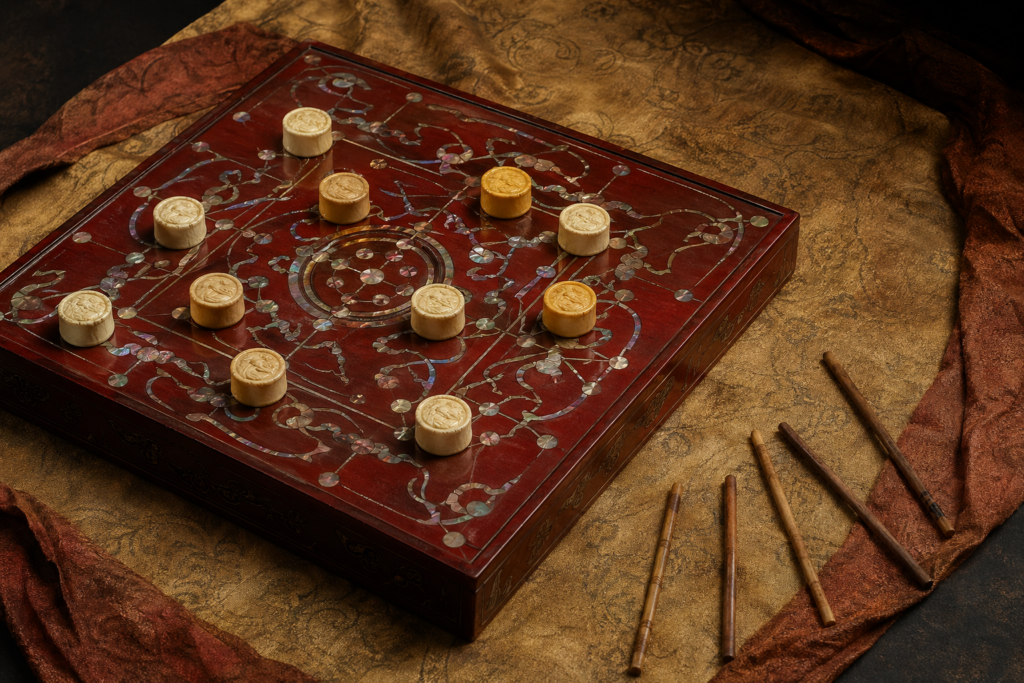

In 1972, archaeologists excavating an aristocratic Han-dynasty tomb in Mawangdui, near Changsha in Hunan province, opened a sealed lacquer box and recovered what is now considered the most complete surviving set of one of the most important board games of ancient China. The set was a complete Liubo board, with twelve playing pieces, six bamboo throwing sticks, and a small accessory bowl — assembled exactly as it would have been in 168 BCE, the year Marquis Lı Cang’s wife was buried with it. The pieces had not been disturbed for 2,140 years.
That tomb find, alongside earlier finds of bronze and jade Liubo sets in Han royal burials, give us almost everything we know about how the game was made and how it looked when in play. What we do not have, despite the abundance of physical evidence, is a confident reconstruction of the rules. Liubo was the prestige board game of Han China for roughly four centuries, played by emperors, written about in poetry, and depicted on tomb murals — and then, sometime around 600 CE, it vanished. By the late Tang dynasty no one was playing Liubo anymore, and the rules were not written down by anyone who knew them. What survives is the equipment.
The Equipment
A complete Liubo set consists of:
- The board. A square layout, typically lacquered wood with inlaid mother-of-pearl in elite versions, marked with a distinctive geometric pattern. The pattern is called TLV by archaeologists because of the shapes of the carved markings — T-shapes at the centre of each side, L-shapes near the corners, and V-shapes at the corners themselves. The same TLV pattern appears on Han bronze mirrors and on cosmological diagrams of the universe, which strongly suggests the board was understood as a representation of the cosmos itself.
- Twelve playing pieces. Six per player, typically carved from ivory, bone, or jade. The pieces in elite sets had distinctive shapes — sometimes animal forms (dragons, fish), sometimes abstract — that distinguished one player’s six from the other’s.
- Six bamboo throwing sticks. The randomizer. The sticks were flat on one side and rounded on the other; players threw all six and read the count of flat-up sides.
- An accessory bowl or scoring counter. Used to track victory points or stake counters. The Mawangdui set has a small lacquer bowl that probably served this function.
What We Know About the Rules
The reconstruction effort began in earnest in the 1950s and has produced several plausible rulesets, none of them fully agreed upon. What seems consistent across the surviving evidence:
It was a chase or capture game for two players. Each player had six pieces; you advanced your pieces around the board and tried to capture or block the other player. This is suggested by the way the pieces are positioned in tomb depictions and by the symmetric layout.
The throwing sticks drove movement. The count of flat-up sides on a six-stick throw produces values from 0 to 6, weighted toward 3 (the most likely outcome). Han-era poetry describes specific stick combinations by name — “wu”, “lu”, “bai” and others — and connects them to specific moves, but the mapping from name to outcome is not fully clear.
There was a central “fish” pool. Several tomb murals show fish-shaped tokens accumulating at the centre of the board during play, and a Western Han poem by Yang Xiong refers explicitly to the moment when “the fish are pulled from the pool” — likely the climactic moment of a game when one player captured the central reward. This may have been a wager pool or a scoring multiplier.
Beyond that, every reconstruction is speculation. The surviving rules manuals from the Tang dynasty (when the game was already dying) describe a related game called Gewu Liubo with what appears to be simplified rules; whether these are the same as the original Liubo or a degraded variant is unclear.
Why It Mattered
Liubo was not a casual game. In the Western Han period, depictions of Liubo on tomb murals are abundant — at the Mawangdui complex, at the imperial tombs of Mancheng, at painted tomb chambers across north China — and the players are almost always elite. The classic depiction shows two robed gentlemen seated facing each other, the board between them, often with attendants or spirits looking on.
The game also had cosmological significance. The TLV pattern on the board mirrors the layout of Han-era cosmic diagrams, where the central square represents the earth and the outer ring represents the heavens. Several scholars have argued that Liubo was understood not just as recreation but as a ritual model of cosmic motion — the pieces tracing paths analogous to the movements of celestial bodies. This is part of why Liubo sets show up in burials: the deceased was equipped to play the game in the afterlife, possibly with celestial opponents.
The most famous depiction of this is a Han-era myth in which the immortal sage Dongfang Shuo is described as playing Liubo with deities. The game was, in some real sense, the medium through which mortals and immortals communicated. This gives Liubo a status comparable to the Egyptian game of Senet, which also functioned as both a recreational game and a model of the soul’s journey through the afterlife. Both games died out by the medieval period; both left an extensive material record but no surviving rules.
The Throwing Sticks Survive
What is striking about Liubo’s disappearance is that the game vanished but the randomizer survived. The flat-and-round bamboo throwing sticks of Liubo are the direct ancestor of the throwing-stick mechanic that persisted in Chinese folk games for the next 1,500 years — the same basic device shows up in Tang and Song-era gambling games, in Korean Yut Nori, and in scattered village games across East Asia. Even today, the Korean game Yut uses a four-stick variant of the same physical principle.
What did not survive was the cubic dice’s predecessor. By the time cubic dice arrived from the Roman world in the late Han, Liubo’s six-stick system was already being used differently — increasingly as a betting randomizer rather than a board-game movement system. When cubic dice took over the gambling table during the Tang dynasty, the sticks lost their high-stakes role and retreated to folk games. The board game and its cosmic apparatus quietly went extinct.
Modern Liubo
Several enthusiast groups have published reconstructed Liubo rulesets, most based on the Mawangdui set and the Tang manuals for Gewu Liubo. The most-cited reconstruction is the version published by the Sino-Platonic Papers in 1989, which proposes a chase-and-capture game where pieces enter from opposite corners, advance via stick throws, and contest the central “fish” pool for bonus moves. It plays as a moderately tactical game with a strong luck element — fast at the opening, slow in the endgame, and decided by who can corner the central pool. Whether it is what the Marquise of Mawangdui actually played in 168 BCE is anyone’s guess.
The board itself, in its TLV beauty, is one of the visual icons of Han art. Reproductions of the Mawangdui board are sold at museum shops in Changsha, and the pattern has been adopted as a motif in modern Chinese design — most prominently on the surfaces of luxury baijiu bottles and Hong Kong jewellery. The game it commemorates is, otherwise, a ghost.
Related Reading
- Ancient Chinese Dice and Board Games
- The History of Sic Bo
- Senet: Journey Through the Afterlife (its Egyptian counterpart)
- The Royal Game of Ur
- The Oldest Board Games Ever Discovered