
Reading this history: “Inspired” in the title describes a conceptual comparison. Direct influence on later slot-machine inventors is not established by the sources presented here.
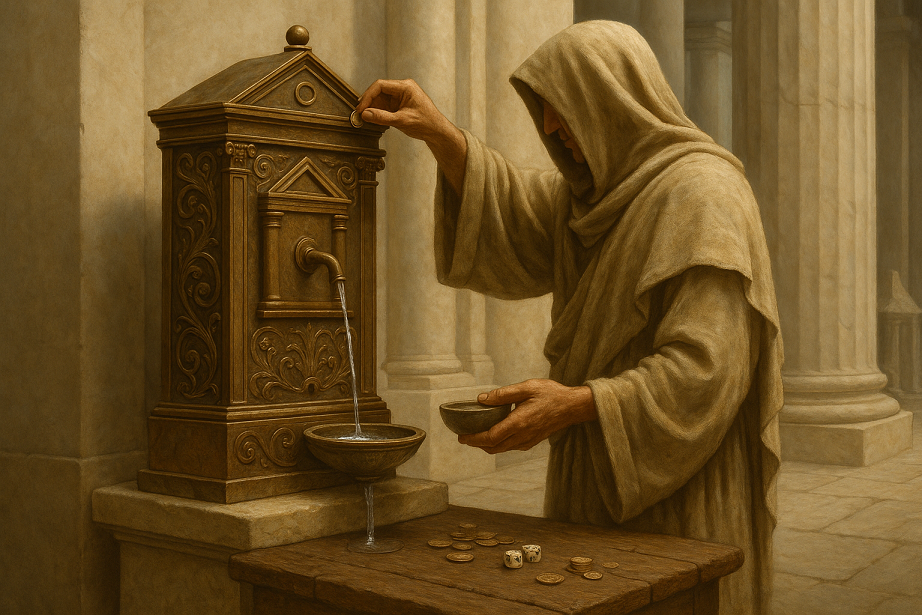
Hero of Alexandria described a coin-operated liquid dispenser in his Pneumatica. It is an intriguing early example of a machine responding to an inserted coin. Comparing it with a slot machine helps distinguish an automatic transaction from a game of chance; it does not demonstrate that later slot-machine inventors copied Hero.
An Invention for the Gods, Not for Gambling
The device described by Hero releases liquid when a coin operates a balance and valve. The description explains a mechanism. Claims about why a particular temple commissioned it, or how widely it was installed, require separate evidence.
The mechanism was ingenious in its simplicity. When a person dropped a coin into a slot, the coin’s weight would fall onto a small pan attached to a lever. This lever would open a valve, allowing the holy water to flow out. As the pan tilted, the coin would eventually slide off, and a counterweight would snap the lever back into place, closing the valve and stopping the flow of water. It was a perfect, self-regulating system.
How does a coin release the water?
Step through the balance, lid and outlet. Watch which part moves and what stops the flow.
The lid outweighs the empty plate and seals the outlet.
Source and what the drawing simplifies
Based on Hero’s Pneumatics, section 21, in the 1851 Woodcroft edition. The combined plate and coin outweigh the lid; once the coin falls away, the lid closes again.
This is a schematic of the operating sequence. Sizes, timings and the amount of water are illustrative. It does not establish influence on later slot machines.
The Casino Connection: The “Coin-In, Result-Out” Mechanic
Hero’s dispenser delivers a product when activated by a coin. A slot machine uses its own rules to determine a chance-based outcome. They can be compared as coin-operated devices, but an analogy is not evidence that one invention caused the other.
This is the fundamental principle that defines every slot machine:
- A user provides a standardized input (a coin or credit).
- The machine automatically performs an action without human intervention.
- The machine provides a standardized output or result.
The shared feature is a coin activating a mechanism. The earlier wording of this article implied a continuous history of transmission across the intervening centuries without documenting that chain. The evidence presented here supports a comparison, not that conclusion.
From Holy Water to Jackpots
Later mechanical slot machines combined coin operation with reels and variable outcomes. Explaining those mechanisms does not require assuming that their inventors drew on Hero’s text. That stronger historical claim would need direct evidence of transmission.
The important distinction is between buying a defined product and paying to receive an uncertain outcome. Hero’s dispenser makes that difference easier to explain, while the history of later slot machines needs to be established from its own sources.
The Slot Machine’s Ancient Roots: Frequently Asked Questions
Who invented the first slot machine?
Charles Fey is associated with the development of early mechanical slot machines. Hero’s much earlier dispenser belongs to the history of coin-operated mechanisms, but it is not evidence that Fey derived his machine from Hero.
What was Hero’s vending machine?
Described in Hero of Alexandria’s treatise Pneumatica (1st century CE), it was a coin-operated dispenser placed in Greek and Roman temples. Worshippers dropped a 5-drachma coin into a slot; the coin landed on a balance arm that lifted briefly, opening a valve and releasing a small amount of holy water for ritual use. Once the coin slid off the arm, the valve closed.
How is the slot machine related to Hero’s device?
Both can be activated by inserting a coin. Hero’s device releases liquid; a slot machine produces an outcome governed by its game rules. This is a mechanical comparison, not a demonstrated direct lineage.
Why is gambling so old?
Ancient objects and written accounts attest to many forms of play and wagering. Their dates and purposes need to be established individually. Stories that an ancient Chinese lottery financed the Great Wall are not documented by a primary source in this article and should not be presented here as established fact.
Did Hero of Alexandria invent gambling devices?
Hero’s dispenser was a transactional device rather than a chance-based payout game. The material presented here does not establish a continuous mechanical lineage from that dispenser to later slot machines.
What other ancient gambling devices existed?
Knucklebones (ancestors of dice) were used for gambling games across the Mediterranean from at least 3000 BCE. Loaded dice — designed to cheat — have been excavated from Pompeii, proving Romans gambled and that they cheated at it. Lot-casting devices are documented in the Old Testament and in Greek temple records.