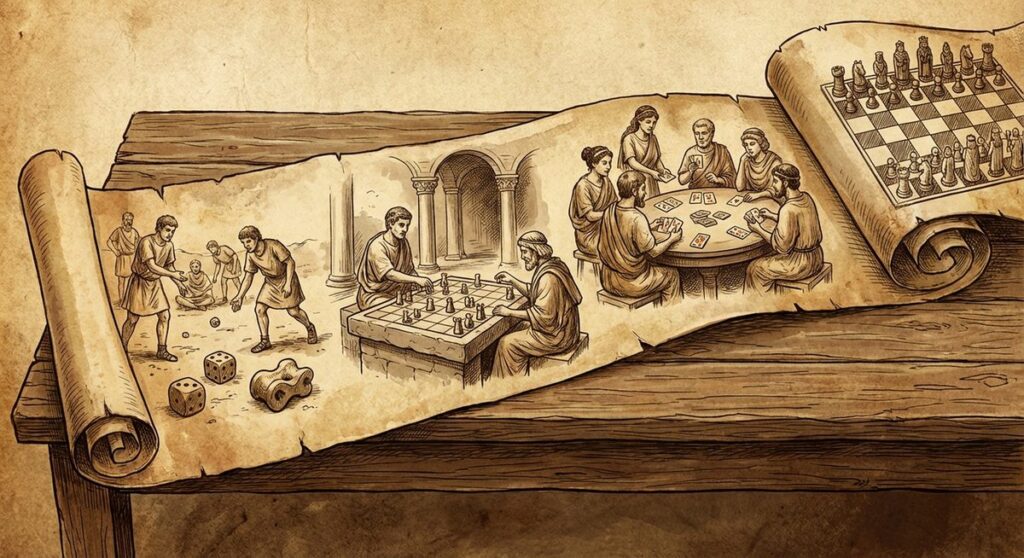

From Ancient Dust to Digital Screens: A 5,000-Year Story
Humanity has always played. Long before the first written laws, before the earliest cities rose from river valleys, people gathered around simple boards scratched into stone and tossed crude dice carved from animal bones. The story of games is, in many ways, the story of civilization itself — a mirror reflecting our evolving societies, beliefs, technologies, and desires.
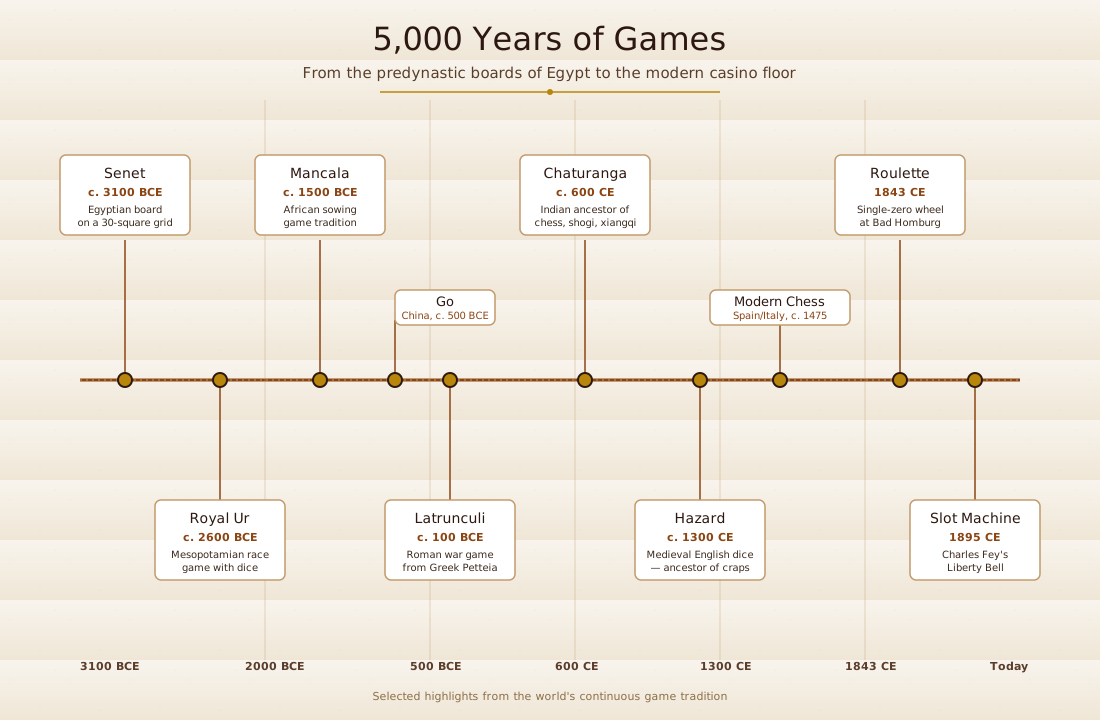
This timeline traces that remarkable journey from the dusty tombs of ancient Egypt to the neon-lit casino floors of Las Vegas, from carved limestone boards in Mesopotamia to the smartphones in our pockets. Along the way, we will encounter pharaohs and philosophers, merchants and monks, soldiers and scientists — all united by the universal human impulse to play.
The Dawn of Play: 3000–2000 BCE
Senet and the Sacred Game (c. 3100 BCE)
The earliest known board game with a documented history is Senet, discovered in predynastic Egyptian burial sites dating to approximately 3100 BCE. This elegant game of thirty squares arranged in three rows of ten was far more than entertainment — it was a spiritual journey. The Egyptians believed that successfully navigating the Senet board symbolized the soul’s passage through the underworld, a belief so deeply held that Senet boards were placed in tombs to accompany the dead into the afterlife.
Paintings in the tomb of Queen Nefertari show her playing Senet, and references appear in the Book of the Dead. The game’s rules evolved over nearly two millennia, shifting from a purely strategic contest to one increasingly governed by chance — perhaps reflecting changing theological ideas about fate and divine will.
The Royal Game of Ur (c. 2600 BCE)
In the royal tombs of the ancient Sumerian city of Ur, archaeologist Sir Leonard Woolley unearthed one of the most beautiful game boards ever created. The Royal Game of Ur, with its stunning inlaid lapis lazuli, carnelian, and shell mosaic, dates to approximately 2600 BCE. This two-player race game used tetrahedral dice and a board of twenty squares, and its rules survived on a cuneiform tablet written by a Babylonian scribe around 177 BCE — making it perhaps the longest-lived game in recorded history.
The game’s discovery revealed something profound: that sophisticated, rule-bound competitive play existed at the very dawn of urban civilization. Similar boards have been found scratched into the great stone guardians at the gates of Khorsabad, suggesting that even palace guards whiled away their hours with a quick game.
Mehen: The Coiled Serpent (c. 3000 BCE)
Among the most mysterious ancient games is Mehen, named after the serpent deity who coiled protectively around the sun god Ra during his nightly journey through the underworld. Played on a round board depicting a coiled snake divided into segments, Mehen used lion-shaped and lioness-shaped playing pieces alongside small marble-like spheres. The game vanished from Egypt around 2000 BCE, though variants appeared centuries later in other cultures — an early example of how games migrate and transform across civilizations.
The Classical World: 2000 BCE–500 CE
Nine Men’s Morris and the Games of Greece and Rome (c. 1400 BCE onward)
As civilizations grew more complex, so did their games. Nine Men’s Morris, one of the oldest strategy games still played today, has been found carved into roofing tiles in ancient Egypt (c. 1400 BCE), into stone at the Bronze Age settlement of Kurion in Cyprus, and into the paving stones of the Roman Forum itself. Its enduring simplicity — two players, each with nine pieces, trying to form “mills” of three in a row — ensured its survival across millennia and continents.
The Greeks and Romans were passionate gamers. Plato mentioned board games in his dialogues. Roman soldiers carried gaming boards wherever they marched, carving them into stone floors from Hadrian’s Wall to the deserts of North Africa. The Romans played Ludus Latrunculorum (the “Game of Mercenaries”), a strategic military game, and Tabula, an ancestor of modern backgammon.
Gambling and Dice in the Ancient World
Dice are older than any board game. The earliest dice — astragali, or knucklebones from sheep and goats — date back thousands of years and were used across the ancient world for both divination and gambling. Gambling in ancient times was ubiquitous: Roman emperors were notorious gamblers, with Augustus, Nero, and Commodus all documented as avid players. The Roman poet Ovid even wrote a guide to gaming strategy.
“The lot is cast into the lap, but its every decision is from the Lord.” — Proverbs 16:33
This intertwining of chance, fate, and divine will ran through virtually every ancient culture’s relationship with dice and gambling, setting the stage for theological and philosophical debates that would continue for millennia.
Go and the Games of East Asia (c. 500 BCE)
While Mediterranean civilizations developed their own gaming traditions, East Asia produced what many consider the most profound strategy game ever created. Go (known as Weiqi in China) emerged in China at least 2,500 years ago, with legends placing its invention even earlier. Confucius mentioned the game, and it became one of the four essential arts of the Chinese scholar — alongside calligraphy, painting, and music.
Go’s rules are breathtakingly simple: two players alternately place black and white stones on a 19×19 grid, attempting to surround territory. Yet from these simple rules emerges a game of such staggering complexity that the number of possible board positions exceeds the number of atoms in the observable universe. Go would spread along trade routes to Korea and Japan, where it became deeply embedded in aristocratic and warrior culture.
The Medieval Transformation: 500–1500 CE
The Birth and Migration of Chess (c. 600 CE)
No game has shaped human culture more profoundly than chess. Born as Chaturanga in India around the 6th century CE, the game traveled westward along the Silk Road, transforming into Shatranj in Persia, then spreading throughout the Islamic world after the Arab conquest of Persia in the 7th century. When the Moors brought Shatranj to Spain, Europe received what would become its defining intellectual game.
The transformation of Shatranj into modern chess occurred gradually over several centuries. The most revolutionary change came in late 15th-century Spain and Italy, when the relatively weak vizier piece was replaced by the powerful queen — creating what was called “Queen’s Chess” or, tellingly, “Mad Queen Chess” for the dramatic new attacking possibilities it introduced. This single rule change transformed chess from a slow, grinding affair into the dynamic, tactical game we know today.
Playing Cards Arrive in Europe (c. 1370)
Playing cards, likely invented in Tang Dynasty China (9th century), traveled westward through the Islamic world and arrived in Europe around 1370. The earliest European references come from Spain, Italy, and Germany, and within decades, cards had spread across the continent with remarkable speed. The Mamluk card deck, with its suits of cups, coins, swords, and polo sticks, became the ancestor of both Italian and Spanish suit systems, while the French eventually developed the now-standard hearts, diamonds, clubs, and spades.
The arrival of cards was a gaming revolution. Unlike board games, which required dedicated equipment and a playing surface, cards were portable, infinitely versatile, and cheap — especially after the invention of the printing press. Governments quickly recognized both the social dangers of card gambling and the revenue potential of taxing card production.
Games, Religion, and Morality
The medieval period saw an ongoing tension between the human love of games and institutional religious disapproval. Church councils repeatedly banned dice and card games. King Louis IX of France prohibited gambling for his subjects (though not, notably, for himself). Yet games persisted and thrived, often finding protection under the argument that chess and similar strategy games developed the mental faculties needed for warfare and governance.
Early Modern Revolution: 1500–1800
The Mathematics of Chance (1654)
In 1654, a French nobleman named the Chevalier de Méré posed a gambling problem to the mathematician Blaise Pascal, who shared it with Pierre de Fermat. Their resulting correspondence gave birth to probability theory — one of the most important branches of mathematics — all sparked by a question about dice games. For the first time, humans had the tools to understand and quantify the randomness that had fascinated them for millennia.
The Rise of the Casino
The word “casino” comes from the Italian casa (house), and the first recognized casino, the Ridotto, opened in Venice in 1638 to provide controlled gambling during the carnival season. Over the following centuries, casinos and gambling houses spread across Europe. Roulette emerged in 18th-century France, combining the spinning wheel with a betting layout that would become one of the most iconic images in gaming history.
The development of roulette illustrates a fascinating transition: games that had once been sacred rituals or aristocratic pastimes were becoming commercial entertainment products, designed and refined to attract players and generate profit.
Colonial-Era Game Diffusion
European colonialism spread European games worldwide while simultaneously introducing Europeans to games from other cultures. Mancala variants, played across Africa and Asia for thousands of years, became known to Western scholars. The British colonial presence in India revived Western interest in chess’s origins and led to the documentation of numerous Indian game traditions that might otherwise have been lost.
The Modern Age: 1800–1950
Board Games as Commercial Products
The 19th century saw board games transformed from handcrafted objects into mass-produced commercial products. The Game of Life (originally “The Checkered Game of Life”) appeared in 1860, created by Milton Bradley. Monopoly, based on Elizabeth Magie’s 1903 “Landlord’s Game” (designed to illustrate the economic theories of Henry George), was commercialized by Parker Brothers in 1935 and became the best-selling board game of the 20th century.
These games reflected their times. Victorian-era board games were often morality tales, rewarding virtue and punishing vice. Depression-era Monopoly offered the fantasy of wealth accumulation during economic catastrophe. War-themed games surged during both World Wars.
The Professionalization of Games
The 19th and early 20th centuries also saw the formalization and professionalization of games. Chess tournaments became major international events, beginning with the London 1851 tournament. The first official World Chess Championship was held in 1886. Card games like bridge developed elaborate bidding systems and international governing bodies. Games were no longer just pastimes — they were serious competitive pursuits with professional players, theorists, and commentators.
The Digital Revolution: 1950–Present
Computers Learn to Play (1950s–1970s)
When the first computers were built, one of the earliest questions researchers asked was: can a machine play games? Alan Turing wrote a chess-playing algorithm in 1950 — before any computer was powerful enough to run it. Claude Shannon published his foundational paper on computer chess the same year. By the 1970s, dedicated chess computers were commercially available, and the stage was set for the ultimate man-versus-machine showdown.
Video Games and the Digital Arcade (1970s–1990s)
The invention of video games — from Pong (1972) to Space Invaders (1978) to the home console revolution of the 1980s — created an entirely new category of play. For the first time, games existed as pure software, liberated from physical components. The gaming industry grew from a novelty into a global entertainment juggernaut, surpassing the film industry in revenue.
Deep Blue and AlphaGo: Machines Surpass Humans
In 1997, IBM’s Deep Blue defeated World Chess Champion Garry Kasparov — a moment many consider a turning point in the history of artificial intelligence. In 2016, Google’s AlphaGo defeated Go champion Lee Sedol, conquering the game long considered the final frontier of human superiority over machines in pure strategic thinking. These victories were not just gaming milestones; they were civilizational ones, forcing humanity to reconsider what it means to think, to strategize, and to play.
The Modern Board Game Renaissance (2000s–Present)
Paradoxically, the digital age has also sparked a renaissance in physical board games. Beginning with Settlers of Catan (1995) and accelerating through the 2000s and 2010s, the modern “Euro game” movement has produced thousands of innovative new board games. Board game cafes have opened in cities worldwide. Crowdfunding platforms have enabled independent designers to bring games directly to market. Annual board game sales now exceed billions of dollars globally.
This revival suggests something profound about the nature of play: even in an age of infinite digital entertainment, humans still crave the tactile, social, face-to-face experience of gathering around a table with physical game pieces — just as they did five thousand years ago in the shade of Mesopotamian ziggurats.
What Games Tell Us About Ourselves
Looking back across five millennia, several themes emerge. Games have always served multiple purposes simultaneously: entertainment and education, social bonding and social stratification, religious ritual and secular pleasure, intellectual exercise and pure escapism. The games a culture plays reveal what that culture values — whether military strategy, commercial success, mathematical elegance, or the thrill of chance.
Perhaps most remarkably, the oldest games are still recognizably games. A modern player transported back to ancient Ur could sit down and, with minimal instruction, play a meaningful game against a Sumerian opponent. The rules have changed, the materials have evolved beyond recognition, but the fundamental human experience of play — the tension, the calculation, the hope, the surprise — remains exactly what it was at the dawn of civilization.
“In every culture, in every era, when humans gather, they play. The forms change. The impulse is eternal.” — Irving Finkel, British Museum
Five thousand years of games and gaming. And the game, it seems, is far from over.
The History of CrapsFrom medieval Hazard to the modern table.
