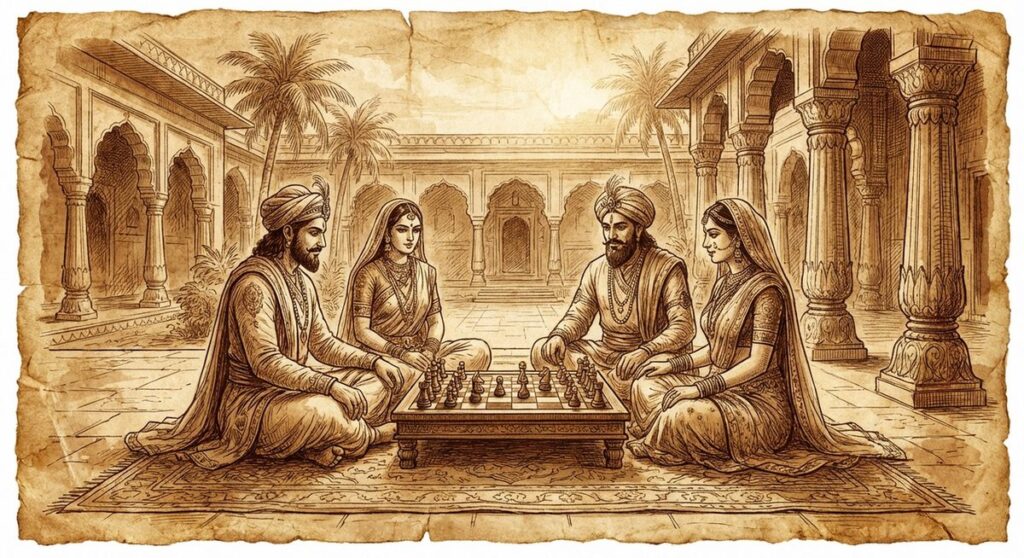

Chess as we know it today — 64 squares, 32 pieces, fixed rules — was not invented. It was distilled. Over roughly 1,500 years, the game travelled from northern India through Persia, across the Islamic world, and into medieval Europe, picking up and shedding rules at every stop. The single moment most historians point to as “chess being invented” is the appearance of Chaturanga in northern India around 600 CE — but Chaturanga itself drew on earlier games and continued to evolve for nearly a thousand years before settling into the modern form. This is the complete timeline.
Quick Answer
Chess was invented in northern India around 600 CE, where it was called Chaturanga (Sanskrit for “four divisions” — referring to the four arms of the Indian army: infantry, cavalry, elephants, and chariots). The game spread through Persia (where it became Shatranj) and the Islamic world before reaching Europe in the 9th–10th centuries. The modern rules — including the powerful queen and the two-square pawn opening — were finalised in 15th-century Spain and Italy, producing what’s sometimes called “mad queen chess” because of how dramatically the queen’s range expanded.
The Pre-Chaturanga Background (Before 600 CE)
Chess didn’t appear in a vacuum. India already had a deep board-game tradition by the 6th century:
- Ashtapada — an 8×8 grid game played at least from the 4th century CE, possibly earlier. The board layout would later become the chess board.
- Pachisi and Chaupar — race games using cowrie-shell dice, popular at every level of society. Chaturanga’s earliest forms used dice too.
- Game-piece moulds from the Mauryan and Gupta periods, suggesting organised gaming culture.
What Chaturanga added was the synthesis: an 8×8 board (from Ashtapada), strategic asymmetric pieces (from Indian military science), and a goal of capturing one specific piece (the rajah, ancestor of the king) rather than just racing or capturing material.
Chaturanga: Northern India, c. 600 CE
The first unmistakable references to Chaturanga appear in Sanskrit texts of the 6th and 7th centuries, particularly in the Subandhu‘s prose romance Vasavadatta (c. 600 CE) and Bana Bhatta’s Harshacharita (c. 625 CE). Both reference an 8×8 board game with pieces representing the four arms of the army.
The early Chaturanga rules were:
- King (Rajah) — moved one square in any direction (essentially the modern king).
- Counsellor (Mantri) — moved one square diagonally only. Much weaker than the modern queen.
- Elephant (Gaja) — moved exactly two squares diagonally, jumping over the intermediate square. Very limited range.
- Horse (Ashva) — moved like the modern knight (L-shape, jumping over pieces).
- Chariot (Ratha) — moved like the modern rook (any number of squares orthogonally).
- Foot Soldier (Padati) — moved one square forward, captured one square diagonally forward (essentially the modern pawn, but no two-square opening move and no en passant).
The game was originally played by four players (one per side of the board), each controlling one army with a king. Two-player Chaturanga, where two armies allied against the other two, became the standard variant within a century or two.
Shatranj: Persia, c. 600–700 CE
By the late 6th century, Chaturanga had reached Persia via trade and diplomatic contact. The Persians renamed it Shatranj (a corruption of Chaturanga) and standardised it as a two-player game. The piece names changed:
- Mantri → Farzin or Vizier (still moved one square diagonally)
- Gaja → Pil (Persian for elephant)
- Ratha → Rukh (Persian for chariot, ancestor of the English “rook”)
The famous Persian story of the chessboard and the grain — where a wise man asks a king to reward him with one grain of rice on the first square, two on the second, four on the third, and so on, doubling each square (the total: 18.4 quintillion grains) — dates to this Persian period and reflects how culturally embedded the game had become.
The Islamic Conquest and Spread, 7th–10th Centuries
When the Arab Caliphate conquered Sassanid Persia in the 7th century, they inherited Shatranj. The Islamic world embraced it enthusiastically:
- al-Adli (9th century) — the first known professional chess master, served the Abbasid caliphs in Baghdad. He wrote one of the earliest chess problem collections.
- as-Suli (10th century) — surpassed al-Adli; his name is still attached to a famous chess endgame problem unsolved for over 1,000 years.
- Algebraic notation precursors emerged in this period — a way to record moves and games systematically.
From the Caliphate, chess spread along three routes:
- West to North Africa and Moorish Spain (8th–9th centuries) — entering Christian Europe via the Iberian frontier.
- North to the Caucasus and Russia (9th–10th centuries) — Russia developed its own variant briefly before merging with the European tradition.
- East to China — though China likely already had Xiangqi, a parallel descendant from the same Indian root, by this point.
European Chess: 10th–14th Centuries
Chess pieces have been excavated across northern Europe from contexts dating to the 11th century — the Lewis Chessmen (c. 1150–1200), found on the Isle of Lewis in Scotland, are the most famous set. The pieces are clearly identifiable: kings, queens, bishops, knights, rooks, pawns. By 1300, chess was being played in monasteries, courts, and merchant houses across Latin Christendom.
Medieval European chess used the same Persian-Islamic rules with the same slow pieces — the queen still moved one diagonal square at a time, the bishop still jumped exactly two squares diagonally. Games could last hours.
The Modern Rules: Spain and Italy, c. 1475
The transformation that produced modern chess happened in the late 15th century in Spain and Italy. The key changes:
- The Queen became the most powerful piece — moving any number of squares in any direction. Previously the weakest piece on the board (one diagonal square at a time), the queen now dominated.
- The Bishop gained long diagonal range — sliding any number of diagonal squares, replacing the earlier two-square jump.
- The Pawn gained the two-square opening move — and en passant capture was introduced to compensate.
- Castling was added — letting the king and rook combine in a single move for safety.
This new fast version of chess was called scacchi alla rabiosa in Italian — “the mad chess” or “chess of the mad queen”, reflecting how dramatic the queen’s empowerment seemed at the time. The Spanish theorist Luis Ramírez de Lucena published the first printed book of modern chess theory, Repetición de Amores y Arte de Ajedrez, in 1497 — and modern chess was, in its essentials, finished.
Standardisation: The 19th Century
The last refinements were procedural rather than structural:
- The Staunton chess set (1849) — designer Nathaniel Cooke standardised piece shapes that are now universal in tournament play.
- Chess clocks (1880s) — invented to limit game duration after a famous match between Wilhelm Steinitz and Adolf Anderssen ran 14+ hours.
- FIDE (1924) — the international federation that now governs world championships and tournament rules.
So When Was Chess Actually Invented?
The honest answer is that chess was invented in stages:
| Period | Form | What changed |
|---|---|---|
| c. 600 CE | Chaturanga (India) | Original 8×8 strategic war game — the foundation |
| c. 700 CE | Shatranj (Persia) | Two-player standardisation |
| c. 800–1000 CE | Islamic chess | Theory, notation, master tradition |
| c. 1000–1475 CE | European chess (medieval) | Same rules, transmitted to Latin Christendom |
| c. 1475 | “Mad queen” chess (Spain/Italy) | Modern rules established |
| c. 1849–1924 | Standardised chess | Pieces, clocks, FIDE governance |
If you want a single answer for school or for trivia: chess was invented in India around 600 CE. If you want the more accurate picture: chess as we play it today was finalised in late-15th-century Spain and Italy, building on a thousand-year evolution from the original Indian game.
FAQ
Who invented chess?
No single person. Chess emerged in northern India around 600 CE as Chaturanga, then evolved over a thousand years across Persia, the Islamic world, and Europe. The modern rules were finalised in late-15th-century Spain and Italy.
When was chess invented?
Around 600 CE in northern India. The earliest unambiguous references are in Sanskrit texts of the 6th–7th centuries.
Where was chess invented?
Northern India. The original game was called Chaturanga (Sanskrit for “four divisions”).
What was the original name of chess?
Chaturanga in Sanskrit. The Persians renamed it Shatranj (a corruption of Chaturanga) when the game reached them in the 7th century.
Why is chess called chess?
The English word “chess” comes from Old French esches, ultimately from Persian shāh (meaning “king”). Calling the game by its key piece’s name was a Persian and then Islamic convention.
How did chess get from India to Europe?
Via Persia (where it became Shatranj in the 7th century), then through the Islamic Caliphate, then into Europe via Moorish Spain in the 9th–10th centuries.
When did the modern chess rules come about?
Around 1475 in Spain and Italy. The queen’s dramatic empowerment (from one-square diagonal to all-direction long range) led contemporaries to call the new variant “mad queen chess”.
Is chess older than other board games?
No. Senet (ancient Egypt, c. 3100 BCE), the Royal Game of Ur (Mesopotamia, c. 2600 BCE), and Mehen are all millennia older. Chess at 1,400 years is relatively young compared to the oldest known board games.
Chess: From Chaturanga to Grandmasters
The full chess history in deeper detail.
Go and Xiangqi: The Asian Chess Cousins
Two other strategic giants from the same era.
Shogi: Japan’s Chess Evolution
The third major chess descendant.
The Oldest Board Games Ever Discovered
Where chess fits in the long timeline.