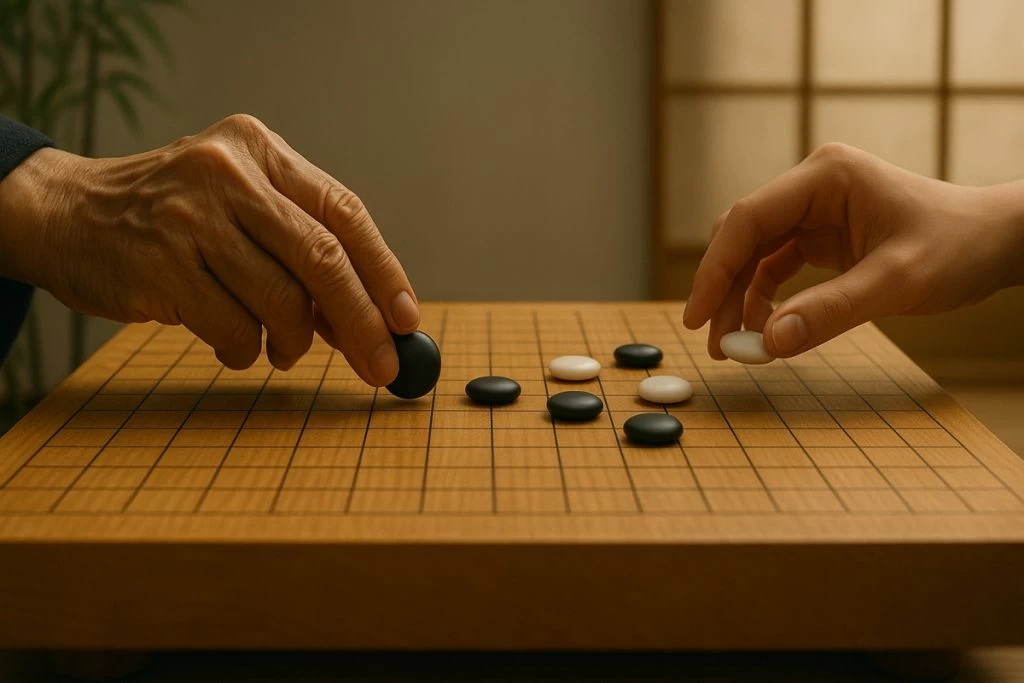

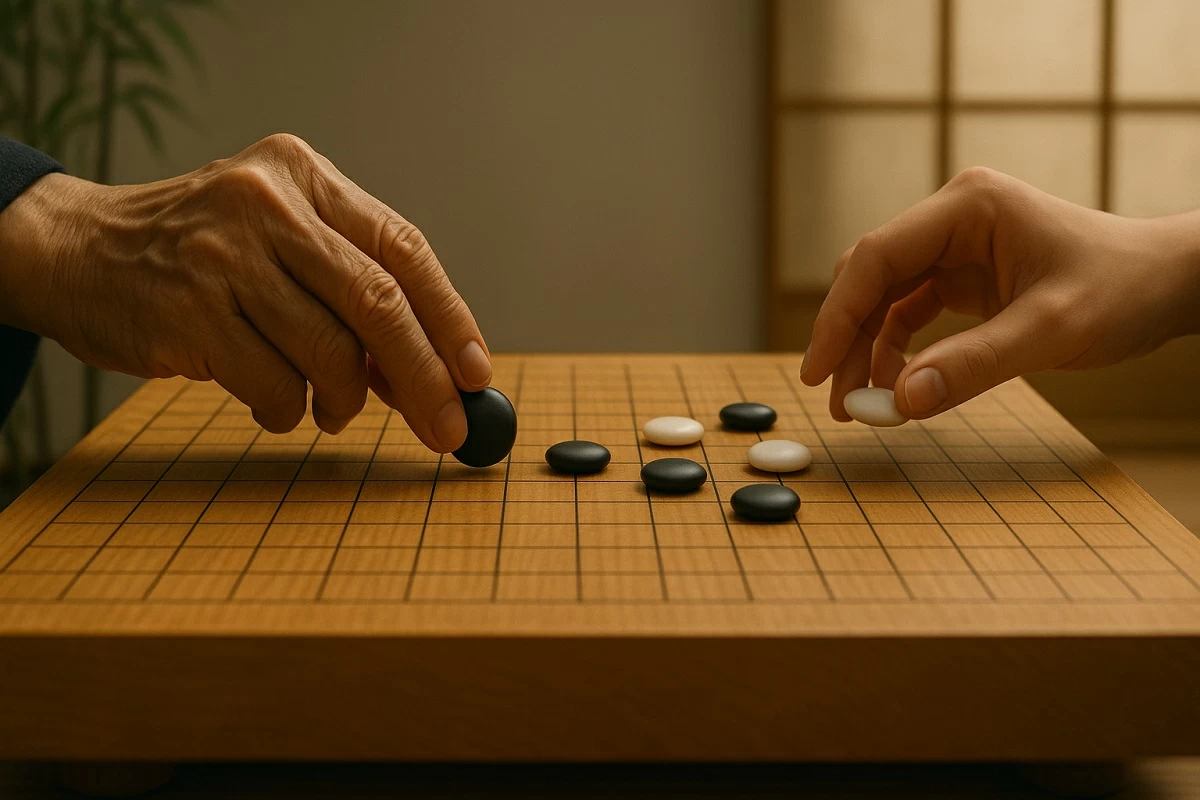
While the civilizations of the Near East were creating the foundational race games of the West, an entirely different and equally profound gaming culture was flourishing in Ancient Asia. China, a cradle of immense innovation, gave rise to two of the world’s most enduring and respected strategy board games: Go and Xiangqi.
Though both are games of pure skill, they represent two fundamentally different philosophies of conflict and strategy. To understand them is to explore a rich history of intellectual and cultural refinement that has challenged minds for millennia.
Go (圍棋 – Wéiqí): The Art of Encirclement
Considered by many to be the oldest continuously played board game in the world, Go is a game of profound simplicity and almost infinite complexity. Legend dates its invention to the mythical Emperor Yao over 4,000 years ago, designed to teach his son discipline and concentration. Historically, it was revered as one of the four essential arts for any Chinese scholar.
The Rules and Philosophy: Unlike games where the board starts full, a game of Go begins with an empty 19×19 grid. Two players, one with black stones and one with white, take turns placing a single stone on any open intersection. The goal is not to capture a king, but to surround more territory than your opponent by the end of the game.
Stones can be captured and removed from the board if they are completely surrounded by opposing stones, their last “liberty” taken away. This simple mechanic gives rise to breathtakingly complex battles over the life and death of large groups of stones, often happening simultaneously in different corners of the board.
Strategic Depth: Go is less of a battle and more of a conversation about space. It teaches balance, influence, and the art of seeing the whole board as a single, interconnected entity. A single stone can influence the fate of a game played a hundred moves later. It is a game of building and creation as much as it is a game of conflict.
Xiangqi (象棋): The Elephant Game
If Go is a grand strategic map, Xiangqi is a tactical battlefield. As a member of the chess family, it shares a common ancestor with the Western game, but it evolved into a uniquely brilliant and aggressive contest. Its name translates to “Elephant Game,” a nod to one of its signature pieces.
- The Board and Unique Pieces: Xiangqi is played on the intersections of a 9×10 grid, which is divided in the middle by a “River.” Key differences from international chess create a completely different strategic feel:
- The Palace: The General (the King) and his two Advisor guards cannot leave a 3×3 fortress known as the Palace. This makes them vulnerable but also concentrates the defensive battle.
- The Cannon (Pao): This is Xiangqi’s most innovative piece. It moves like a Rook but can only capture by jumping over exactly one other piece (friend or foe), known as a “screen.” This creates unique tactical possibilities for long-range attacks.
- The River: The Elephant pieces cannot cross the river, limiting their role to defense. In contrast, the Soldier (pawn) pieces become more powerful after crossing it, gaining the ability to move sideways.
- The Flying General: The two Generals cannot face each other along an open file, meaning one can effectively check the other from across the entire board if no pieces are in the way.
- Strategic Feel: Because of the Cannon and the open nature of the board, Xiangqi is often a much faster and more brutal game than its Western cousin. It is a game of sharp tactics, immediate threats, and dynamic, fluid battles.
Two Philosophies of Conflict
Go and Xiangqi are pillars of intellectual heritage. Go, with its empty board and simple components, teaches organic strategy, influence, and the importance of every single move. Xiangqi, with its diverse army and rigid palace, teaches tactical precision and the art of the decisive attack. Together, they represent a remarkable spectrum of strategic thought and stand as a testament to the enduring power of a great game.
Go & Xiangqi — Frequently Asked Questions
What is Go?
Go is an ancient Chinese strategy game played on a 19×19 grid, with two players placing black and white stones to surround territory. Originating in China around 2,500 years ago, Go is considered the oldest continuously-played board game in the world. The objective is simple — control more territory than your opponent — but the strategic depth is so vast that it took AI longer to master than chess (DeepMind’s AlphaGo defeated a world champion in 2016).
What is Xiangqi?
Xiangqi (象棋) — also called Chinese chess — is a two-player abstract strategy game played on a 9×10 grid, with pieces placed on the intersections of lines (not squares). It descends from the same Indian root as Western chess but evolved separately in China from the 7th century CE, with distinctive features like a river dividing the board and a “palace” restricting the movement of generals and advisors.
How old is the game of Go?
Chinese tradition attributes Go’s invention to the legendary Emperor Yao (c. 2300 BCE), supposedly to teach his son discipline. Archaeological evidence is more conservative — the earliest physical Go boards date to around 500–600 BCE. Either way, Go has been continuously played for at least 2,500 years, longer than any other game still in widespread use today.
How do you play Go?
Two players take turns placing black or white stones on intersections of a 19×19 grid (smaller 9×9 or 13×13 boards are used for beginners). Stones don’t move once placed. A stone or group of stones is captured if all their adjacent intersections are filled by the opponent. The game ends when both players pass; the winner controls the most territory plus captures.
Is Xiangqi the same as Western chess?
No — they share an ancestor (Indian Chaturanga) but evolved differently. Xiangqi has 16 pieces per side (vs 16 in chess but different roles), uses a board with intersections instead of squares, divides the board with a river, and restricts certain pieces to the palace. The general can never face the opposing general directly across an open file.
Why was Go harder for AI than chess?
Chess has roughly 10⁴⁰ possible game states; Go has 10¹⁷⁰ — vastly more than there are atoms in the observable universe. Brute-force search algorithms that solved chess (Deep Blue, 1997) couldn’t scale to Go. AlphaGo’s 2016 victory required a different approach: deep neural networks trained on millions of human games plus self-play.
Where is Xiangqi most popular today?
Xiangqi remains the most popular board game in mainland China and the Chinese diaspora, with active professional leagues and tournaments. Estimates put the player base at over 500 million worldwide, making it one of the most-played games in any era.
Chess: From Chaturanga to Grandmasters
The Indian root of Xiangqi and Western chess.
Shogi: Japan’s Chess Evolution
The third great Asian chess descendant.
The Oldest Board Games Ever Discovered
Go’s place in the long timeline.
