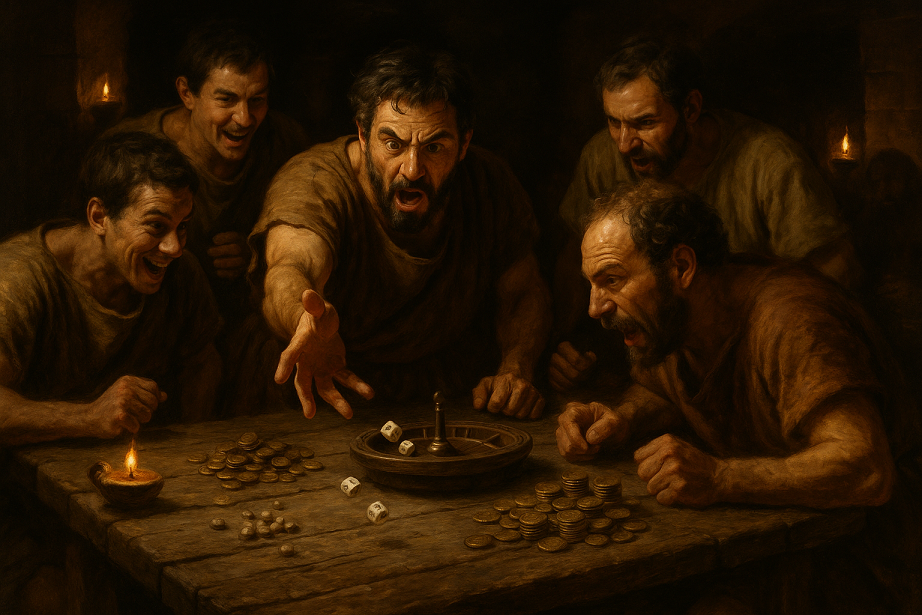

The unmistakable sound of dice tumbling across a felt table is a cornerstone of the modern casino experience. But this thrilling game of chance has roots that stretch back over two millennia, to the taverns, military camps, and villas of ancient Rome. The Romans were fanatical gamblers, and their favorite games, played with Tesserae (dice) and Tali (knucklebones), are the clear and direct ancestors of casino dice games like Craps.
The Tools of a Roman Gambler
The Romans used two primary types of random number generators for their games of chance:
- Tesserae: These were six-sided dice, virtually identical to the ones we use today. They were typically crafted from bone, ivory, wood, or bronze. The sides were numbered one to six, and just like modern dice, the opposite sides always added up to seven.
- Tali: These were more primitive but equally popular. They were the knucklebones of sheep or goats, which had four distinct long sides. These sides were assigned values, often 1, 3, 4, and 6. A typical throw involved tossing four Tali at once.
While Tali were common, the six-sided Tesserae, with their straightforward numerical outcomes, provide the most direct link to modern casino games.
The Unshakeable Roman Obsession with Dice
Gambling with dice was technically illegal in ancient Rome outside of the Saturnalia festival, but this law was universally ignored. From the common soldier in his barracks to the Emperor Augustus in his palace, everyone played. Dice games were a social staple, a way to pass the time, settle disputes, and, most importantly, wager money—often heavily.
Roman literature and archaeological findings are filled with references to dice. Cheating was rampant, with loaded dice being a common complaint. The stakes could range from a few coins to entire fortunes, showcasing just how seriously the Romans took their games of chance.

The Casino Connection: Betting on the Sum
The core mechanic that connects these ancient pastimes to modern casino games is the act of betting on the sum of the roll. This is the absolute foundation of both Craps and Sic Bo. Roman games revolved around specific outcomes from the thrown dice. A “Venus throw” with Tali (four different sides showing) was the best possible result, while a “Dogs throw” (four ones) was the worst.
With Tesserae, players would bet on whether the total sum would be high or low, or they might wager on specific numbers appearing. This is identical in principle to Craps, where players bet on the outcome of a roll of two dice—whether it’s a 7, an 11, or a specific point number. The equipment has been refined from carved bone to precision-engineered plastic, but the fundamental action of wagering on a random numerical result from a dice throw is a tradition that has passed directly from Rome to the modern casino floor.
