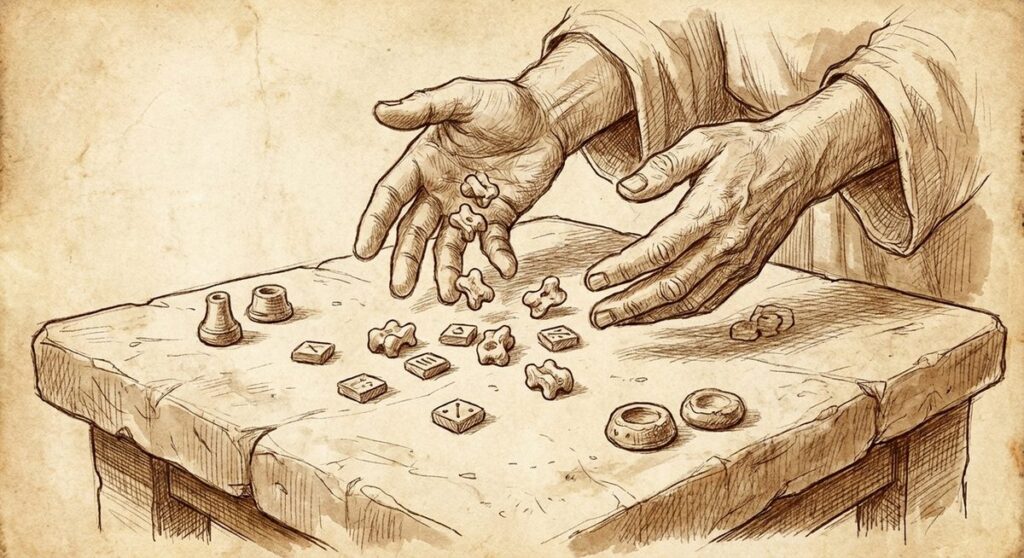

Humans have been wagering on uncertain outcomes for almost as long as recorded history. The oldest gaming dice ever found come from Mesopotamia around 3000 BCE. Loaded dice — designed to cheat — have been excavated from Pompeii. The Bible references casting lots; Tang dynasty China ran state lotteries to fund the Great Wall; Roman emperors banned dice gambling on weekdays. The history of gambling is, in a real sense, the history of probability, finance, and law all entangled. Here’s how the major ancient civilisations gambled — and what their games became.
Mesopotamia and Egypt: The Beginning of Recorded Gambling (3000–500 BCE)
The earliest physical evidence of gambling is the Burnt City in modern Iran, where archaeologists found a backgammon-like board and dice dated to about 2800 BCE. By that point, dice gambling was already old enough to have generated its own equipment industry.
Egypt’s famous Senet board game (from c. 3100 BCE) used throw-sticks rather than dice — flat sticks marked on one side, thrown to determine moves. By the New Kingdom, the game had taken on religious significance: tomb paintings show the deceased playing Senet against an unseen opponent for safe passage to the afterlife.
In Mesopotamia, the Royal Game of Ur (c. 2600 BCE) used three tetrahedral dice marked on two of four corners. Surviving cuneiform tablets describe wagering on the outcomes — making this one of the oldest documented gambling games.
Classical Greece: Knucklebones and Petteia (500 BCE–300 CE)
The Greeks gambled with astragaloi (knucklebones) — the actual ankle bones of sheep or goats. Each bone has four distinguishable sides, producing a primitive four-sided die. Children played with them; adults wagered on them. Specialised market stalls sold polished, hardened sets.
Beyond knucklebones, the Greeks played:
- Petteia — a strategy game with no dice element. Plato cites it as a teaching tool. The game’s military-themed mechanics influenced later games like Roman Latrunculi.
- Lots — public divination via random selection. Used in courts and political offices, with explicit religious framing.
- Cottabos — a wine-throwing game played at symposia. Less gambling than entertainment, but stakes (often small money or personal items) were common.
Greek philosophers had complicated views. Aristotle classed gamblers alongside thieves as people unwilling to do real work. Plato in his Laws proposed restricting gambling to military training contexts.
Rome: Universal, Loud, and Often Illegal (200 BCE–400 CE)
The Romans gambled enthusiastically on dice (tesserae), knucklebones, gladiator fights, chariot races, and the medieval-ancestor game of Hazard. Loaded dice excavated from Pompeii prove they cheated at it.
Roman gambling law was complicated. The lex talaria theoretically banned dice gambling outside of the December Saturnalia festival, but the law was almost universally ignored. Augustus and Claudius were both publicly addicted to dice; Claudius wrote a now-lost book on the subject. The historian Suetonius records emperors gambling away substantial fortunes in single nights.
Beyond dice, the Romans organised what may have been the first state-licensed lottery. Augustus held lotteries to distribute property; Nero’s lotteries gave away houses, ships, and slaves. The format spread across the empire.
Tang Dynasty China: State Lotteries and Tile Games (600–900 CE)
Imperial China developed two great gambling traditions: lottery and tile games.
The lottery was state policy. Tang officials sold lottery tickets to fund infrastructure projects — including, by tradition, sections of the Great Wall of China. Players picked numbers; winners received state currency or rice. The system functioned as both revenue-raising and population census.
Tile games — direct ancestors of modern Mahjong — appeared in the Tang dynasty as carved bone or bamboo sets used for both gambling and pure strategic play. These would evolve over the next thousand years into the modern Mahjong tile set, finalised in the 19th century.
Pre-Columbian Mesoamerica: Stakes Beyond Money (1500 BCE–1500 CE)
The Mesoamerican ball game mixed athletic competition with ritual gambling. Players wagered jewelry, slaves, even their own freedom; in extreme religious contexts, losing captains could be sacrificed. This wasn’t recreational gambling — it was a deeply embedded political and religious institution.
The Aztecs also played patolli, a board game with bean-dice that drew enormous crowds and large wagers. Spanish chroniclers described patolli players betting “everything they had” on single games. The Spanish suppressed the game during the conquest, partly because of its association with Aztec religion and partly because Spaniards lost money to it themselves.
Medieval Europe: The Church Push-Back
Hazard — the direct ancestor of modern craps — was popular in 14th-century England. The Church alternately tolerated and condemned it. Crusaders banned dice gambling in the Holy Land (then immediately violated their own ban). Chaucer’s Canterbury Tales features a gambling scene; the Pardoner’s Tale uses dice as a moral metaphor.
By the late medieval period, Italian merchants had introduced playing cards (originally from China via the Islamic world). The new technology produced a wave of new games and an equally large wave of moral panic.
The Modern Inheritance
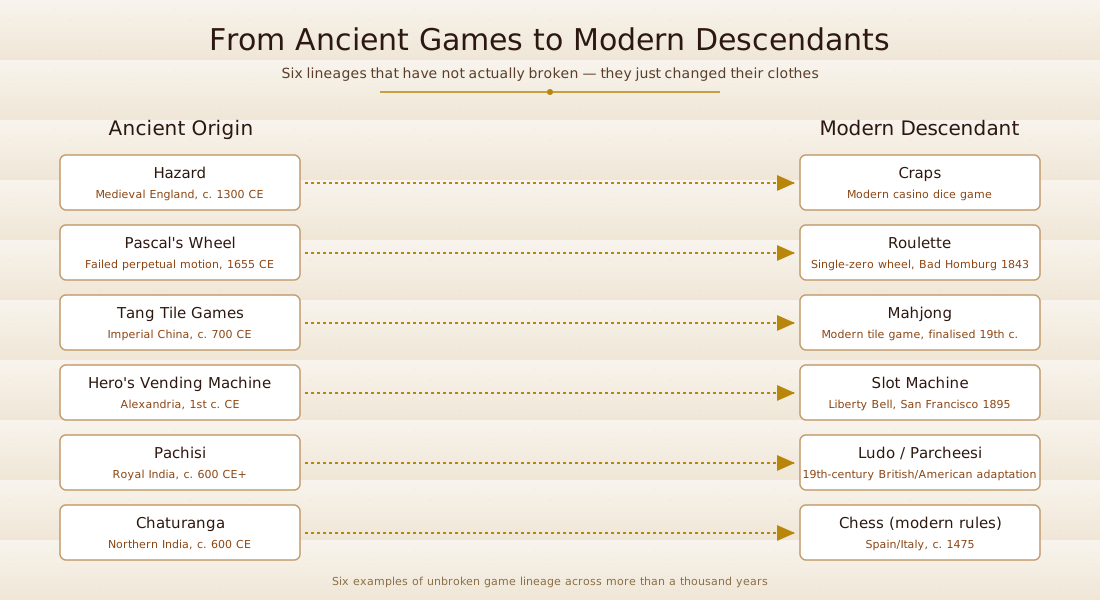
Almost every major casino game today has an ancient or medieval ancestor:
- Craps — descends from medieval English Hazard, which descends from Roman dice gambling.
- Roulette — formalised in 18th-century France, but roulette-style spinning games appear much earlier in Roman and Chinese contexts.
- Mahjong — descends from Tang dynasty tile games.
- Lotteries — direct continuous tradition from Augustus to the modern state lotto.
- Slot machines — mechanically descend from Hero of Alexandria’s coin-operated devices (1st century CE), via 19th-century vending technology.
FAQ
What’s the oldest known gambling game?
Dice gambling, attested in Mesopotamia and Egypt by around 3000 BCE. The earliest physical dice in archaeological contexts come from the Burnt City in modern Iran, dated to about 2800 BCE.
Did ancient civilisations have lotteries?
Yes. Roman emperors organised lotteries from the 1st century BCE; Tang dynasty China ran state lotteries to fund infrastructure including parts of the Great Wall.
Was gambling legal in ancient Rome?
Officially mostly no — the lex talaria banned dice gambling outside the Saturnalia festival. In practice the law was almost universally ignored, including by emperors.
Did ancient people cheat at gambling?
Yes, prolifically. Loaded dice (designed to favour certain numbers) have been excavated from Pompeii and from Roman military camps across the empire. Some dice have hollow interiors filled with mercury.
What’s the connection between ancient gambling and modern casinos?
Most modern casino games have direct lineage to ancient or medieval games. Craps from Hazard (medieval English, from Roman dice). Roulette formalised in 18th-century France. Slot machines mechanically descend from Hero of Alexandria’s 1st-century coin-operated water dispenser.
Hero’s Vending Machine
The 1st-century device that’s the slot machine’s ancestor.
The History of Craps
From medieval Hazard back to Roman dice.
The History of Roulette
From Pascal’s experiment to the modern wheel.
The History of Mahjong
From Tang dynasty tiles to the modern game.
Modern Casino Sites (US)
Where the ancient games are played today.
Lineage Deep Dives