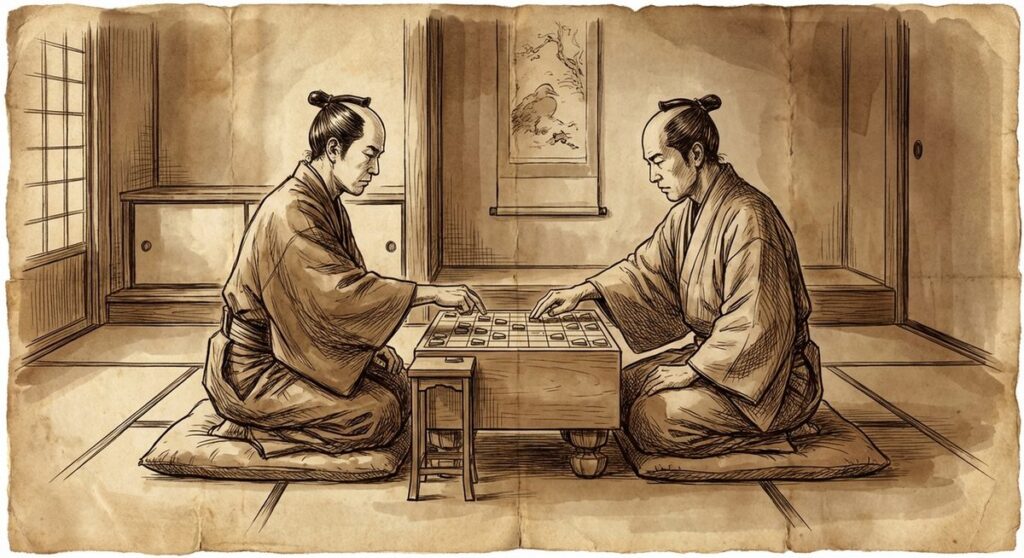

In a modest room in Tokyo, a young professional sits cross-legged before a wooden board, contemplating a position that has consumed nearly three hours of intense concentration. Across from him, his opponent — a ninth-dan grandmaster — waits with the patience of a stone garden. Between them lies a battlefield of 81 squares, populated by wedge-shaped wooden pieces bearing elegant kanji characters. This is shogi, Japan’s ancient and endlessly fascinating variant of chess, a game that has captivated the Japanese mind for over a millennium and continues to draw millions of devoted players today.
What makes shogi truly extraordinary among the world’s chess variants is a single, revolutionary rule: captured pieces do not leave the game. Instead, they switch allegiance, joining the captor’s reserve forces and available for redeployment on any future turn. This “drop rule” transforms the game from a war of attrition into a dynamic contest where material advantage is fleeting and tactical possibilities multiply with every exchange. It is a concept so profound in its implications that it has shaped not only shogi strategy but, some scholars argue, Japanese military and philosophical thinking for centuries.
Ancient Origins: From India to the Islands
Like virtually all chess-family games, shogi traces its ultimate ancestry to chaturanga, the ancient Indian game that emerged sometime between the 3rd and 6th centuries CE. Chaturanga — meaning “four divisions” in Sanskrit, referring to infantry, cavalry, elephants, and chariots — spread along the Silk Road in multiple directions, evolving into distinct regional variants as it traveled. To the west, it became shatranj in Persia and eventually modern chess in Europe. To the east, it became xiangqi in China, janggi in Korea, and makruk in Thailand.
The precise route by which chess-type games reached Japan remains a subject of scholarly debate. The most widely accepted theory holds that xiangqi or a closely related Chinese variant was transmitted to Japan via the Korean peninsula or through direct contact with Tang Dynasty China sometime during the Nara period (710–794 CE). However, some researchers have proposed an alternative southern route through Southeast Asia, pointing to certain similarities between shogi and makruk that are absent in xiangqi.
The earliest documentary evidence of shogi in Japan comes from the Shin Sarugakuki, a literary work written by Fujiwara no Akihira around 1058–1064 CE, which mentions the game alongside go as a popular pastime among the aristocracy. However, the oldest surviving physical evidence dates even earlier — archaeological excavations at Kofukuji Temple in Nara uncovered shogi pieces inscribed with the date 1058 CE, confirming that the game was already well established by the mid-Heian period.
Early Variants and the Road to Modern Shogi
What makes the early history of Japanese chess particularly fascinating is the sheer proliferation of variants that emerged during the medieval period. While modern shogi is played on a 9×9 board with 40 pieces, historical records describe an astonishing array of larger and more complex versions:
- Heian shogi — the earliest known form, played on a smaller board without the drop rule
- Dai shogi (Great shogi) — played on a 15×15 board with 130 pieces per side
- Tenjiku shogi (Exotic shogi) — a 16×16 board with 78 pieces per side, featuring extraordinarily powerful pieces
- Tai shogi (Grand shogi) — a massive 25×25 board with 354 pieces per side
- Taikyoku shogi — the largest known variant, played on a staggering 36×36 board with 402 pieces per side, a game so complex that a single match could theoretically take weeks
These enormous variants were likely more intellectual curiosities than practical games, but they demonstrate the Japanese enthusiasm for elaborating and experimenting with chess-family game mechanics. Over time, the trend reversed, and by the 16th century, the smaller, faster 9×9 version had emerged as the dominant form — likely because it was the most strategically satisfying and practically playable.
The Revolutionary Drop Rule
The single feature that most dramatically distinguishes shogi from all other chess variants is the drop rule (in Japanese, mochigoma, meaning “pieces in hand”). When a player captures an opponent’s piece, that piece does not leave the game. Instead, it joins the capturing player’s reserve, and on any subsequent turn, the player may choose to place — or “drop” — that piece onto any unoccupied square on the board rather than moving a piece already in play.
The implications of this rule are profound and far-reaching:
Strategic Consequences
Games almost never end in draws. Unlike international chess, where approximately half of grandmaster games end in draws, shogi draws are exceedingly rare — occurring in less than 1% of professional matches. The constant influx of material through drops means that defensive formations can always be breached given sufficient skill and creativity. There is always a way to attack.
Material exchanges are fundamentally different. In Western chess, trading pieces when you have a material advantage is generally sound strategy, as it simplifies the position and magnifies your lead. In shogi, every exchange puts a new piece into both players’ hands, creating new offensive possibilities for both sides. A player who captures a powerful piece gains not only the removal of that piece from the opponent’s board but also its future use as a weapon.
The endgame is explosive rather than grinding. While chess endgames often involve the slow, methodical advancement of passed pawns, shogi endgames are frequently the most violent and tactically complex phase of the game. With accumulated pieces in hand, both players can launch devastating attacks, and the final moves often feature cascading sequences of drops and sacrifices that would be impossible in any other chess variant.
“In chess, as pieces are exchanged, the game simplifies. In shogi, as pieces are exchanged, the game becomes more complex. This fundamental difference creates a game experience unlike any other in the chess family.” — Yoshiharu Habu, professional shogi player and the only person to hold all seven major titles simultaneously
The Historical Origins of the Drop Rule
When and why the drop rule was introduced remains one of the great mysteries of shogi history. No other chess variant worldwide independently developed this mechanic, making it a uniquely Japanese innovation. Several theories have been proposed:
One popular explanation connects the rule to the Japanese practice of employing captured enemy soldiers, a common feature of medieval Japanese warfare. Unlike European feudal warfare, where captured knights were typically ransomed, Japanese warlords frequently incorporated defeated enemies into their own forces. The drop rule, in this view, reflects a distinctly Japanese understanding of warfare and loyalty.
Another theory suggests a more practical origin: the drop rule may have been introduced specifically to eliminate draws and create a more decisive game, better suited to the Japanese aesthetic preference for clear outcomes and the gambling culture that surrounded board games during the medieval period.
Whatever its origins, the drop rule was firmly established by the late 16th century, when the modern form of shogi was codified under the patronage of the Tokugawa shogunate.
Pieces and Their Movement
Modern shogi uses 20 pieces per player — the same number as in international chess — but with important differences in movement and character. All pieces are flat, wedge-shaped wooden tokens (called koma) with their identity written in kanji. Crucially, pieces are not distinguished by color; instead, ownership is determined by the direction the pointed end faces — toward the opponent.
This elegant design solution is necessitated by the drop rule: since any piece can switch sides, using colors would be impractical. The directional wedge system is one of shogi’s most distinctive visual features.
The Piece Roster
Each player begins with:
- 1 King (Osho/Gyokusho) — moves one square in any direction, identical to the chess king
- 1 Rook (Hisha) — moves any number of squares orthogonally, identical to the chess rook
- 1 Bishop (Kakugyo) — moves any number of squares diagonally, identical to the chess bishop
- 2 Gold Generals (Kinsho) — move one square in any direction except diagonally backward
- 2 Silver Generals (Ginsho) — move one square diagonally or straight forward
- 2 Knights (Keima) — jump in an L-shape, but only forward (unlike chess knights, which can move in all eight directions)
- 2 Lances (Kyosha) — move any number of squares straight forward only
- 9 Pawns (Fuhyo) — move one square straight forward only, and capture the same way (unlike chess pawns, which capture diagonally)
The Promotion System
When a piece enters, moves within, or leaves the promotion zone — the three rows closest to the opponent’s side — it may be promoted (and in some cases must be promoted). Promotion is indicated by flipping the piece over to reveal a different character, usually written in red. Promoted pieces gain enhanced movement:
The Rook promotes to Dragon King, gaining the ability to move one square diagonally in addition to its normal rook movement. The Bishop promotes to Dragon Horse, gaining one square of orthogonal movement. These promoted major pieces are extraordinarily powerful and often decisive in the endgame. Silver Generals, Knights, Lances, and Pawns all promote to Gold General movement. Notably, Gold Generals and Kings cannot promote.
When a promoted piece is captured, it reverts to its unpromoted state in the capturing player’s hand. This prevents the accumulation of too many powerful promoted pieces and adds another layer of strategic consideration to captures and drops.
The Professional Shogi World
Japan’s professional shogi system is one of the most rigorous and demanding competitive structures in any board game worldwide. Overseen by the Japan Shogi Association (JSA), founded in 1924, the professional system produces players of extraordinary skill through a training pipeline that begins in childhood and demands years of grueling apprenticeship.
The Path to Professional Status
Aspiring professionals enter the JSA’s training program, known as Shoureikai, typically between the ages of 10 and 15. Acceptance requires passing an entrance examination of exceptional difficulty. Once admitted, trainees are assigned ranks beginning at 6-kyu and must fight their way up through a series of leagues. The critical threshold is reaching 3-dan — at this point, the trainee enters a brutally competitive league where only the top performers are promoted to 4-dan and official professional status.
The catch is devastating: trainees who have not achieved 4-dan by age 26 are permanently expelled from the system. This “age limit” rule means that many talented players who have devoted a decade or more of their lives to shogi are forced to abandon their professional aspirations. It is a system that produces champions of the highest caliber but at a significant human cost.
As of recent years, there are approximately 160 active professional players and roughly 50 active female professionals (who compete in a separate system called LPSA). The gender separation has been a subject of ongoing debate, particularly since several female players have demonstrated ability comparable to their male counterparts.
The Title Match System
Professional shogi revolves around eight major titles, each contested annually in prestigious match series:
- Ryuo (Dragon King) — the highest-prize title, with the winner receiving approximately ¥44 million (around $300,000)
- Meijin (Master) — the most historically prestigious title, dating back centuries
- Oi, Oza, Kisei, Osho, Kio, and Eio — additional major titles, each sponsored by different newspapers
Title matches are elaborate affairs, often played over two days with each player receiving eight or nine hours on their clock — in stark contrast to the rapid time controls common in Western chess tournaments. The matches take place in luxurious traditional Japanese settings — ryokan (inns), temples, and historic buildings — and are broadcast live on NHK television and dedicated internet channels to audiences of millions.
Legendary Players and Historic Matches
Yoshiharu Habu: The Greatest of All Time
No discussion of shogi can be complete without Yoshiharu Habu, widely regarded as the greatest player in the history of the game. Born in 1970, Habu achieved professional status at age 15 and quickly established himself as a player of generational talent. In 1996, he accomplished the unprecedented feat of holding all seven major titles simultaneously — a record that has never been matched and may never be.
Over his career, Habu has won a record 99 title matches across all major competitions, a number so far beyond his contemporaries that it defies comparison. His playing style combines deep positional understanding with ferocious tactical ability, and his contributions to shogi theory have reshaped understanding of the game at every level.
Habu is also notable for his crossover success in international chess, having earned a FIDE rating and competed in international tournaments — a testament to the deep strategic thinking that shogi cultivates.
Sota Fujii: The Prodigy
In recent years, the shogi world has been electrified by Sota Fujii, who became the youngest professional player in history at age 14 years and 2 months in 2016. Fujii immediately set records, winning his first 29 consecutive official games — a streak that captivated the entire nation and made front-page news across Japan.
Fujii’s rise has drawn millions of new fans to shogi, particularly young people, and has sparked a genuine renaissance of interest in the game. His achievement of becoming the youngest holder of multiple titles has drawn comparisons to Habu’s early career and prompted excited speculation about whether he might eventually surpass the master’s records.
The Human vs. Computer Battle
Shogi’s encounter with artificial intelligence followed a trajectory similar to chess but with important differences. Due to the drop rule, which dramatically increases the branching factor (the number of possible moves at any given position), shogi proved a harder challenge for computers than chess. While IBM’s Deep Blue defeated chess world champion Garry Kasparov in 1997, it was not until 2013 that computer programs convincingly demonstrated superiority over top professional shogi players in the Denousen (Man vs. Computer) series.
The shogi community’s response to computer superiority has been notably different from the chess world’s. Rather than viewing AI as a threat, many professional players have embraced computer analysis as a training tool, and the integration of AI into professional preparation has accelerated the evolution of shogi strategy at an unprecedented pace. Positions and openings that were considered unplayable for centuries have been rehabilitated through computer analysis, creating what many players describe as a golden age of shogi theory.
Cultural Significance in Japan
Shogi occupies a position in Japanese culture that goes far beyond mere entertainment. It is a cultural institution, deeply intertwined with Japanese aesthetics, philosophy, and social structure.
Shogi and Japanese Aesthetics
The game embodies several core concepts of Japanese aesthetics. The beauty of the pieces themselves — hand-carved from tsuge (boxwood) with characters written in sumi ink or lacquer — reflects the Japanese reverence for craftsmanship. A high-quality shogi set is a work of art, with master piece-makers commanding prices of hundreds of thousands of yen for their creations.
The game’s emphasis on reading ahead and anticipating the opponent’s intentions connects to the concept of ma — the appreciation of space and timing that pervades Japanese art, architecture, and martial arts. The long silences during professional matches, when players spend 30 minutes or more on a single move, are not seen as boring but as essential to the game’s aesthetic experience.
Shogi in Popular Culture
Shogi features prominently in Japanese manga, anime, and literature. The manga series March Comes in Like a Lion (3-gatsu no Lion) by Chica Umino, which follows a young professional shogi player’s personal and professional struggles, has been both a critical and commercial success, spawning an anime adaptation and live-action films. The series is praised for its accurate depiction of the professional shogi world and its sensitive exploration of the psychological pressures faced by competitive players.
Numerous other manga and anime feature shogi, from Shion no Ou (a mystery series set in the shogi world) to Naruto (where the character Shikamaru Nara is a devoted shogi player whose strategic thinking on the board translates to battlefield tactics).
The Social Role of Shogi
In everyday Japanese life, shogi serves as a common social activity across all ages and social classes. Shogi clubs can be found in schools, community centers, and dedicated shogi parlors (shogi kaikan) in every major city. The game is taught in many elementary schools as a tool for developing logical thinking and concentration, and interscholastic shogi tournaments draw thousands of young competitors.
For older Japanese, shogi serves a social function similar to chess cafes in Europe or card rooms in America — a gathering place for community, conversation, and friendly competition. The game’s accessibility (a basic set costs only a few hundred yen) and its infinite strategic depth make it equally satisfying for casual players and lifelong devotees.
Shogi in the Global Context
While shogi remains overwhelmingly a Japanese phenomenon — with an estimated 20 million players in Japan — the game has been slowly gaining international recognition. The International Shogi Popularization Foundation and various national shogi federations in Europe, North America, and Asia have worked to introduce the game to non-Japanese audiences.
International shogi tournaments have been held regularly since the 1980s, and the World Shogi Forum, organized by the JSA, brings together amateur players from dozens of countries. Online platforms have dramatically accelerated international growth, with sites like 81Dojo and Lishogi providing free play and instruction in multiple languages.
Comparative study of shogi alongside xiangqi and international chess reveals fascinating insights into how different cultures have shaped the same ancestral game in radically different directions. Where chess developed increasingly powerful pieces and fast, decisive attacks, and xiangqi emphasized the strategic importance of controlling a river boundary, shogi uniquely introduced the recycling of captured forces — creating a game where every piece, no matter how humble, retains value throughout the entire contest.
This philosophical difference — the idea that nothing is ever truly lost, that every element can be reborn in a new context — resonates with Buddhist concepts of impermanence and rebirth that are deeply embedded in Japanese culture. Whether the drop rule was consciously designed to reflect these ideas or whether the cultural resonance is coincidental, the result is a game that feels distinctly and profoundly Japanese in ways that go far beyond surface aesthetics.
Learning Shogi Today
For those intrigued by shogi’s unique character, the game has never been more accessible to non-Japanese speakers. English-language resources include comprehensive websites, YouTube channels, and translated strategy books. Several online platforms offer play against opponents of all skill levels, and most feature tutorials and problem sets for beginners.
The initial learning curve is manageable for anyone familiar with chess concepts, though mastering the kanji characters on the pieces takes some practice. Many beginners start with internationalized piece sets that add symbols or directional arrows to the traditional kanji, easing the transition. Some modern sets use pictographic designs inspired by ancient game pieces found in archaeological contexts, bridging millennia of gaming history.
The true challenge — and the true joy — of shogi lies in internalizing the implications of the drop rule. For a chess player accustomed to simplifying exchanges, the realization that every capture creates new offensive potential for both sides is genuinely mind-expanding. It requires a fundamental rethinking of value, risk, and strategic planning that many players find intellectually exhilarating.
“When I first learned shogi after twenty years of chess, it felt like someone had taken a game I thought I understood completely and revealed an entirely new dimension. The drop rule doesn’t just change the tactics — it changes how you think about the fundamental nature of conflict and exchange.” — Larry Kaufman, International Master in both chess and shogi
The Future of Shogi
As Japan’s population ages and competes with digital entertainment for young people’s attention, the future of shogi has been a subject of concern among traditionalists. Yet the game’s recent trajectory offers considerable cause for optimism. The Fujii phenomenon has brought unprecedented media attention and a surge of young players. AI analysis has reinvigorated professional play with new ideas and strategies. And the gradual internationalization of the game promises a broader base of players and enthusiasts.
Shogi’s essential appeal — a chess variant where nothing is ever truly dead, where today’s loss becomes tomorrow’s weapon, where the game grows more complex rather than simpler as it progresses — is timeless. For over a thousand years, this remarkable game has challenged and delighted some of the finest strategic minds in one of the world’s most intellectually demanding cultures. Its unique evolution from the ancient Indian game of chaturanga into something wholly and beautifully Japanese stands as one of the great creative achievements in the long history of human games.
