
Unearthing Humanity’s Oldest Pastime
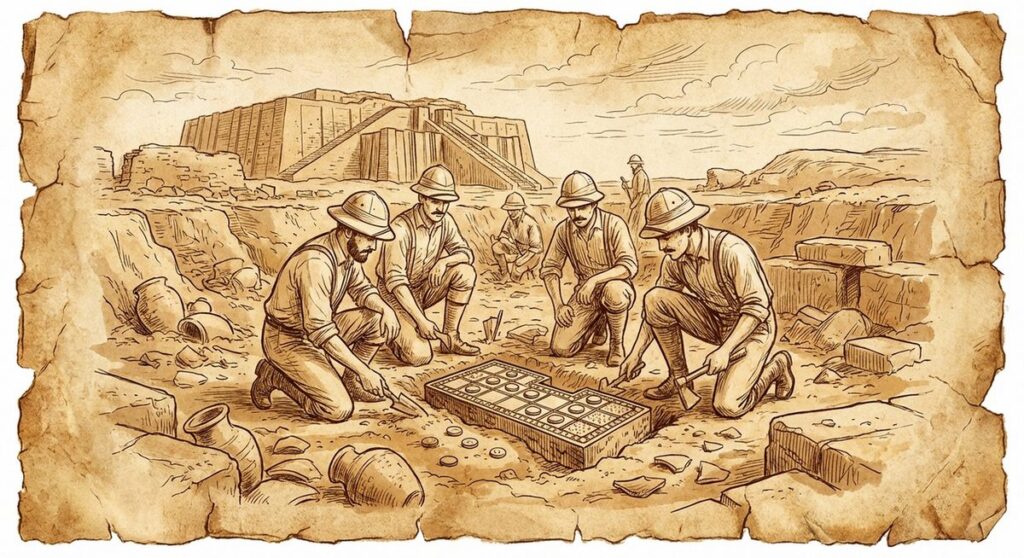
When archaeologists carefully brush away millennia of dust and debris, they sometimes uncover something unexpectedly human: a game board. Not a weapon, not a tool, not a religious idol — but a surface designed for play. These discoveries tell us something profound about our species. Even in the earliest complex societies, when survival demanded constant effort, humans carved out time and resources for structured, rule-bound entertainment.
The following list presents the oldest board games ever discovered by archaeologists, arranged roughly by the age of the earliest known physical evidence. For each game, we examine what was found, where it was found, and what the discovery reveals about the people who played it thousands of years ago.
1. Senet — The Game of Passing (c. 3100 BCE, Egypt)
The oldest board game with clear archaeological provenance is Senet, a game of thirty squares arranged in three rows of ten. The earliest known Senet board was found in the predynastic burial site of Merknera at Saqqara, dating to approximately 3100 BCE — making it over five thousand years old.
Senet boards have been recovered from dozens of Egyptian tombs spanning nearly two millennia. The most famous examples include the exquisite board found in Tutankhamun’s tomb (c. 1323 BCE), crafted from ebony and ivory with golden playing pieces, and the simpler boards scratched into stone surfaces by common workers at construction sites along the Nile.
What makes Senet archaeologically significant is not just its age but its evolution. Early Senet appears to have been a purely strategic game between two players, each racing their pieces across the board. By the New Kingdom period (c. 1550–1070 BCE), the game had acquired deep religious significance, with the board representing the soul’s journey through the Duat (underworld). Specific squares were associated with deities and spiritual trials. This transformation from secular entertainment to sacred ritual is documented in tomb paintings, the Book of the Dead, and physical boards with religious inscriptions.
Key Archaeological Evidence
- Earliest board: Saqqara burial, c. 3100 BCE
- Most elaborate: Tutankhamun’s ebony and ivory set
- Most numerous: Over 40 complete boards recovered from various sites
- Rules reconstruction: Based on tomb paintings and a 1st-century text by an unknown author
2. Mehen — The Coiled Serpent (c. 3000 BCE, Egypt)
Mehen is one of the most enigmatic ancient board games. Named after the serpent deity who protected the sun god Ra, the game was played on a distinctive circular board depicting a coiled snake, with the serpent’s body divided into segments that served as playing spaces. The snake’s head occupied the center of the board — the goal that players aimed to reach.
Archaeological finds include boards from Abydos and other predynastic Egyptian sites, along with lion-shaped and lioness-shaped playing pieces and small marble-like balls. What makes Mehen particularly intriguing is its disappearance: the game vanished from Egypt around 2000 BCE, leaving behind only physical boards and artistic depictions but no written rules.
Scholars have proposed various rule reconstructions, but Mehen remains only partially understood. Its circular board design is unique among ancient Egyptian games and suggests a sophisticated understanding of spatial gameplay that differs fundamentally from the linear race games that dominated the period.
3. The Royal Game of Ur (c. 2600 BCE, Mesopotamia)
The Royal Game of Ur is arguably the most important single archaeological discovery in the history of board games. Unearthed by Sir Leonard Woolley during his excavations of the Royal Cemetery at Ur (in modern-day Iraq) between 1922 and 1934, the game boards are stunning works of art — inlaid with lapis lazuli, carnelian, red limestone, and shell in intricate geometric patterns.
The game is played on a board of twenty squares, with two players racing their pieces from one end to the other, using tetrahedral dice to determine movement. What makes the Royal Game of Ur extraordinary among ancient games is that we possess an actual rule book: a cuneiform tablet written by the Babylonian scribe Itti-Marduk-balatu around 177 BCE describes the rules in detail, complete with references to astrological meanings assigned to different squares.
The fact that a scribe was recording the rules of this game in 177 BCE — over two thousand years after the boards in the Royal Cemetery were buried — speaks to the game’s extraordinary longevity.
Variants of the Royal Game of Ur have been found across the ancient Near East, from Iran to the eastern Mediterranean. Boards scratched into the stone floors of the palace at Khorsabad suggest that Assyrian palace guards played the game to pass the time, while examples from India indicate the game’s rules may have influenced the development of Pachisi and, ultimately, modern Ludo.
4. Mancala — The Count-and-Capture Family (c. 1400 BCE, East Africa)
The mancala family of games — characterized by rows of pits or hollows in which seeds, stones, or other small counters are distributed through a “sowing” mechanism — is among the oldest and most widespread game families in the world. The name comes from the Arabic naqala, meaning “to move.”
Dating mancala is challenging because the game requires minimal equipment — rows of holes scooped into earth or carved into stone, plus a handful of seeds or pebbles. The oldest confirmed mancala boards are carved stone rows found at sites in Eritrea and Ethiopia, some dating to around 1400 BCE, though some scholars argue for much older origins based on ambiguous pit arrangements at Neolithic sites.
What distinguishes mancala from other ancient games is its mathematical sophistication. Despite using the simplest possible equipment, mancala variants involve complex combinatorial calculations. The hundreds of distinct mancala variants played across Africa, Asia, and the Caribbean represent one of the great distributed inventions in human history — a game concept independently developed or adapted by cultures across vast geographical distances.
5. Go (Weiqi) — The Surrounding Game (c. 500 BCE, China)
Go, known as Weiqi in China, Baduk in Korea, and Igo in Japan, is the oldest strategy game still played in its original form with essentially unchanged rules. Chinese literary references place the game’s invention in legendary antiquity, but the earliest reliable historical references date to approximately the 5th century BCE, in the writings of Confucius and Mencius.
The oldest physical Go boards date from the Han Dynasty (206 BCE–220 CE), including a well-preserved 17×17 board found in a tomb at Wangdu, Hebei province. Early Chinese Go appears to have been played on a 17×17 grid before standardizing to the modern 19×19 grid.
Go’s archaeological record is modest compared to Egyptian games — not because it was less important, but because Chinese burial customs differed from Egyptian ones. However, literary evidence confirms that Go was considered one of the four essential scholarly arts (qin, qi, shu, hua — music, Go, calligraphy, painting) and was played at the highest levels of Chinese society for over two millennia.
6. Nine Men’s Morris — The Mill Game (c. 1400 BCE, Egypt)
Nine Men’s Morris, also known as Mills, Merels, or Mühle in German, holds a special distinction among ancient games: it may have the widest geographical distribution of any board game in the ancient world. Boards have been found carved into roofing tiles at the Egyptian temple of Kurna (c. 1400 BCE), into stone benches in ancient Greek temples, into the flagstones of the Roman Forum, and into cathedral cloisters across medieval Europe.
The game’s rules are elegantly simple. Two players each place nine pieces on a board of three concentric squares connected by lines. When a player forms a “mill” (three pieces in a row along a line), they may remove one of the opponent’s pieces. The goal is to reduce the opponent to two pieces or block all their moves.
The game’s survival across nearly three and a half millennia and its presence on every inhabited continent (through European colonialism) make it one of the most successful game designs in human history. Its simplicity — requiring only a scratched pattern and a few stones or coins — ensured that anyone, anywhere, could play.
7. Ludus Duodecim Scriptorum / Tabula (c. 200 BCE, Rome)
The Roman game Ludus Duodecim Scriptorum (“Game of Twelve Lines”) and its successor Tabula are direct ancestors of modern backgammon. Archaeological evidence includes numerous game boards carved into stone surfaces across the Roman Empire, from Britain to Syria, as well as portable wooden and bone sets found in domestic contexts.
The game was immensely popular in Roman society. Emperor Claudius was reportedly so devoted to Tabula that he had a board mounted on his chariot so he could play while traveling. Emperor Zeno’s famously unlucky Tabula throw in 480 CE was recorded for posterity — the earliest known record of a specific game position in any backgammon-like game.
The transition from Duodecim Scriptorum (played on a board with three rows of twelve points) to Tabula (played on two rows of twelve points, like modern backgammon) occurred gradually during the 1st century CE and represents one of the best-documented evolutionary steps in board game history.
8. Patolli (c. 200 BCE, Mesoamerica)
Patolli was the great board game of pre-Columbian Mesoamerica, played by the Aztecs, Maya, and other civilizations across Central America. The game used a cross-shaped board and bean dice, with players racing their pieces around the board’s arms. Archaeological evidence includes ceramic and stone boards and numerous artistic depictions in codices and murals, dating back to at least the Late Preclassic period (c. 200 BCE).
Patolli was deeply embedded in Mesoamerican religious and social life. Players reportedly wagered everything from blankets and precious stones to their personal freedom. The game was associated with Macuilxochitl, the Aztec god of games, and playing without first making an offering to the deity was considered dangerous. After the Spanish conquest, Catholic missionaries banned Patolli for its pagan religious associations — one of several instances in history where colonial powers suppressed indigenous games.
9. Liubo — The Six Sticks Game (c. 500 BCE, China)
Liubo is one of the great lost games of the ancient world. Once enormously popular in China — perhaps more popular than Go during certain periods — the game had vanished by the end of the Han Dynasty (220 CE), and its rules are now lost. What remains are magnificent bronze, lacquer, and stone game sets found in aristocratic tombs, along with numerous artistic depictions showing two players seated across a board with six counting sticks.
The most spectacular Liubo artifacts include complete sets from Western Han tombs, with boards of exquisitely lacquered wood, carved ivory pieces, and polished bronze dice. A famous Eastern Han dynasty stone relief shows two immortals playing Liubo in heaven, suggesting the game had acquired cosmological significance similar to Senet in Egypt.
Various scholars have proposed rule reconstructions based on fragmentary literary references, but none has achieved consensus. Liubo remains a tantalizing reminder that our knowledge of ancient gaming is inevitably incomplete — great games have been born, flourished, and died leaving only their physical remains.
10. Knucklebones / Astragali (Prehistoric, Widespread)
Strictly speaking, knucklebones (astragali) are not a board game but rather the oldest known gaming implements of any kind. The ankle bones of sheep and goats, which have four distinct flat sides, were used as dice, game tokens, and fortunetelling devices across the ancient world. Examples have been found at archaeological sites dating back over five thousand years, from the Middle East to Central Asia to the Mediterranean.
Knucklebones bridge the gap between games and divination. In many cultures, the same objects were used both to play games and to consult the gods. This dual purpose — entertainment and prophecy — may represent the oldest known connection between gaming and the sacred, a connection that would persist through dice oracles, Senet’s afterlife symbolism, and the divinatory use of playing cards well into the modern era. Their story connects directly to the broader history of gambling in antiquity.
What These Discoveries Reveal
Taken together, these ten game families tell a story about humanity that no other category of archaeological artifact quite captures. Tools tell us about work. Weapons tell us about conflict. Religious objects tell us about belief. But games tell us about choice — about what people did when they had the freedom to do whatever they wished.
Several patterns emerge from the archaeological record:
- Universality: Every complex society that has been archaeologically investigated has produced evidence of games. There are no known exceptions.
- Social stratification: The materials used for game sets precisely mirror social hierarchies — lapis lazuli and gold for royalty, scratched stone for soldiers and workers, dried mud for children.
- Religious integration: The oldest games are consistently associated with religious or cosmological meaning, suggesting that structured play may have originated in ritual contexts.
- Cultural exchange: Games are among the most readily transmitted cultural artifacts, spreading along trade routes and through military conquest far faster than languages, religions, or artistic styles.
- Remarkable longevity: Several of these games — Go, Nine Men’s Morris, mancala variants — have been played continuously for over two thousand years, making them among the longest-surviving cultural practices of any kind.
As archaeologists continue to excavate sites around the world, our understanding of ancient gaming will undoubtedly deepen. New discoveries may push the origins of known games even further back in time or reveal entirely unknown games from civilizations whose gaming traditions remain unexplored. What we already know, however, is remarkable enough: humanity has been playing structured, rule-bound games for at least five thousand years, and probably much longer.
The oldest board games ever discovered are not merely curiosities. They are evidence of something fundamental about our species — that even at the dawn of civilization, we needed not just food, shelter, and safety, but also the challenge, the camaraderie, and the sheer joy of a good game.
