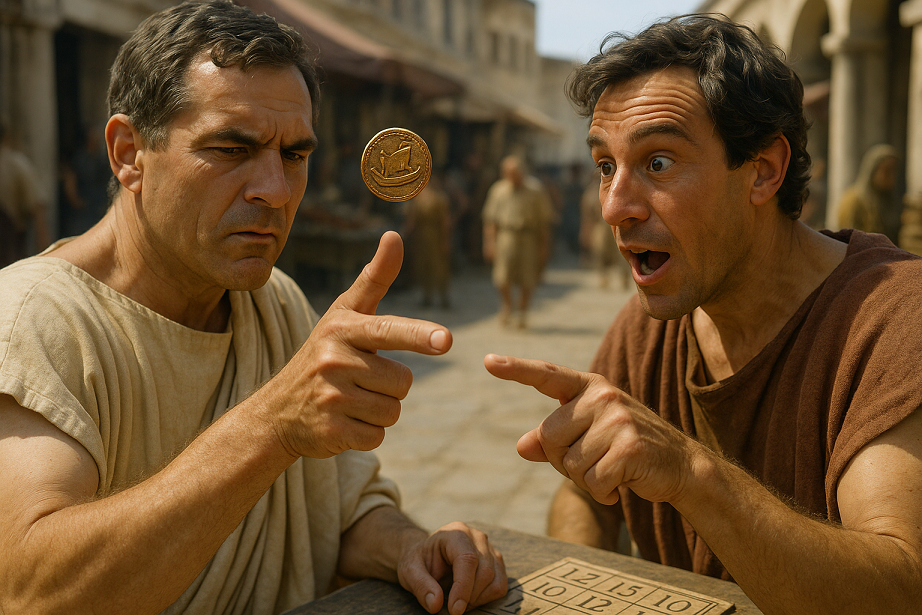

Baccarat is often seen as a game of sophistication and complexity, played in high-limit rooms with intricate rituals. Yet, at its very core, the game’s primary wager boils down to a simple, near 50/50 choice. This fundamental concept of a binary bet has an ancestor that is as simple as it gets: a Roman coin toss known as Navia aut Caput, or “Ship or Head.”
The Simplest Game of Chance: Ship or Head
In ancient Rome, just as today, a coin flip was the ultimate decider for simple disputes and wagers. The name “Ship or Head” derived directly from the imagery on their currency. Many Roman coins featured the head of a deity (like the two-faced god Janus) or an emperor on one side—the “Caput.” On the reverse, a common image was the prow of a ship, a symbol of Rome’s naval power—the “Navia.”
The game was exactly what it sounds like: one person would flip a coin, and the other would bet on which side would land facing up. It required no skill, no equipment beyond a single coin, and no complex rules. It was pure, unadulterated chance, played by everyone from soldiers and commoners to senators.

The Casino Connection: The Birth of the Binary Wager
The profound connection between Navia aut Caput and modern casino games is not in the gameplay itself, but in the betting structure. This simple coin toss is the earliest, purest form of the binary wager—a bet on one of two possible outcomes.
This is the absolute bedrock of many of the most popular bets on the casino floor:
- Baccarat: The primary bet in Baccarat is choosing between the Player hand and the Banker hand. Despite the complex card-drawing rules determined by the house, the player’s decision is fundamentally a “Ship or Head” choice. You are wagering on one of two sides to win.
- Roulette: The most famous outside bets in Roulette are Red vs. Black, Odd vs. Even, and High vs. Low. Each one is a classic binary wager, a direct descendant of the Navia aut Caput principle.
From a Simple Flip to a Casino Empire
Casino game designers throughout history understood the immense appeal of this simple 50/50 proposition. It’s easy to understand, provides a quick result, and creates immediate tension. They built entire games of perceived complexity and elegance around this simple, powerful core.
Baccarat adds the sophisticated ritual of dealing from a shoe and the suspense of the card reveal, but at its heart, the main bet remains a simple guess between two options. Roulette surrounds the wager with a spinning wheel and dozens of other betting possibilities. But the enduring popularity of these simple, binary bets proves that the thrill of a Roman coin flip has never lost its appeal.
So, the next time you place a chip on “Player” in Baccarat or “Red” in Roulette, remember that you are participating in a gambling tradition that is over 2,000 years old, born from the simple Roman wager of Navia aut Caput.
