
When War Became Sport
In the spring of 1130, on a muddy field outside the walls of Würzburg, two groups of mounted knights charged at each other with leveled lances. There was no invading army. No castle was under siege. No kingdom hung in the balance. This was a tournament — a formalized competition that transformed the chaos of medieval warfare into something new and extraordinary: organized sport.
The medieval tournament is one of the most misunderstood institutions in European history. Popular imagination, shaped by Hollywood and Renaissance fairs, pictures gleaming knights in polished armor tilting at each other before adoring crowds of ladies. The reality — especially in the tournament’s early centuries — was far more brutal, far more complex, and far more consequential for the development of Western sports culture.
From the blood-soaked melees of the 11th century to the choreographed jousts of the 15th, the tournament evolved from a military training exercise into an elaborate cultural spectacle that shaped chivalric identity, aristocratic politics, and the very concept of competitive sport as we understand it today.
Origins: Training for War
The Problem of the Mounted Knight
The tournament emerged from a practical military problem. By the 10th and 11th centuries, the mounted knight had become the dominant force on European battlefields. But training a knight was extraordinarily expensive and time-consuming. A warhorse alone cost as much as a substantial farm. Armor, weapons, and years of training added further costs. Once this enormous investment was made, how could a knight maintain his combat skills during peacetime?
Individual practice with quintains (rotating targets) and pell work (striking a wooden post) could only achieve so much. The skills that mattered most in battle — riding in formation, gauging an opponent’s movements, managing fear and adrenaline in the chaos of a charge — could only be developed through realistic combat against other trained fighters.
The tournament provided the answer.
The Earliest Tournaments
The first documented tournaments appear in northern France in the late 11th century. The earliest reliable reference dates to 1066 — the same year as the Battle of Hastings — when a chronicle mentions a gathering of knights for competitive combat near the town of Tours. By the early 12th century, tournaments were becoming regular events across northern France, Flanders, and the Rhineland.
These early tournaments bore almost no resemblance to the jousting spectacles of later centuries. They were melees — mass combats involving dozens or even hundreds of knights fighting across open countryside. The “arena” might span several square miles, encompassing fields, forests, and even villages. Teams were typically organized by region, and the fighting was conducted with real weapons — the same swords, lances, and maces used in actual warfare.
The Melee: Organized Chaos
How It Worked
A typical early melee began with two teams of knights assembling at opposite ends of a designated area. At a signal, they charged. What followed was a swirling, chaotic mass combat that could last for hours. Knights fought mounted and on foot, in groups and individually. The objective was to capture opponents — a captured knight was required to surrender his horse, armor, and weapons, or pay a ransom for their return.
This ransoming system was not incidental; it was the economic engine of the tournament. A skilled knight could earn a fortune through tournament victories. William Marshal, the most famous tournament champion of the 12th century, reportedly captured over 500 knights during his career, building immense wealth that would eventually make him one of the most powerful men in England.
The Violence
Early melees were shockingly violent by modern standards — and even by the standards of medieval observers. Deaths were not uncommon. In 1241, a tournament near Neuss in Germany reportedly resulted in the deaths of over 60 knights, many from heat exhaustion and crushing in their heavy armor rather than direct weapon strikes. Chronicles from the period regularly note fatalities, serious injuries, and the destruction of surrounding farmland and villages caught in the path of the combat.
“They come together with such force that pieces of their lances fly into the air, and the sound of the breaking can be heard from a great distance.” — Roger of Howden, 12th century chronicler
The Church repeatedly condemned tournaments, issuing papal bans in 1130, 1139, 1148, and 1179. Those killed in tournaments were initially denied Christian burial. Yet the bans had little practical effect — tournaments were too important to the aristocratic military class to be suppressed by clerical disapproval, and enforcement was sporadic at best.
William Marshal: The Greatest Knight
No figure better embodies the tournament culture of the 12th century than William Marshal (c. 1146-1219). Born the younger son of a minor English baron, Marshal built his career entirely through tournament success. His biography, written shortly after his death, provides the most detailed account we have of the tournament circuit in its early form.
Marshal traveled from tournament to tournament across northern France, sometimes fighting in events held every two weeks. He developed partnerships with other knights, sharing the spoils of captured opponents. His prowess was legendary — he was said to be virtually unbeatable in single combat and a devastating force in the melee.
Tournament success brought Marshal political connections, wealth, and eventually a marriage to the heiress of Pembroke. He served five English kings and was appointed regent of England in 1216, at the age of 70. His life trajectory — from landless younger son to ruler of a kingdom — was made possible entirely by the tournament system.
The Evolution of the Joust
From Melee to Individual Combat
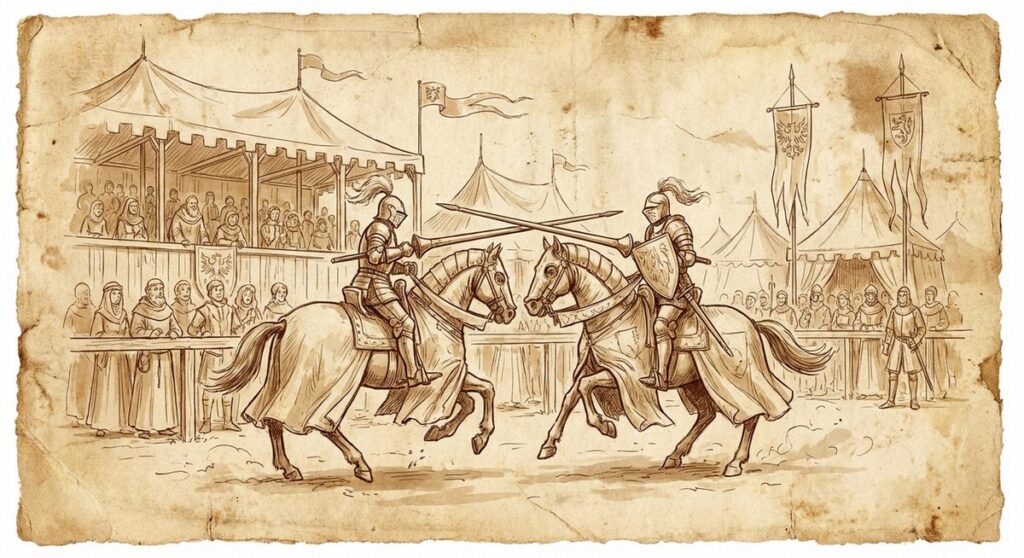
While the melee remained the centerpiece of tournaments well into the 14th century, a parallel form of competition gradually rose to prominence: the joust. In its simplest form, the joust was a one-on-one mounted combat between two knights, each armed with a lance. The objective was to unhorse the opponent or break one’s lance on his shield or body.
Jousting existed alongside the melee from early in the tournament’s history, but it was initially considered a minor preliminary event — a warm-up or side attraction before the main melee. Over the 13th and 14th centuries, however, the joust steadily grew in prestige as the melee declined.
Several factors drove this shift:
- Safety: Individual combat was easier to regulate and less likely to produce mass casualties
- Spectacle: A joust between two champions was more visually dramatic and easier for spectators to follow than a chaotic melee
- Royal control: Kings preferred jousts because they were easier to organize, control, and use for political purposes
- Chivalric ideology: The joust emphasized individual heroism, which aligned with the increasingly romanticized ideals of knighthood
The Tilt Barrier
The most important technical innovation in jousting history was the introduction of the tilt barrier (also called the list) in the early 15th century. This was a wooden fence running down the center of the jousting lane, separating the two riders so they passed each other on opposite sides. Before the tilt, jousters rode directly at each other in open ground, creating a high risk of head-on collision between horses — often with fatal consequences for both horse and rider.
The tilt barrier transformed jousting from a genuinely dangerous combat exercise into a more controlled competitive sport. Riders could focus entirely on their lance technique, and the risk of catastrophic collision was virtually eliminated. This innovation opened the door to jousting as entertainment and spectacle rather than pure martial training.
Scoring and Rules
As jousting became more formalized, elaborate scoring systems developed. Points were awarded for:
- Breaking a lance on the opponent’s shield or body: 1 point (the most common scoring method)
- Unhorsing the opponent: An immediate victory, the most decisive outcome
- Striking the helmet: Higher value than a body hit, reflecting greater skill
- Penalty points: Deducted for striking the horse, hitting below the waist, or other fouls
Jousts were typically conducted as a series of passes (individual charges), with the winner determined by accumulated points or by unhorsing. Tournament heralds kept careful records, and results were announced with elaborate ceremony.
The Tournament as Spectacle
Pageantry and Performance
By the 14th and 15th centuries, tournaments had evolved into elaborate cultural events that combined athletic competition with theater, fashion, and political display. The martial content was increasingly framed within themes drawn from romance literature — Arthurian legend, classical mythology, and allegorical narratives.
At the famous Eglinton Tournament and other late medieval events, knights adopted personas from literary works. They might enter the lists dressed as Lancelot, Tristan, or Alexander the Great, accompanied by retinues of squires and attendants in matching livery. The line between athletic competition and theatrical performance became increasingly blurred.
The Pas d’Armes
The pas d’armes (“passage of arms”) was a distinctive tournament format that flourished in the 15th century, particularly in Burgundy. In this format, one or more knights (the “holders”) would declare their intention to defend a specific location — a bridge, a crossroads, a castle gate — against all challengers for a set period, sometimes lasting weeks.
The pas d’armes was explicitly theatrical. Elaborate narrative frameworks were constructed: a damsel in distress, a magical artifact to be won, a quest to be completed. Challengers were presented with a choice of weapons (lance, sword, axe) indicated by touching colored shields hung at the entrance. The entire event was designed as an immersive experience combining combat, storytelling, and social display.
The Role of Women
Women occupied a complex and prominent position in tournament culture. As patrons and spectators, noblewomen were essential to the tournament’s social function. The tradition of a lady bestowing a favor (a scarf, a sleeve, or other personal item) upon a knight to carry into the lists was deeply embedded in chivalric culture and served as a visible symbol of social bonds.
Beyond spectatorship, women sometimes served as judges of tournament conduct. The Court of Love tradition, in which women adjudicated questions of chivalric behavior, intersected with tournament culture in events where a lady or group of ladies determined which knight had fought most nobly, most skillfully, or most courageously.
Parallel Competition Games
The Hastilude Family
Jousting and the melee were the most prestigious forms of tournament competition, but they were accompanied by a range of auxiliary martial games, collectively known as hastiludes:
- Quintain: Riding at a pivoting target; if the rider failed to strike squarely, the target’s counterweight swung around to knock him from the saddle
- Ring-tilting: Spearing small suspended rings at full gallop — a test of precision rather than power
- Sword combat on foot: Regulated fighting with blunted swords within an enclosed arena
- Axe combat: Similar to sword fighting but with pollaxes — particularly popular in Burgundian tournaments
These secondary events served as both training exercises and entertainment, filling the gaps between the main jousting sessions and providing opportunities for less wealthy or less experienced knights to participate.
Board Games and Intellectual Competition
Tournaments were not exclusively physical affairs. The broader culture of aristocratic competition encompassed intellectual games as well. Chess, Nine Men’s Morris, and tables (backgammon) were commonly played in the pavilions and halls surrounding the tournament grounds. The same competitive spirit and strategic thinking that drove knights onto the jousting field found expression in these quieter but no less intense contests.
The connection between physical and mental competition was explicitly recognized in medieval culture. A complete knight was expected to excel at both arms and games — the ideal of the “accomplished courtier” that would later be codified by Castiglione in The Book of the Courtier (1528) had deep roots in tournament culture.
Politics and Power
Tournaments as Diplomacy
Tournaments were never purely athletic events — they were political instruments of the first order. Kings and princes used tournaments to display wealth, forge alliances, assess the loyalty and capability of their vassals, and project power to rival courts.
The Field of the Cloth of Gold (1520), arguably the most famous tournament in history, exemplifies this political dimension. Organized as a diplomatic summit between Henry VIII of England and Francis I of France, the event featured several days of jousting, wrestling, and other competitions set within an astonishingly lavish temporary city of pavilions, fountains, and banquet halls. The entire spectacle was designed to demonstrate the magnificence — and therefore the legitimacy and power — of both monarchs.
Henry and Francis themselves jousted (against other opponents, not each other — the diplomatic risk was too great). The event’s astronomical cost — estimated at the equivalent of hundreds of millions in modern currency — was justified as an investment in international prestige.
Social Mobility and Exclusion
Tournaments both reinforced and destabilized social hierarchies. On one hand, participation was strictly limited to the knightly class — elaborate heraldic verification ensured that no one of insufficient rank could enter. On the other, success in tournaments could elevate a skilled but poor knight to wealth and prominence, as William Marshal’s career demonstrated.
By the 14th century, tournament participation had become increasingly restricted. German tournaments in particular developed elaborate rules of exclusion based on ancestry, requiring participants to prove multiple generations of noble lineage. This reflected broader anxieties about social mobility in a period when the rigid feudal hierarchy was beginning to crack under economic and demographic pressures.
The Tournament’s Legacy for Modern Sport
Concepts We Inherited
The medieval tournament contributed several foundational concepts to modern sports culture that we now take for granted:
- The bracket tournament: The format of elimination rounds, with winners advancing to face each other, derives from jousting tournament structures
- Weight/class divisions: While not formalized in tournaments, the practice of matching opponents of comparable skill and reputation anticipates modern weight classes and rankings
- Spectator sports: Tournaments were among the first events designed explicitly for audience enjoyment, with designated viewing areas, commentators (heralds), and dramatic narrative structures
- Heraldry and team identity: The system of identifying competitors through unique visual symbols (coats of arms) is the direct ancestor of modern team logos and uniforms
- Rules and referees: Tournament marshals who enforced rules and judged outcomes established the principle of impartial officiating
- Sportsmanship: The chivalric code governing tournament behavior — fighting fairly, showing mercy to a defeated opponent, competing with honor — is the foundation of modern sportsmanship ethics
The End of the Tournament
The tournament tradition declined through the 16th century, victim of changing military technology, evolving social structures, and tragic accidents. The most famous such accident occurred in 1559, when King Henry II of France was killed during a joust when a splinter from his opponent’s shattered lance pierced his visor and entered his brain. Henry’s death sent shockwaves through European courts and accelerated the already-evident decline of jousting as a royal pastime.
Gunpowder weapons had rendered the mounted knight militarily obsolete by this period, removing the original justification for tournament training. Aristocratic competition increasingly shifted to other forms — fencing, equestrianism, and eventually the codified team sports (cricket, football, rugby) that would emerge from English public schools in the 18th and 19th centuries.
Echoes in the Modern World
The medieval tournament may have ended five centuries ago, but its influence permeates modern sports in ways both obvious and subtle. The Olympic Games, revived in 1896, explicitly drew on both classical Greek and medieval chivalric traditions. The concept of a “champion” — an individual who fights on behalf of a cause or community — comes directly from tournament culture. Even the language of sports commentary, with its talk of “jousting” for position and “tilting” at targets, preserves the tournament’s linguistic legacy.
More profoundly, the tournament established the principle that regulated competitive violence could serve constructive social purposes — training warriors, resolving disputes, entertaining communities, and providing a stage for displays of individual excellence. This principle, refined and civilized over centuries, remains the philosophical foundation of competitive sport.
The knights who charged at each other on those muddy French fields in the 12th century could not have imagined the Super Bowl, the World Cup, or the Olympics. But in their tournaments, they planted the seeds from which these modern spectacles grew — transforming the brutal necessities of war into the organized, rule-bound, spectator-friendly competitions we recognize as sport. From the board games played between bouts to the strategic thinking that governed both combat and competition, the medieval tournament was the crucible in which modern sport was forged.
