
The Game Before the Sport
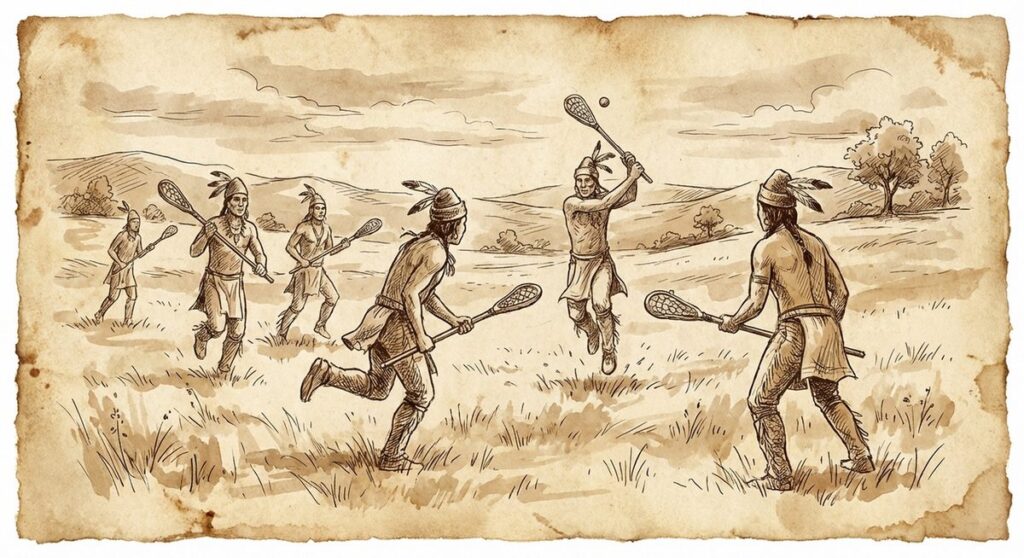
Long before lacrosse sticks were mass-produced from titanium alloys, before face-off specialists analyzed film in NCAA locker rooms, and before the sport was announced for the 2028 Los Angeles Olympics, a very different game was played on the fields and forests of North America. It had no standardized rules, no regulation field dimensions, and no time limits. Teams could number in the hundreds. Games could last for days. And it was never merely a sport.
The Haudenosaunee people — the Six Nations confederacy also known as the Iroquois — call it dehuntshigwa’es, meaning “men hit a rounded object.” Other nations had their own names: baaga’adowe among the Ojibwe, kapócha tóli among the Choctaw, tewaarathon in Mohawk. European colonists, observing the netted sticks that resembled a bishop’s ceremonial staff (la crosse in French), gave the game the name that stuck.
But every indigenous name for the game points toward its deeper purpose. This was the Creator’s Game — played not for trophies or spectators, but as a gift to the spirit world, a form of medicine, a tool for resolving conflict, and an expression of communal identity that predated European contact by centuries, perhaps millennia.
Origins in the Mist of Time
Archaeological and Oral Evidence
Pinpointing the exact origin of lacrosse is impossible, and that impossibility is itself meaningful. The game is so deeply woven into the oral traditions and ceremonial life of dozens of indigenous nations that it exists beyond the reach of Western historical methods. Oral histories among the Haudenosaunee place the game’s origins at the time of creation itself — it was given to the people by the Creator as a gift, a sacred activity meant to be played for the enjoyment of the spirit world.
Archaeological evidence, while fragmentary, supports great antiquity. Stone and ceramic effigies depicting figures holding stick-and-ball implements have been found at sites dating to approximately 1100 CE, though some scholars argue for earlier origins. The geographic distribution of lacrosse variants across nearly all of eastern North America — from the Great Lakes to the Gulf Coast, from the Atlantic seaboard to the Great Plains — suggests the game had already diversified into regional forms long before European contact in the 16th century.
Three Distinct Traditions
Anthropologists have identified three major regional variants of indigenous lacrosse, each with distinctive equipment and playing styles:
- Northeastern (Haudenosaunee/Iroquois): Played with a wooden stick topped by a closed pocket, the ball fully enclosed. Teams of 6–15 players on a defined field. This is the direct ancestor of modern lacrosse.
- Great Lakes (Ojibwe/Menominee/Ho-Chunk): Played with a stick featuring a small, round, closed cup barely larger than the ball. Games featured massive teams — sometimes 100+ per side — on fields stretching over a mile.
- Southeastern (Choctaw/Cherokee/Chickasaw): Uniquely, this variant used two sticks per player, each about two feet long with small cups, used to pinch and carry the ball. Known as “stickball,” it was played with extraordinary intensity and physical contact.
The Sacred Dimension
Medicine Game
Among the Haudenosaunee, lacrosse functions as a medicine ceremony. Games are played to heal the sick, to honor the dead, and to give thanks to the Creator. When a community member falls ill, a medicine game may be organized on their behalf — the energy and spirit of the competition is believed to carry healing power.
Before such games, elaborate ritual preparations take place. Players may fast, undergo sweat lodge ceremonies, and consult with medicine people. The sticks themselves are considered sacred objects, crafted from hickory by skilled artisans who understand both the physical and spiritual requirements of the tool. A player’s stick is a deeply personal possession, often decorated with symbolic carvings and never treated carelessly.
“The Creator gave us this game to play for his enjoyment, to settle disputes among ourselves, and to heal the sick. It is not ours to own — it is ours to play with gratitude.” — Oren Lyons, Onondaga Faithkeeper
Conflict Resolution
One of the most remarkable functions of indigenous lacrosse was its role as an alternative to warfare. When disputes arose between nations or communities — over territory, resources, or grievances — a lacrosse game could be organized to settle the matter. The outcome of the game carried the weight of resolution, and both parties were expected to honor it.
This was not merely symbolic. The games played for conflict resolution were intensely physical, with injuries common and occasionally fatal. Players understood they were channeling the aggression and competitive energy that might otherwise erupt into armed conflict. In this sense, lacrosse served a function remarkably similar to the Mesoamerican ball game — another indigenous American sport that carried profound ritual and political significance.
Cosmological Connections
In Haudenosaunee cosmology, lacrosse is played in the sky world as well as on earth. The Thunderers — powerful sky beings who bring rain and protect the people — are said to play lacrosse among the clouds, with thunder representing the crack of their sticks and lightning the flash of the ball. When humans play lacrosse, they mirror this celestial game, creating a link between the earthly and spiritual realms.
Other nations hold similar beliefs. Among the Cherokee, the game is connected to stories of animals and birds competing in a primordial lacrosse match — a myth that explains the characteristics of certain creatures and reinforces the game’s place in the natural order. The bat, according to this tradition, was rejected by both teams before proving its worth, earning its place in the animal kingdom through determination on the lacrosse field.
The Great Games of History
Massive Encounters
European observers from the 17th century onward left vivid accounts of indigenous lacrosse games that staggered their imagination. French Jesuit missionaries in the 1630s described games involving hundreds of players on fields stretching between villages miles apart. Games could last from sunrise to sunset over two or three consecutive days, with entire communities turning out to watch, wager, and celebrate.
The Choctaw stickball games of the southeastern United States were particularly renowned for their scale and intensity. Artist George Catlin, who witnessed and painted Choctaw games in the 1830s, described scenes of athletic brilliance and bruising physicality that he compared to the most intense sporting events he had ever witnessed. His paintings remain among the most important visual records of indigenous lacrosse.
The 1763 Game at Fort Michilimackinac
Perhaps the most famous lacrosse game in history was one that concealed a military operation. On June 2, 1763, during Pontiac’s War, a group of Ojibwe and Sauk warriors organized a lacrosse game outside the walls of British-held Fort Michilimackinac (in present-day Michigan). The British garrison, invited to watch, opened the fort’s gates and gathered outside to enjoy the spectacle.
During the game, the ball was deliberately thrown toward the fort’s open gate. As players rushed to retrieve it, they seized weapons hidden by women beneath blankets near the entrance. The warriors stormed the fort, killing or capturing most of the garrison. This episode, known as the Siege of Fort Michilimackinac, demonstrated both the cultural centrality of lacrosse (the British found nothing suspicious about a large-scale game) and the strategic sophistication of indigenous military planning.
Colonial Encounter and Transformation
European Fascination
From the earliest contact, European observers were fascinated by lacrosse. French missionaries, fur traders, and military officers all recorded their observations, though their understanding of the game’s sacred dimensions was typically shallow. Most saw it as a remarkably athletic but “savage” pastime — admiring the physical prowess while failing to comprehend the spiritual framework.
The first Europeans to actually play the game were likely French colonists in Canada during the 17th and 18th centuries, who participated in informal matches with indigenous players. But the systematic adoption of lacrosse by Euro-Canadians would wait until the 19th century.
William George Beers and the Codification of Lacrosse
The pivotal figure in lacrosse’s transformation from indigenous ceremony to codified Western sport was William George Beers, a Montreal dentist and passionate sportsman. In 1860, Beers published the first written rules for lacrosse, standardizing field dimensions, team sizes (twelve per side), equipment specifications, and scoring procedures.
Beers’ motivations were complex and not entirely admirable. He genuinely loved the game and recognized its extraordinary athletic demands. But he also saw lacrosse as a vehicle for Canadian national identity — a sport uniquely North American that could rival cricket and football as a marker of cultural distinctiveness. His 1869 book, Lacrosse: The National Game of Canada, explicitly framed the sport in nationalist terms.
Critically, Beers’ codification also served to exclude indigenous players. As lacrosse became organized into clubs and leagues during the 1860s and 1870s, rules were introduced — sometimes explicitly, sometimes through social pressure — that barred indigenous athletes from competition. The Kahnawake Mohawk, who had been among the finest players in the Montreal area, found themselves increasingly marginalized from the sport their ancestors had created.
The Paradox of Appropriation
The history of lacrosse’s codification represents one of the starkest examples of cultural appropriation in sports history. A sacred indigenous practice was systematically stripped of its spiritual meaning, repackaged as a secular competitive sport, used to build Canadian national identity, and then institutionally closed to the very people who had created it.
This paradox was not lost on indigenous communities. The Haudenosaunee in particular maintained their own lacrosse traditions throughout the colonial period, continuing to play medicine games and ceremonial matches according to their own customs even as the “official” sport evolved along Western lines.
The Haudenosaunee National Team
Reclaiming the Creator’s Game
One of the most powerful stories in modern sports is the emergence of the Haudenosaunee Nationals (also known as the Iroquois Nationals) as a competitive lacrosse team on the world stage. Founded in 1983, the team represents the Haudenosaunee Confederacy — not the United States or Canada — and competes under their own flag at international tournaments.
The team’s existence is a political and cultural statement of profound significance. By fielding a national team, the Haudenosaunee assert their sovereignty and their inalienable connection to the game. Players carry Haudenosaunee-issued passports rather than US or Canadian ones, a practice that has occasionally caused diplomatic complications at international tournaments.
The 2010 Manchester Controversy
The most public of these complications occurred before the 2010 World Lacrosse Championship in Manchester, England. The British government refused to recognize Haudenosaunee passports for entry, effectively barring the team from the tournament. Despite intervention from the US State Department, which offered to issue temporary US passports, the Haudenosaunee team declined on principle — accepting US passports would undermine their sovereignty claim.
The team did not compete in Manchester, but their stand resonated globally. The incident highlighted the intersection of sports, sovereignty, and indigenous rights in a way that no other athletic event had. World Lacrosse (the sport’s international governing body) subsequently worked to ensure that Haudenosaunee passports would be accepted at future events.
Competitive Achievement
The Haudenosaunee Nationals are not merely a symbolic team — they are among the best in the world. They have consistently finished in the top three at World Lacrosse Championships, often defeating teams from nations with populations hundreds of times larger. Their style of play, rooted in traditional techniques and a deep spiritual connection to the game, combines with modern training methods to produce a uniquely formidable approach.
Modern Lacrosse: Growth and Tensions
Explosive Growth
Lacrosse is currently the fastest-growing team sport in North America. Youth participation has surged, new professional leagues have launched (the Premier Lacrosse League founded in 2019 and the National Lacrosse League for box lacrosse), and the sport has expanded internationally to Europe, Asia, and Oceania. The announcement of lacrosse’s inclusion in the 2028 Olympics marks a historic milestone — the sport was previously included in the 1904 and 1908 Olympics but was then dropped for over a century.
The Question of Indigenous Inclusion
As lacrosse grows globally, the question of indigenous inclusion and recognition becomes increasingly pressing. The Haudenosaunee Nationals’ participation in the 2028 Olympics required extensive negotiation with the International Olympic Committee, which typically recognizes only nation-states. The eventual decision to allow their participation was celebrated as a landmark victory for indigenous sports sovereignty.
Beyond the elite level, indigenous communities across North America continue to use lacrosse as a tool for youth development, cultural preservation, and healing. Programs on reserves and reservations provide equipment, coaching, and — most importantly — cultural context, ensuring that young indigenous players understand the spiritual heritage of the game they play.
Box Lacrosse and the Mohawk Influence
A distinctive variant, box lacrosse, emerged in the 1930s as an indoor version played in hockey arenas. This faster, more physical game became particularly popular among Mohawk communities, especially at Kahnawake and Akwesasne near Montreal. Mohawk players have dominated box lacrosse for decades, and the National Lacrosse League’s rosters are filled with indigenous athletes whose skills trace directly to traditional playing styles.
Box lacrosse represents a fascinating case of indigenous reclamation through adaptation. Rather than simply preserving the old forms, Mohawk players and communities embraced the new variant and made it their own, demonstrating the same innovative spirit that had produced the game in the first place.
The Stickmakers: Sacred Craft
No discussion of lacrosse is complete without acknowledging the stickmakers — the artisans who craft traditional wooden lacrosse sticks. Among the Haudenosaunee, stickmaking is a revered skill passed through families and communities. The process begins with selecting the right hickory tree, which is then steamed, bent into the characteristic curved head, and strung with leather or woven netting.
Traditional sticks are not just equipment — they are living objects imbued with the spirit of the wood and the intention of the maker. Each stick has its own character, and players develop intimate relationships with their sticks over years of use. Master stickmakers like Alfie Jacques of Onondaga are recognized as cultural treasures, their work bridging the ancient and modern dimensions of the game.
Even as modern lacrosse has shifted almost entirely to synthetic sticks — lighter, more consistent, and more durable — traditional wooden sticks remain central to ceremonial play and are experiencing a renaissance among players who value their connection to the game’s origins.
A Living Heritage
Lacrosse stands as one of the most powerful examples of a living indigenous cultural tradition in the modern world. Unlike many ancient games that survive only in archaeological records or museum displays, lacrosse is simultaneously a sacred ceremony played according to centuries-old customs and a cutting-edge global sport headed for the Olympics.
This dual identity creates ongoing tensions — between tradition and innovation, between indigenous sovereignty and international sports governance, between the Creator’s Game and the commercial entertainment product. But these tensions are also a source of vitality. They ensure that lacrosse can never be fully separated from its indigenous roots, no matter how far the sport travels from the fields where it was first played.
As with the Mesoamerican ball game, lacrosse reminds us that sports are never just games. They are expressions of cosmology, instruments of diplomacy, vehicles for identity, and bridges between the human and the divine. The Creator’s Game endures — not as a relic of the past, but as a living testament to the ingenuity and spiritual depth of the First Nations who gave it to the world.
