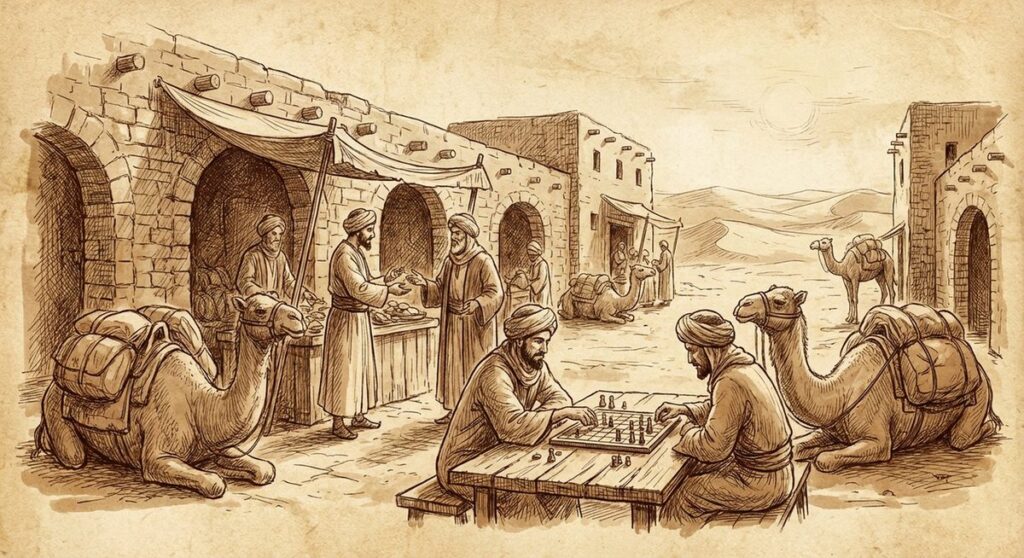

The Greatest Game Migration in History
When we think of the Silk Road, we imagine camel caravans laden with silk and spices, moving slowly across deserts and mountain passes connecting East and West. We think of merchants, monks, and diplomats traversing thousands of miles between Chang’an and Constantinople. But among the bolts of silk, the pouches of saffron, and the bundles of incense, something else traveled these ancient trade routes — something intangible yet remarkably durable: games.
The Silk Road was not a single road but a vast network of overland and maritime trade routes connecting China, Central Asia, the Indian subcontinent, Persia, Arabia, and the Mediterranean world. Active from roughly the 2nd century BCE to the 15th century CE, this network facilitated one of the greatest cultural exchanges in human history. And among the cultural artifacts that moved along these routes, games were uniquely mobile. A merchant who learned a new game at a caravanserai in Samarkand could carry it in his memory to Baghdad or Bukhara without adding a single ounce to his cargo.
This article traces the journeys of five game families along the Silk Road and its connected trade networks, revealing how play crossed linguistic, religious, and political boundaries to create the global gaming culture we know today.
Chess: From Indian Battlefields to Persian Courts to the World
The Indian Origins
The game we call chess began as Chaturanga, a Sanskrit word meaning “four divisions” — referring to the four branches of the Indian army: infantry, cavalry, elephants, and chariots. These became the pawn, knight, bishop, and rook of modern chess. Chaturanga emerged in the Gupta Empire (c. 280–550 CE), likely in northern India, and was played on an 8×8 grid called an ashtapada.
The earliest reliable literary reference to Chaturanga dates to approximately 600 CE, in the Sanskrit text Vasavadatta by Subandhu. But the game’s roots may extend further back — the ashtapada board itself appears in Indian sources several centuries earlier, suggesting it was used for other games before Chaturanga was invented.
The Persian Transformation
Chaturanga traveled westward to Sassanid Persia, where it became Shatranj — a name derived from the Sanskrit Chaturanga through a phonetic shift. The Persian adaptation introduced several important changes. The rules were codified more precisely. The pieces received new names: the Indian raja became the Persian shah (king), and the mantri (counselor) became the farzin (vizier). The exclamation “Shah Mat!” (“the king is helpless”) gave us the word “checkmate.”
The famous Persian text Chatrang-namak (“The Book of Chess”) tells how an Indian king sent Chaturanga to the Persian court as a challenge, and how the Persians not only mastered the game but invented backgammon (Nard) as a counter-challenge — a story that, whether historical or legendary, beautifully captures the competitive cultural exchange that drove game transmission along trade routes.
The Arab Expansion
When Arab forces conquered Persia in the 7th century CE, they embraced Shatranj with extraordinary enthusiasm. The Abbasid caliphs in Baghdad became passionate patrons of the game, hosting tournaments and sponsoring professional players called aliyat (grandmasters). The earliest known chess problems and systematic opening analysis were produced by Arab masters like al-Adli (c. 840 CE) and as-Suli (c. 920 CE).
From Baghdad, Shatranj spread in two directions simultaneously: westward across North Africa to Moorish Spain (arriving by the 10th century CE) and eastward back along the Silk Road to Central Asia and beyond. This westward expansion brought chess to Europe, where it would undergo its final major transformation in the late 15th century with the creation of the powerful queen piece.
Backgammon: The Great Race Game Moves West
Mesopotamian Ancestors
The race-game concept — two players moving pieces along a track determined by dice throws — is among the oldest game mechanics in the world. The Royal Game of Ur (c. 2600 BCE) and the Egyptian game of Senet (c. 3100 BCE) both used this basic structure. But the specific game we know as backgammon has its most direct roots in the Persian game Nard (also called Nardshir), which emerged in Sassanid Persia around the 3rd–6th century CE.
Along the Trade Routes
Nard spread in all directions along Silk Road networks. Moving westward, it became the Byzantine Tabula, then medieval European “Tables” — the generic name for backgammon-family games throughout the Middle Ages. The word “backgammon” itself first appeared in English in 1645, though the game had been played in England for centuries under other names.
Moving eastward, Nard reached China (where it was called shuanglu) during the Tang Dynasty (618–907 CE) and became popular at the imperial court. Chinese literary sources describe it as a fashionable import from the Western Regions — the Chinese term for Central Asia and beyond. From China, the game spread to Korea and Japan, where it was known as sugoroku and remained popular until it was largely displaced by Go and Shogi.
The geographical range of backgammon-family games — from Iceland to Japan, from Scandinavia to East Africa — traces the full extent of Silk Road trade networks and their secondary connections with remarkable precision. No other single game family maps the medieval Eurasian trade system so completely.
Playing Cards: Paper Money Becomes Paper Games
Chinese Invention
Playing cards were invented in Tang Dynasty China (9th century CE), and their origins are intertwined with two other Chinese inventions: paper and paper money. The earliest references describe “leaf games” (yezi xi) played at the Tang court, and some scholars believe the first playing cards were literally adapted from paper currency — or at least inspired by the concept of assigning different values to pieces of decorated paper.
Chinese playing cards bore little resemblance to modern Western cards. Early Chinese decks used suit systems based on denominations of paper money (coins, strings of coins, myriads of strings) and included illustrated “court” cards depicting characters from popular novels and legends.
The Westward Journey
Playing cards traveled westward from China through Central Asia, reaching the Mamluk Sultanate of Egypt by the 13th century. The Mamluk deck — the critical link between Chinese and European cards — used four suits: cups, coins, swords, and polo sticks. The court cards were king (malik), viceroy (na’ib malik), and second viceroy (thani na’ib). Because Islamic art discouraged the depiction of human figures, Mamluk court cards featured elaborate calligraphic designs rather than portraits.
From Egypt, cards entered Europe — most likely through Moorish Spain and Italian trading ports — around 1370. The earliest European references come from Spain (1371), Switzerland (1377), and Florence (1377). Within just a few decades, cards had spread across the entire continent, an astonishingly rapid diffusion for a pre-printing-press era.
The Mamluk suit system directly influenced the Italian suits (cups, coins, swords, clubs) and Spanish suits (cups, coins, swords, batons). The French later simplified these into the now-standard hearts, diamonds, clubs, and spades — designs optimized for mass production with woodblock printing and, later, movable type.
A Game-Changing Technology
The arrival of playing cards in Europe was arguably the most significant event in Western gaming history since the adoption of chess. Cards were cheap, portable, infinitely versatile, and socially democratic — playable by peasants and princes alike. They spawned hundreds of distinct games within a century of their arrival, from simple gambling games to the complex trick-taking games that would eventually produce bridge, the most intellectually demanding card game ever devised.
Go and Xiangqi: East Asian Strategy Games
Go’s Eastward Journey
Go (Weiqi), invented in China at least 2,500 years ago, followed Silk Road tributary routes into Korea and Japan, where it underwent profound cultural transformations. Go reached Korea (where it is called Baduk) around the 5th century CE and Japan (as Igo) by the 7th century CE, likely transmitted through Buddhist monks and diplomatic missions.
In Japan, Go became far more than a game. Under the Tokugawa shogunate (1603–1868), the government established four official Go academies (Go houses) with salaried professional players. The annual Oshirogo (“Castle Games”) were played before the shogun himself. This level of state patronage produced a tradition of professional Go play and systematic game theory unmatched anywhere in the world until the 20th century.
Xiangqi: Chinese Chess on the Road
Xiangqi (Chinese Chess) developed in China, likely influenced by both Indian Chaturanga and indigenous Chinese games. The game features a distinctive river dividing the board and uses flat disc-shaped pieces with Chinese characters rather than the three-dimensional carved figures of Western chess. Xiangqi spread along Silk Road networks to Vietnam (where it became Co Tuong) and to Chinese diaspora communities throughout Southeast Asia.
The relationship between Chaturanga, Shatranj, Xiangqi, and other chess variants remains a subject of scholarly debate. Did chess spread from India to China, from China to India, or did both traditions develop independently from a common ancestor? The Silk Road’s role as a two-way transmission network makes it plausible that influences flowed in both directions, with each culture adapting and transforming the game according to its own military traditions, aesthetic preferences, and philosophical frameworks.
Mancala: Africa’s Gift to the Silk Road World
The Oldest Counting Game
Mancala — the great family of “count-and-sow” games played across Africa, Asia, and the Caribbean — presents a fascinating counterpoint to the westward-flowing game traffic of the Silk Road. While chess and cards moved generally from East to West, mancala variants appear to have spread from Africa into the Middle East and South Asia, carried along the maritime trade routes of the Indian Ocean and the overland connections between East Africa and the Arabian Peninsula.
The oldest confirmed mancala boards, carved into stone in Eritrea and Ethiopia, date to around 1400 BCE. The game’s extraordinary diversity — with hundreds of distinct variants played across the continent — suggests a very long history of development within Africa. Names alone tell the story of its spread: Oware (West Africa), Bao (East Africa), Kalah (commercialized Western version), Pallanguzhi (South India), Congkak (Southeast Asia).
Maritime Connections
The Indian Ocean trade network — sometimes called the “Maritime Silk Road” — carried mancala to India, Sri Lanka, the Maldives, and Southeast Asia. Arab and Swahili merchants, who dominated Indian Ocean trade for centuries, were the primary vectors of transmission. The discovery of mancala boards at archaeological sites along the Arabian coast, at Silk Road caravanserais in Central Asia, and in South Indian temple complexes traces these maritime and overland connections with remarkable clarity.
In some regions, mancala acquired profound cultural significance beyond mere entertainment. In parts of East Africa, Bao is considered such a demanding intellectual pursuit that master players are accorded social status comparable to scholars. In the Philippines, mancala variants were associated with harvest rituals and agricultural magic — the “sowing” of seeds in the game’s pits echoing the sowing of crops in the fields.
The Mechanics of Game Transmission
How, exactly, did games travel along the Silk Road? Unlike silk, spices, or precious metals, games are not physical commodities that can be packed onto camels. The transmission of games required human interaction — people playing together, teaching each other, watching and imitating. This makes game transmission fundamentally different from commodity trade and more akin to the spread of languages, religions, and artistic styles.
Vectors of Transmission
- Merchants: Long-distance traders spent weeks or months at caravanserais and trading posts, where games helped pass the time and build social bonds across linguistic barriers.
- Soldiers: Military conquest repeatedly introduced games to conquered populations. The Arab conquest of Persia transmitted Shatranj; the Mongol Empire facilitated game exchange across the largest contiguous land empire in history.
- Diplomats and scholars: The formal exchange of games between courts was well documented. The Chatrang-namak‘s story of the Indian king sending Chaturanga to Persia reflects a real tradition of diplomatic game exchange.
- Religious figures: Buddhist monks carried Go from China to Japan. Islamic scholars helped codify and systematize Shatranj theory. Christian monks in medieval Europe preserved and transmitted game knowledge through manuscripts.
- Enslaved peoples: The forced displacement of populations through slavery transmitted games involuntarily. Mancala variants in the Caribbean were brought by enslaved Africans, preserving a cultural tradition across the Atlantic.
Adaptation and Transformation
Games never traveled unchanged. Each culture that adopted a new game adapted it to reflect local values, aesthetics, and social structures. Indian Chaturanga’s elephant became the Persian pil, the Arabic fil, the European “bishop” (in English) or “fool” (in French, fou). Mamluk polo sticks became European clubs. Chinese paper money cards became Italian tarot trumps.
These transformations were not random. They followed predictable patterns:
- Military pieces were reinterpreted to reflect local military traditions (elephants → bishops)
- Religious restrictions shaped aesthetics (Islamic prohibition on images → calligraphic Mamluk cards)
- Social structures influenced gameplay (the powerful European queen replacing the weak Persian vizier may reflect the influence of powerful medieval queens like Isabella of Castile)
- Materials changed to match local resources (ivory → wood → paper → plastic)
Legacy: The Connected World of Play
The Silk Road’s role in game transmission has left an indelible mark on the modern world. Today, chess is played on every continent. Backgammon variants are found from Reykjavik to Tokyo. Playing cards are universal. The connected world of play that we take for granted — in which a person in Buenos Aires can play the same game as a person in Beijing — is a direct legacy of the ancient trade routes that first connected distant civilizations.
The Silk Road merchants who taught each other games at dusty caravanserais five centuries ago could not have imagined that their casual pastime would help create a global culture of play. But that is exactly what they did — one game at a time, one journey at a time, one evening of shared entertainment at a time.
Understanding how games traveled the Silk Road also illuminates broader processes of cultural exchange. Games are leading indicators of cultural contact — they often appear in a new region before other cultural imports, because they require no shared language, no religious conversion, no political agreement. Two strangers who speak no common tongue can sit down and, with gestures and demonstration, teach each other a game within minutes. This makes games among the most powerful and universal tools of cross-cultural communication ever devised.
The next time you shuffle a deck of cards, set up a chess board, or roll a pair of dice, you are participating in a tradition that stretches back through the Silk Road, through the courts of Baghdad and the bazaars of Samarkand, through the temple complexes of India and the palace gardens of Tang Dynasty China — a tradition as old as trade itself, and as enduring as the human need to play.
