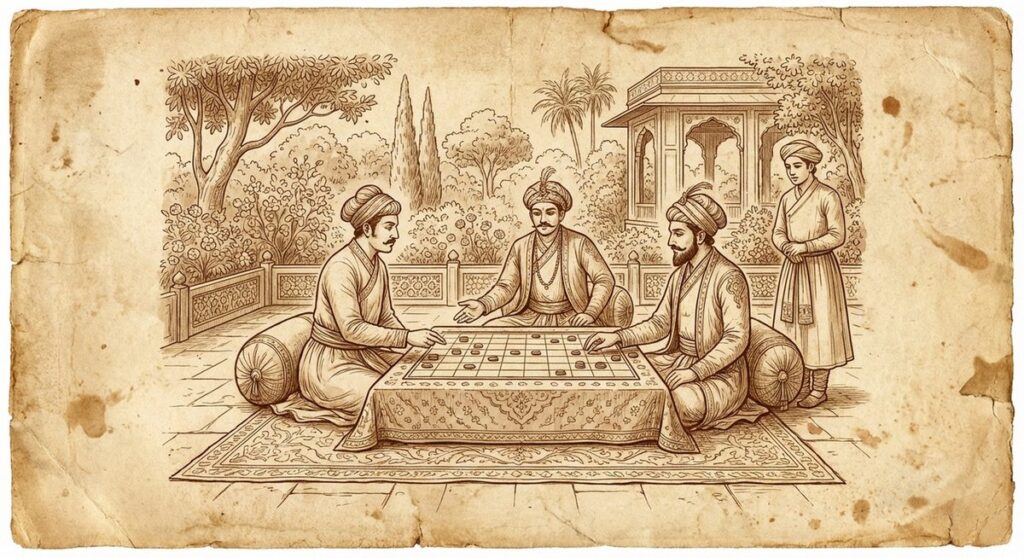

Play Pachisi right here — toss the cowries and race four pieces around the royal cross. The full story of the game follows below.
Toss the cowries to begin.
How to play (the rules we implemented)
Goal: race all 4 of your pieces out of the central Charkoni, counter-clockwise around the cross, and back home into the Charkoni — first to bring all four home wins.
The cowrie dice: toss 6 cowrie shells and count how many land mouth-up:
- 0 up = 25 · 1 up = 10 · 6 up = 6 — these three are graces: an extra toss, and you may bring a new piece out.
- 2–5 up = move that many.
The name Pachisi means "twenty-five" — the top throw. Your first piece may leave on any toss; after that, new pieces enter only on a grace.
Castles (✕ squares): a piece on a castle is safe and cannot be captured. Land on an opponent elsewhere to send it back to the Charkoni — and take an extra toss. A piece needs an exact throw to come home.
About these rules: rules for Pachisi genuinely vary (cowrie count, doubling, capture-before-home). We implemented an accessible, internally consistent ruleset on the Parcheesi-family circuit: 6 cowries, the 0=25 / 1=10 / 6=6 grace table, twelve castles, capture-to-the-Charkoni, exact finish. The earliest secure evidence for the game is the Mughal court of Akbar (16th c.) — the famous life-size Pachisi courtyard at Fatehpur Sikri — which we cover in the history below.
In the magnificent courtyard of Fatehpur Sikri, the red sandstone palace complex built by Mughal Emperor Akbar the Great in the 16th century, an extraordinary spectacle once unfolded. The emperor himself sat elevated on a central platform, directing beautifully dressed courtiers and slave girls across a giant cross-shaped board inlaid into the palace courtyard. These living game pieces moved at the emperor’s command, acting out a game that had been a royal obsession in India for centuries: Pachisi.
This image — of human beings serving as game pieces on a monumental board — captures something essential about Pachisi’s extraordinary cultural significance. This was not merely a pastime but a spectacle worthy of an emperor, a game so deeply woven into Indian civilization that it features in the nation’s oldest literary traditions and continues to echo through the world in forms that billions of people play today, often without knowing the ancient roots of their entertainment.
Pachisi’s story stretches from the mythological battlefields of the Mahabharata to the mass-produced board games of 20th-century America, from the sacred textiles of Indian craftspeople to the digital apps of the smartphone age. It is a story of empire, colonialism, cultural adaptation, and the remarkable human impulse to roll dice and race across a board.
Origins and Early History
The precise origins of Pachisi are lost to time, but the game’s roots reach deep into the Indian subcontinent’s history. The cross-shaped board — Pachisi’s most distinctive visual feature — appears in archaeological contexts dating back centuries before the earliest written descriptions of the game, suggesting a long period of development before the rules were codified in the form we recognize.
Mythological Connections
Indian tradition connects dice games to the most ancient layers of the culture. The Rig Veda, composed between 1500 and 1200 BCE, contains the famous “Gambler’s Lament” (Aksha Sukta), a hymn in which a compulsive dice player describes the misery that gambling has brought upon his family. While this refers to simpler dice games rather than Pachisi specifically, it establishes that dice-based gaming was a profound cultural force in Indian society from the earliest recorded period.
The Mahabharata, one of the two great Indian epics, contains the legendary dice game between the Pandava prince Yudhishthira and his cousin Duryodhana (with the villainous Shakuni rolling the dice). In this fateful contest, Yudhishthira gambles away his kingdom, his brothers, himself, and finally his wife Draupadi — setting in motion the catastrophic war that forms the epic’s climax. While the game described in the Mahabharata is not Pachisi per se, the cultural association between cross-and-circle board games and cosmic stakes runs as a continuous thread through Indian gaming history.
The Cloth Board Tradition
Traditional Pachisi boards were not rigid wooden or cardboard constructions but embroidered cloth, often beautifully decorated with intricate needlework. This textile tradition is significant for several reasons: cloth boards could be rolled up and easily transported, they reflected the sophisticated Indian textile arts, and their organic materials mean that early examples have rarely survived in the archaeological record. The few surviving antique cloth boards, preserved in museum collections, reveal extraordinary craftsmanship, with playing squares delineated in silk thread and decorative motifs drawn from Hindu iconography.
This tradition of cloth gaming boards connects Pachisi to other ancient games played on fabric or leather surfaces, including some variants found in the broader family of race games descended from ancestors like the Royal Game of Ur, which used comparable race-and-capture mechanics over four millennia ago.
Rules and Mechanics
Understanding Pachisi’s enduring appeal requires an appreciation of its elegant game mechanics, which balance luck and strategy in a uniquely satisfying way.
The Board
The Pachisi board is cross-shaped, consisting of four arms radiating from a central square called the charkoni. Each arm is divided into three columns of eight squares each, for a total of 96 playing squares plus the central starting area. Certain squares are marked as castle squares (safe spaces where pieces cannot be captured), typically indicated by a cross or special marking.
Equipment and Setup
Pachisi is played by two to four players, each controlling four pieces (traditionally shaped as cone-like wooden pawns in distinctive colors: yellow, green, red, and black). Instead of cubic dice, traditional Pachisi uses cowrie shells — six or seven shells thrown together, with the count determined by how many land with their opening facing up:
- 0 shells up = 25 (the highest throw, called “pachis” — from which the game takes its name, literally “twenty-five” in Hindi)
- 1 shell up = 10
- 2 shells up = 2
- 3 shells up = 3
- 4 shells up = 4
- 5 shells up = 5
- 6 shells up = 6 (and a bonus throw)
The use of cowrie shells rather than dice is a distinctive feature that connects Pachisi to ancient Indian gaming traditions and gives the throwing mechanism a different probability distribution than standard dice.
Movement and Capture
Players move their pieces from the center outward along the middle column of their arm, around the perimeter of the board in a counterclockwise direction, and back up the left column of their arm to the center. The first player to return all four pieces to the charkoni wins.
The strategic depth of Pachisi comes from several interacting mechanics:
- Captures — landing on an opponent’s piece sends it back to the center, forcing them to restart that piece’s journey
- Blockades — two pieces of the same color on a single square form an impassable barrier
- Castle squares — safe spaces where pieces cannot be captured, allowing strategic positioning
- Bonus throws — capturing an opponent’s piece or rolling a pachis (25) earns an additional throw
- Team play — in four-player games, players sitting opposite each other form teams, creating opportunities for cooperative strategy
“Pachisi is that rarest of games: one where luck creates the circumstances and skill determines the outcome. A novice may win occasionally through fortunate throws, but over time, the player who best manages risk, timing, and positional strategy will dominate.”
Pachisi at the Mughal Court
The Mughal period (1526–1857) represents the golden age of Pachisi’s cultural prestige. The Mughal emperors — themselves descended from Central Asian conquerors who had adopted many aspects of Indian culture — elevated Pachisi to the status of a royal ceremony.
Akbar’s Living Game
The most famous Pachisi installation is the giant board at Fatehpur Sikri, Akbar’s capital city near Agra. This outdoor court, still visible to tourists today, features a cross-shaped pattern of red and white sandstone squares where the emperor played with human pieces. The 16th-century chronicler Abu’l-Fazl ibn Mubarak, author of the Ain-i-Akbari (a detailed administrative document of Akbar’s reign), describes how the emperor maintained dedicated Pachisi courts at several of his palaces and how the game was played with great ceremony and substantial wagers.
Abu’l-Fazl records that Akbar played Pachisi “with living persons as pieces, on great painted boards in the palace courts.” The emperor’s passion for the game was not merely recreational — it reflected the Mughal court’s broader engagement with Indian cultural traditions and Akbar’s well-documented policy of religious and cultural synthesis.
Symbolism and Status
At the Mughal court, Pachisi served multiple social functions beyond entertainment:
- Diplomatic tool — games between rulers and ambassadors provided informal settings for negotiation
- Patronage display — the quality of the game set and the stakes wagered demonstrated the host’s wealth and generosity
- Social hierarchy reinforcement — who was invited to play with the emperor was itself a mark of favor
- Justice and judgment — some accounts suggest that Akbar occasionally used Pachisi outcomes as a form of divine judgment in disputes
Regional Variations Across India
While “Pachisi” is the most widely known name, the game exists in numerous regional variations across the Indian subcontinent, each reflecting local cultural preferences and gaming traditions.
Chaupar (Chausar)
Chaupar is an older, more complex variant that may actually predate Pachisi. Played with three elongated dice (rather than cowrie shells) and featuring different movement rules, Chaupar was considered the more aristocratic and strategically demanding version. It is Chaupar, rather than Pachisi, that is most commonly identified as the game played in the Mahabharata dice episode. The distinction between Chaupar and Pachisi is roughly analogous to the difference between chess and checkers — related games of different complexity levels sharing a common conceptual ancestry.
Other Regional Variants
- Pagade — played in Karnataka with subtle rule modifications
- Dayakattam — a Tamil Nadu variant with different board dimensions
- Thayam — another South Indian variant played during festivals
- Sokkattan — played in parts of South India with cowrie shells
These regional variants demonstrate how the fundamental Pachisi concept — a cross-shaped race game with capture mechanics — proved adaptable enough to accommodate diverse local preferences while maintaining its essential character. This mirrors the pattern we see in other ancient games, where a core concept proliferates into a family of related variants across regions, much like the ancient strategy game traditions that spawned dozens of regional descendants.
The Western Journey: Parcheesi, Ludo, and Beyond
The story of how Pachisi crossed the oceans and was transformed into some of the world’s most popular commercial board games is inseparable from the history of British colonialism in India.
The British Encounter
British colonial officials, merchants, and soldiers encountered Pachisi during the 18th and 19th centuries and were captivated by its combination of simplicity and strategic depth. They brought the game back to England, where it underwent significant modifications to suit European tastes and commercial requirements.
The most consequential change was the replacement of cowrie shells with cubic dice, which simplified the randomization mechanism and made the game more familiar to Western players accustomed to dice-based games. The cloth board was replaced with a rigid cardboard or wooden board, and the rules were simplified to reduce game length and strategic complexity.
Parcheesi: The American Transformation
In 1860, an American adaptation of Pachisi was copyrighted under the name Parcheesi (a phonetic spelling of “pachisi”). The game was eventually acquired by Selchow & Righter, who marketed it aggressively as “The Royal Game of India” — trading on the exotic appeal of its origins while thoroughly domesticating its mechanics.
Parcheesi simplified several aspects of the original game: the use of two standard dice rather than cowrie shells, fixed safe spaces, and streamlined capture and re-entry rules. These modifications made the game more accessible to casual players but reduced the strategic depth that characterized the Indian original. Despite these simplifications, Parcheesi became one of the best-selling board games in American history, a family staple that has sold hundreds of millions of copies worldwide.
Ludo: The British Simplification
In 1896, an English patent was granted for Ludo — an even more simplified version of Pachisi designed specifically for children. Ludo used a single die instead of two, had a smaller board, and eliminated most of the strategic elements (blockades, team play) that gave Pachisi its depth. What remained was essentially a pure race game with minimal decision-making, ideal for young children but lacking the strategic sophistication of the original.
Despite — or perhaps because of — its simplicity, Ludo became enormously popular throughout the British Empire and its former colonies. Today, Ludo is one of the most widely played board games in the world, with particular popularity in South Asia (where it has, ironically, displaced traditional Pachisi in many households), Africa, the Caribbean, and parts of Latin America. During the COVID-19 pandemic, the digital version Ludo King became one of the most downloaded mobile games globally, with over 500 million downloads.
Sorry! and Other Descendants
The Pachisi family tree extends further than many players realize. Sorry!, the popular Parker Brothers game first published in the United States in 1934, is essentially a Pachisi variant that replaces dice with cards, adding a different randomization mechanism while retaining the fundamental race-and-capture structure. Trouble (with its iconic Pop-O-Matic bubble die) is another simplified descendant, as is the German game Mensch argere Dich nicht (“Man, Don’t Get Angry”), which has been Germany’s most popular board game for over a century.
Cross-and-Circle Games: A Global Family
Pachisi belongs to a broader category that game historians call “cross-and-circle games” — board games played on a cross-shaped or circular track with race-and-capture mechanics. This family extends far beyond India:
- Patolli — an Aztec cross-shaped race game with remarkable similarities to Pachisi, played with beans as dice and with religious significance
- Nyout (Yut Nori) — a Korean cross-shaped race game using throwing sticks, still widely played during the Lunar New Year
- Edris A Jin — a Middle Eastern variant played across the Arab world
- Ludo variants — dozens of regional adaptations across Africa, each with local names and rule modifications
The independent development of cross-and-circle games in the Americas (Patolli) and Korea (Nyout) raises fascinating questions about convergent evolution in game design. Did these games develop independently from a common human impulse to simulate races on cruciform boards? Or do they reflect ancient cultural connections — perhaps along Silk Road or trans-Pacific trade routes — that have been lost to history? These questions mirror similar debates about the origins of ancient games across cultures, as explored in our coverage of the Royal Game of Ur.
Cultural Significance and Artistic Representations
Pachisi’s cultural footprint extends far beyond the game board. In Indian art, literature, and religious iconography, the game serves as a metaphor for cosmic play — the gods themselves are depicted as Pachisi players, with human souls as the pieces moved across the board of existence.
In Hindu Mythology
The god Shiva is depicted playing Pachisi with his consort Parvati in numerous temple carvings and miniature paintings. In these representations, the game symbolizes the divine play (lila) through which the gods create and sustain the universe. The throws of the cowrie shells represent fate, while the players’ strategic choices represent free will — a philosophical framework that resonates with Hindu theology’s exploration of destiny and agency.
In Mughal Miniature Painting
The Mughal school of miniature painting produced exquisite depictions of Pachisi games at court. These paintings provide invaluable historical evidence about how the game was played, what the boards and pieces looked like, and what social contexts surrounded gameplay. The level of detail in these miniatures — showing the precise arrangement of cowrie shells, the expressions of the players, the courtiers watching — makes them primary sources of remarkable richness.
In Modern Popular Culture
Pachisi and its descendants continue to resonate in contemporary culture. The game features in Bollywood films, in Indian television dramas that depict historical settings, and in contemporary art that engages with India’s cultural heritage. The Mahabharata dice game scene remains one of the most frequently depicted episodes in Indian art, appearing in everything from classical dance performances to graphic novels.
Pachisi Today: Revival and Recognition
In recent years, there has been growing interest in reviving traditional Pachisi as distinct from its simplified commercial derivatives. Cultural organizations in India have organized Pachisi tournaments using traditional cloth boards and cowrie shells, and artisans continue to produce handcrafted boards following centuries-old techniques.
Game historians and enthusiasts in the West have also rediscovered the original Pachisi rules and recognized the strategic depth that was lost in the transition to Parcheesi and Ludo. Online communities dedicated to traditional board games have published detailed rule guides and strategy analyses, introducing a new generation to the game’s full complexity.
“When you strip away the commercial simplifications and return to the original Pachisi — with its cowrie shells, its blockades, its team play, and its rich strategic vocabulary — you discover a game of remarkable depth and elegance. It is one of India’s great gifts to world culture, deserving of the same scholarly attention we give to chess.”
— Irving Finkel, British Museum curator and game historian
The story of Pachisi is ultimately a story about how games travel, adapt, and transform across cultures. From the courtyard of Fatehpur Sikri to the smartphone screens of the 21st century, from the sacred mythology of Shiva and Parvati to the family game nights of suburban America, Pachisi has demonstrated an extraordinary capacity for reinvention while preserving the fundamental joy that has made cross-and-circle race games a human universal for thousands of years.
For readers interested in exploring other ancient games that have undergone similar journeys of transformation and cultural adaptation, we recommend our articles on the Royal Game of Ur and the art of ancient strategy.
Pachisi — Frequently Asked Questions
What is Pachisi?
Pachisi is a cross-and-circle race game from ancient India, traditionally played on a cloth board shaped like a plus sign. Two to four players race their pieces from the centre, around the arms, and back to the centre — with cowrie shells acting as dice. The game is the direct ancestor of modern Ludo and Parcheesi.
How old is Pachisi?
Pachisi is documented in India from at least the 6th century CE, with depictions in the Ajanta Caves. Some scholars argue the game’s roots extend much earlier, into the Mauryan or even Vedic periods. The Mughal emperor Akbar (16th century) reportedly played life-sized Pachisi in his palace courtyard at Fatehpur Sikri, using slave girls as living game pieces.
How do you play Pachisi?
Each player has four pieces. Cowrie shells (typically six or seven) are thrown — the number that land mouth-up determines the move count. Players race their pieces around the cross-shaped track, sending opponents back to the start by landing on the same square. The first player to bring all four pieces home wins.
What’s the difference between Pachisi and Ludo?
Ludo is a 19th-century British adaptation of Pachisi, simplified for European players. Ludo uses six-sided dice instead of cowrie shells, has a fixed board (not a cloth cross), and standardised piece counts. The race-around-the-cross core is identical.
What’s the connection to Parcheesi?
Parcheesi is the trademarked American version of Pachisi, brought to the US in the 1860s by an enterprising importer. The name itself is an Anglicisation of the Hindi word pacīs (twenty-five), the highest possible roll in classical Pachisi.
Frequently asked questions
How do you play Pachisi?
Each player has four pieces that start in the central Charkoni. Toss six cowrie shells, move a piece by the number that land mouth-up, and race all four counter-clockwise around the cross and back home. Land on an opponent off the castle squares to send it back to the start.
What does Pachisi mean?
Pachisi is Hindi for “twenty-five” — the value of the best cowrie throw, when all six shells land mouth-down.
Is Pachisi the same as Ludo?
Ludo is a simplified descendant of Pachisi, patented in Britain in the late 19th century with cubic dice instead of cowrie shells. Parcheesi is the American version. Pachisi is the older Indian original.
How old is Pachisi?
Claims of great antiquity are contested. The earliest secure evidence is the 16th-century Mughal court of Akbar, including the famous life-size board at Fatehpur Sikri where living people served as the pieces.
What are cowrie shells?
Small sea-shells used as binary dice: each lands either mouth-up or mouth-down, and you count the mouths-up for your move. They gave the game both its randomiser and its name.
