
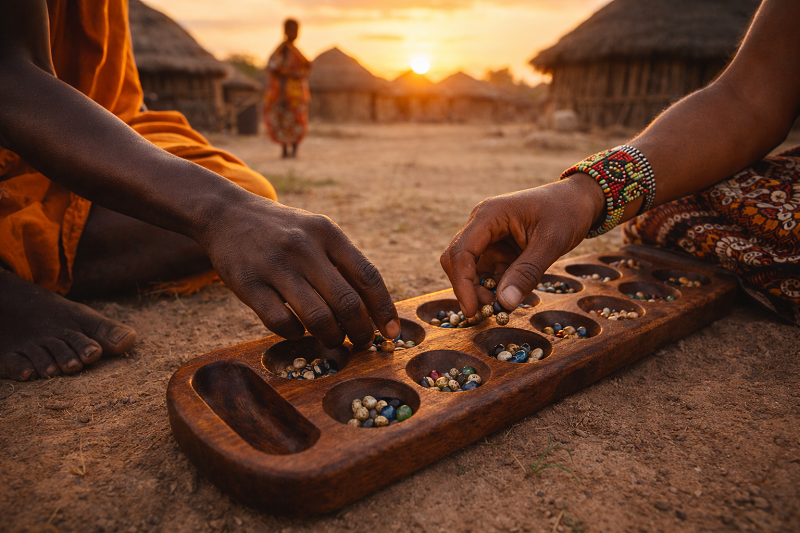
In the sun-drenched villages of Africa, beneath the shade of ancient baobabs and along the dusty streets of bustling markets, a game has been played for countless generations—a game so old that its true origins are lost in the mists of prehistory. Mancala, the elegant dance of seeds and strategy, stands as one of humanity’s most enduring intellectual pursuits. Unlike games tied to a single ruleset or board design, Mancala represents an entire family of “sowing” or “count-and-capture” games that have flourished across Africa, the Middle East, Asia, and beyond. Archaeological evidence suggests that variations of Mancala may have been played as far back as the 6th or 7th century CE, with some scholars proposing even more ancient roots stretching into the classical era. The game’s beauty lies in its elegant simplicity: a board with pits or holes, a collection of seeds or stones, and the fundamental human drive to outthink an opponent. Yet beneath this apparent simplicity lies mathematical complexity, strategic depth, and cultural richness that has captivated players for over a millennium. This article explores the history of Mancala, tracing its possible origins, examining its many regional variants, and celebrating its status as one of the world’s oldest continuous gaming traditions.
The Mystery of Mancala’s Origins
Pinpointing the exact birthplace and date of Mancala’s invention is one of the great challenges in game history. Unlike chess or Go, which have relatively clear historical documentation, Mancala’s origins are shrouded in uncertainty, debated by historians, archaeologists, and cultural anthropologists. The very name “Mancala” itself is a modern construct, derived from the Arabic word “naqala” (نقلة), meaning “to move” or “to transfer”—a fitting description of the game’s core mechanic of moving seeds from pit to pit.
The most compelling archaeological evidence points to ancient East Africa as a probable cradle of Mancala games. Carved stone boards resembling Mancala layouts have been discovered at sites in Ethiopia and Eritrea, with some researchers dating certain examples to the Aksumite Empire (circa 100–940 CE). The ancient city of Aksum, a major trading hub connecting Africa with the Mediterranean, Arabia, and India, would have been an ideal environment for a game to develop and spread along commercial routes. Rock carvings found in Ethiopian highlands show distinctive rows of cup-shaped depressions that match Mancala board patterns, suggesting the game was played in that region for many centuries.
However, other scholars point to evidence of similar sowing games in ancient Egypt. Some have interpreted certain carved depressions in Egyptian temples and monuments as potential game boards, though this remains controversial. If these interpretations are correct, Mancala-type games might have existed as early as the New Kingdom (1550–1070 BCE) or even earlier. The game could have coexisted alongside Senet and Mehen as part of Egypt’s rich gaming culture, though it left far less explicit evidence in tombs and artwork.
What is certain is that by the medieval period, Mancala games were widespread across sub-Saharan Africa, North Africa, and the Middle East. Arab traders, who maintained extensive commercial networks across the African continent and into Asia, likely played a crucial role in disseminating various Mancala variants. The game’s minimal equipment requirements—it could be played with stones and holes dug in the ground—made it perfectly suited for traveling merchants, soldiers, and nomadic peoples. This portability and accessibility ensured that Mancala would become truly ubiquitous, evolving into hundreds of distinct regional variants.
Understanding the Mancala Family: Core Mechanics
To speak of “Mancala” as a single game is somewhat misleading; it is more accurate to describe it as a family of related games sharing common principles. Despite the numerous variants—over 800 distinct names and rule sets have been documented across Africa alone—nearly all Mancala games share fundamental characteristics that define the family.
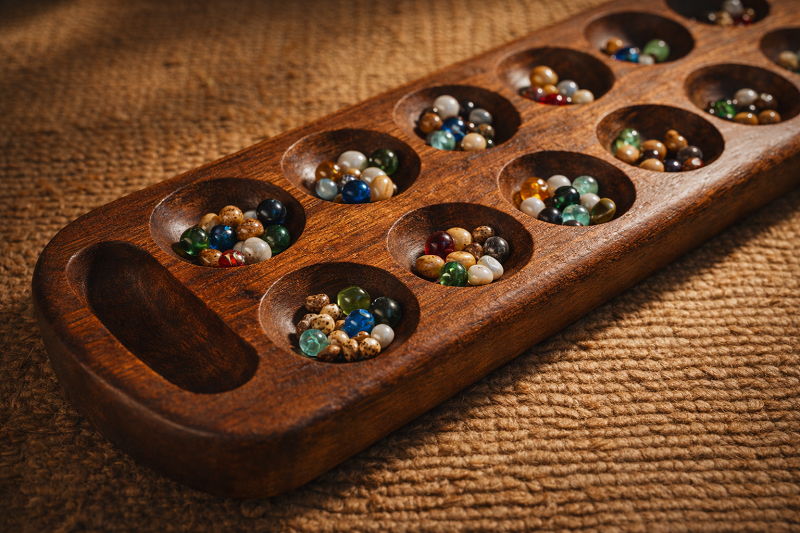
The Board: A typical Mancala board consists of two, three, or four rows of pits, holes, or cups. The most common configuration features two rows, with each row belonging to one player. Boards can be elaborately carved from wood, stone, or ivory, or they can be as simple as depressions dug into the earth or carved into rock surfaces. The number of pits per row varies by regional variant—six is common (as in Oware/Wari), but some games use more (Bao uses eight pits per row plus additional “store” pits).
The Seeds: Playing pieces are called “seeds,” though they can be actual seeds, pebbles, shells, beads, or any small objects. A game typically begins with a set number of seeds distributed evenly across all pits. The tactile pleasure of handling smooth seeds or stones is part of Mancala’s enduring appeal—the game engages not just the mind but also the senses.
The Sowing Mechanic: This is the defining feature of all Mancala games. On a player’s turn, they select one of their pits and pick up all the seeds it contains. They then “sow” these seeds, dropping one seed into each consecutive pit moving in a specific direction (usually counterclockwise). This mechanic, simple to learn but rich in strategic implications, creates the distinctive rhythm of Mancala gameplay—the sound of seeds clicking into pits, the visual tracking of their distribution, the mental calculation of future board states.
Capture and Victory: The rules for capturing opponent’s seeds vary significantly between variants, but the underlying principle is consistent: players attempt to position their final seed of a sowing move in such a way that it triggers a capture. In Oware/Wari, landing in an opponent’s pit that results in exactly two or three seeds allows the player to capture those seeds. Other variants have different capture conditions. The game typically ends when one player cannot make a legal move, or when certain board conditions are met. The player who has captured the most seeds wins.
Regional Variants: A World of Diversity
The true richness of Mancala lies in its remarkable diversity. As the game spread across continents, each culture adapted it, creating variants that reflect local aesthetics, mathematical traditions, and strategic preferences. Here are some of the most significant regional versions:
Oware/Wari (West Africa): Perhaps the most internationally recognized Mancala variant, Oware (also spelled Awari, Wari, or Ayò) is played throughout West Africa, particularly in Ghana, Nigeria, and neighboring countries. The standard board has two rows of six pits each, with four seeds per pit at the start. Oware is renowned for its strategic complexity—expert players must think several moves ahead, calculating not just immediate captures but long-term positional advantages. The game has a well-developed theory, with opening strategies, mid-game tactics, and endgame techniques analyzed by masters. In some West African communities, Oware is more than recreation; it is a mental discipline, taught to children as a way to develop mathematical thinking and strategic planning.
Bao (East Africa): Considered by many to be the most complex member of the Mancala family, Bao is played primarily in Tanzania, Kenya, and surrounding regions. The board has four rows and eight columns, creating a 32-pit playing surface. Bao incorporates multiple phases of play, special rules for certain board positions, and capture mechanisms of considerable sophistication. Mastering Bao can take years; it is regarded in East Africa much as chess is regarded in the West—as the ultimate test of strategic thinking. Tournaments attract skilled players, and Bao masters are celebrated figures in their communities.
Kalah (North America): Ironically, one of the most commercially successful Mancala variants in the Western world is Kalah, which was actually invented in the United States in 1940 by William Julius Champion Jr. Kalah simplified and standardized Mancala rules for an American audience unfamiliar with African traditions. While purists sometimes dismiss it as a “dumbed down” version, Kalah played a crucial role in introducing Mancala concepts to millions of Western players, many of whom then sought out more traditional variants.
Toguz Kumalak (Central Asia): Demonstrating Mancala’s spread beyond Africa, Toguz Kumalak is the national board game of Kazakhstan and Kyrgyzstan. The game features unique mechanics including “tuzduk”—a rule allowing players to claim opponent’s pits under certain conditions. This Central Asian variant shows how Mancala principles adapted to nomadic steppe cultures, traveling along the Silk Road trade routes.
Congkak (Southeast Asia): In Malaysia, Indonesia, and the Philippines, Mancala games are known collectively as Congkak or Sungka. These variants often feature beautifully carved boat-shaped wooden boards and use shells or stones as playing pieces. Congkak has been played in the region for centuries, likely introduced by Arab or Indian traders, and has become deeply integrated into local culture, particularly as a game associated with women and family gatherings.
The Mathematics and Strategy of Mancala
Beneath Mancala’s accessible exterior lies surprising mathematical depth. The game is fundamentally about arithmetic and counting—players must constantly calculate how many seeds are in each pit, how far a sowing move will extend, where the final seed will land, and what captures or advantageous positions might result. This requirement for continuous mental calculation made Mancala not just a game but an educational tool.
In many African societies, children learned basic arithmetic through Mancala. The game teaches counting, addition, visualization of sequences, and pattern recognition. More advanced players develop skills in combinatorial thinking and probability assessment. Because the game state is completely visible (no hidden information) and has no element of chance (no dice or cards), Mancala is a perfect information game like chess or Go. This means that, theoretically, optimal play can be calculated, though the complexity of variants like Oware and especially Bao makes complete computational analysis extremely difficult.
Strategic depth varies by variant, but generally includes several key concepts. Tempo control—managing the rhythm of play to ensure you maintain the initiative—is crucial. Pit loading—deliberately accumulating seeds in key pits to enable large captures—is a fundamental tactic. Board control—dominating regions of the board to limit opponent’s options—mirrors territorial control in games like Go. Expert players think in terms of “threats” and “defenses,” much like chess players, creating situations where the opponent faces multiple bad options and must choose the least damaging response.
Computer analysis of simpler Mancala variants has revealed that, like checkers, some versions are theoretically solvable. Kalah was weakly solved in 2000, showing that perfect play leads to a win for the starting player in the standard six-pit version. However, more complex variants like Oware and Bao remain beyond complete computational solution, maintaining their mystery and ensuring that human intuition and creativity still have a crucial role in top-level play.
Cultural Significance and Social Context
Mancala is far more than a game in the cultures where it flourished; it is a social institution, a teaching tool, a form of artistic expression, and a symbol of cultural identity. In many African communities, Mancala games are played in village centers, under trees where elders gather, and in marketplaces where traders take breaks from commerce. The games serve multiple social functions simultaneously—entertainment, certainly, but also social bonding, dispute resolution, courtship ritual, and demonstration of intellectual prowess.
In some West African societies, mastery of Oware or similar games was (and in some places still is) considered a mark of intelligence and maturity. Young people seeking to prove their readiness for adult responsibilities might demonstrate their skills at the board. Elders use the game to teach lessons about patience, planning, and consequences—the seeds you sow will determine what you reap, a lesson applicable far beyond the game board.
The game also carries gender associations that vary by region. In some areas, Mancala is primarily a men’s game, played in public spaces and associated with demonstrations of strategic thinking. In other regions, particularly in Southeast Asia, it is more commonly associated with women and domestic spaces. These gender associations are cultural constructs rather than inherent to the game, and contemporary players of all genders enjoy Mancala worldwide.
The boards themselves often function as art objects. Elaborately carved wooden Mancala boards from West Africa, featuring intricate decorative motifs, animal figures, and geometric patterns, are prized by museums and collectors. These boards represent hours of skilled craftsmanship and serve as status symbols—a beautifully carved board indicated wealth and taste. Some boards were family heirlooms, passed down through generations, accumulating history and stories with each game played upon their surface. This transformation of a game board into an art object parallels the treatment of other game pieces in various cultures, from the ivory Royal Game of Ur boards to ornate medieval chess sets.
Mancala’s Journey to the Global Stage
For centuries, Mancala remained primarily an African and Middle Eastern phenomenon, with offshoots in Central and Southeast Asia but little presence in Europe or the Americas. This changed dramatically in the 20th century as anthropologists, missionaries, and travelers returned from Africa with accounts of the game. The publication of scholarly works on African games in the early-to-mid 20th century introduced Mancala to Western academic audiences.
The real breakthrough came in the 1960s and 1970s when educational movements in North America and Europe began seeking culturally diverse materials for schools. Mancala, with its clear educational benefits and non-Western origins, became a favorite in progressive classrooms. Commercial game companies began producing standardized sets, and by the 1980s, Mancala boards were available in toy stores across the developed world.
The digital revolution further accelerated Mancala’s globalization. Computer versions of various Mancala games appeared early in the history of personal computing. Today, Mancala apps are downloaded by millions, allowing players worldwide to learn the game, practice against AI opponents, or compete against human players across the globe. Online Mancala communities share strategies, discuss variants, and organize tournaments. This digital presence has created a feedback loop: Western interest in Mancala has prompted renewed appreciation in some African communities, while the formation of international Mancala associations has worked to preserve traditional variants and playing culture.
Mancala has also found a place in competitive gaming. International Mancala tournaments, particularly for Oware and Bao, attract serious players. World championship events have been organized, with competitors from multiple continents. While Mancala has not achieved the institutional status of chess (with its FIDE organization and grandmaster system), it has developed a competitive ecosystem of dedicated players, theorists, and organizers working to elevate the game’s profile globally.
Mancala and Cognitive Development
Modern educational research has validated what African elders knew intuitively for centuries: Mancala is an exceptional tool for developing cognitive skills. Studies have shown that regular Mancala play improves mathematical abilities, particularly in arithmetic, counting, and basic algebra. The game requires players to perform rapid mental calculations repeatedly—adding seeds, predicting move outcomes, counting multiple steps ahead—which strengthens numerical fluency.
Beyond mathematics, Mancala develops executive function skills including planning, working memory, and cognitive flexibility. Players must hold multiple possible future board states in mind simultaneously, a skill that transfers to other domains of problem-solving. The game teaches delayed gratification—sometimes the best move is not the one that captures seeds immediately but rather sets up a stronger position for later turns.
Some educational programs have incorporated Mancala specifically to help students struggling with math anxiety. Because the game feels playful rather than academic, students engage with mathematical concepts without the stress associated with formal instruction. The physical nature of moving seeds provides kinesthetic learners with a concrete representation of abstract numerical operations. Several studies have documented measurable improvements in math scores among students who played Mancala regularly as part of their curriculum.
The game’s cognitive benefits extend beyond childhood. In some communities, Mancala is played by elderly individuals as a form of mental exercise, potentially helping maintain cognitive function as part of active aging strategies. The social aspect of face-to-face play adds an additional benefit, combating isolation while exercising the mind.
Preservation, Innovation, and the Future
As with many traditional games, Mancala faces challenges in the modern era. In some African communities, particularly in rapidly urbanizing areas, traditional games are declining as younger generations turn to video games, smartphones, and Western entertainment. The oral tradition by which Mancala rules and strategies were passed from elders to youth is weakening in places where traditional social structures are changing.
Efforts to preserve Mancala traditions have taken multiple forms. UNESCO has recognized certain traditional games, including some Mancala variants, as intangible cultural heritage requiring protection and promotion. Museums in Africa and Europe have created exhibits dedicated to African board games, showcasing historical boards and documenting playing traditions. Academic institutions have funded research into the history and mathematics of Mancala games, producing scholarly work that ensures knowledge is preserved even if oral traditions fade.
Simultaneously, Mancala continues to evolve and inspire innovation. Game designers have created new variants, sometimes combining Mancala mechanics with elements from other game traditions. Educational game developers have built curricula around Mancala, developing specialized boards and teaching materials. Artists continue to create beautiful new boards, merging traditional carving techniques with contemporary aesthetics. This dual process—preservation of traditional forms alongside creative innovation—suggests a vibrant future for the Mancala family.
The game’s spread into global consciousness may ultimately be its best preservation strategy. With millions of players worldwide now familiar with at least some version of Mancala, the game’s survival is assured even as specific regional variants face challenges. The question is whether the deep cultural knowledge embedded in traditional playing communities—the stories, the social contexts, the nuanced strategic understanding developed over generations—can be preserved alongside the basic mechanics of the game.
Conclusion
Mancala stands as a testament to the universality of human intellectual creativity and the particular genius of African gaming culture. From uncertain origins in the highlands of ancient Ethiopia or the temple courts of Egypt, the game spread across an entire continent and beyond, adapting to countless cultures while maintaining its essential character. It is simultaneously ancient and contemporary, simple and complex, recreational and educational. Every game of Mancala played today—whether on a elaborately carved wooden board in a Ghanaian village, on a plastic set in an American classroom, or on a smartphone screen in Tokyo—connects the player to a tradition stretching back over a millennium.
The Mancala origins may be obscured by time, but its impact is crystal clear. It has taught millions of children to count and think strategically. It has provided countless hours of enjoyment to players across cultures and centuries. It has inspired artists, challenged mathematicians, and brought communities together. In an age of increasingly complex and technologically sophisticated games, Mancala reminds us that enduring gameplay doesn’t require elaborate equipment or complicated rules—just a well-designed mechanic, a worthy opponent, and the timeless human desire to compete, to think, and to win. As one of the world’s oldest continuously played strategy games, Mancala has earned its place not just in the history of gaming, but in the broader story of human civilization.
FAQs
- What is Mancala?
- Mancala is a family of board games originating in Africa, characterized by “sowing” gameplay where players distribute seeds or stones around a board with multiple pits or holes. Players pick up all pieces from one pit and distribute them one-by-one into subsequent pits, attempting to capture opponent’s pieces. It is one of the world’s oldest game families, with variations played across Africa, the Middle East, and Asia for over a thousand years.
- Where did Mancala originate?
- The exact origin of Mancala is debated, but most evidence points to East Africa, particularly the ancient Aksumite Empire in modern-day Ethiopia and Eritrea, as a probable birthplace. Archaeological evidence includes carved stone game boards dating back many centuries. However, some researchers suggest even earlier origins in ancient Egypt. By medieval times, Mancala games were widespread across the African continent and had spread via trade routes to the Middle East and Asia.
- How many different Mancala games exist?
- Over 800 distinct names and rule variations of Mancala games have been documented across Africa alone, with additional variants in the Middle East, Central Asia, and Southeast Asia. Major variants include Oware/Wari (West Africa), Bao (East Africa), Kalah (North American commercial version), Toguz Kumalak (Central Asia), and Congkak (Southeast Asia). Despite the diversity, all share the core “sowing” mechanic of distributing pieces around pits.
- Is Mancala a game of luck or skill?
- Mancala is purely a game of skill with no element of chance—there are no dice, cards, or random components. All information is visible to both players, making it a “perfect information game” like chess or Go. Success depends entirely on strategic thinking, calculation, planning ahead, and tactical execution. This characteristic makes Mancala an excellent educational tool for developing mathematical and strategic thinking skills.