
Origin and Discovery
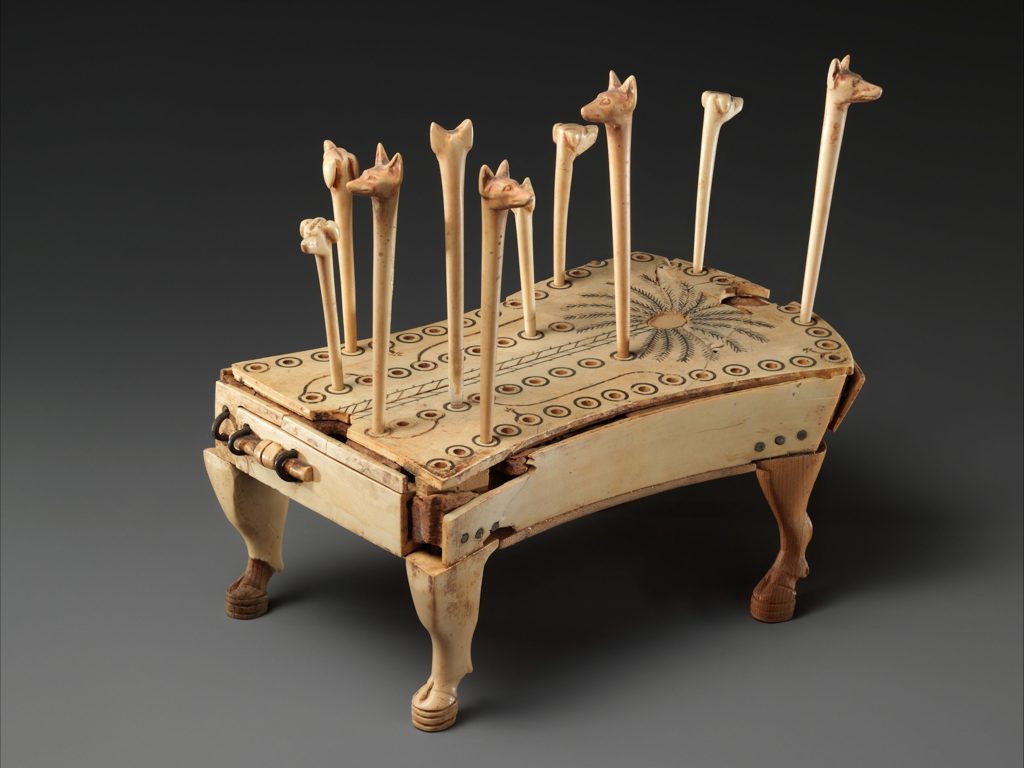
The game of Hounds and Jackals dates back to Egypt’s Middle Kingdom, specifically during the 12th Dynasty under the reign of Amenemhat IV, approximately between 1814 and 1805 BCE. This ancient game, which is a part of The Metropolitan Museum of Art’s collection in New York (Accession Number 26.7.128), was discovered in a pit tomb at Thebes (Tomb CC25). The game board, made of ebony and ivory, is an exquisite example of ancient Egyptian craftsmanship.
Initially brought to light by the renowned archaeologist William Mathew Flinders Petrie in 1890, the game has since been uncovered in over 40 different sites across Egypt, Israel, Syria, Iran, and other locations around the Levant and Mediterranean regions.
Description
The exact ancient Egyptian name for Hounds and Jackals remains unknown. Petrie referred to it as the “Game of 58 Holes” due to the game board’s design, which featured two sets of 29 holes. Later, Howard Carter, who found a particularly ornate version of the game, named it “The Game of Hounds and Jackals” because the playing pieces were carved to resemble the heads of dogs and jackals. Another less common name, “Shen,” derives from the hieroglyph found on some of the boards, typically near a prominent hole at the top of the game.
Gameplay and Rules
The original rules of Hounds and Jackals have been lost to time, leading to various reconstructions by historians and archaeologists. Many of these attempts, however, resulted in unengaging gameplay. The first notable attempt at reconstructing the rules was by Dmitriy Skiryuk, a Russian game re-constructor, who detailed his version in three blog posts. Another set of rules, differing significantly from Skiryuk’s, was published by Donna Washburne (known online as Welsch Dragonfly) on Instructables.com.
Strategy and Mechanics
Hounds and Jackals is largely a game of chance rather than strategy, similar to other ancient games like Senet, Aseb, and the Royal Game of Ur. The game employs throwing sticks instead of traditional dice, which introduces an element of unpredictability due to the uneven probabilities of different scores:
- Score of 2: Most common (probability of 6/16)
- Scores of 1 and 3: Next most common (probability of 4/16 each)
- Scores of 4 and 5: Least common (probability of 1/16 each)
To maximize their chances of success, players should strategically manage the gaps between their pieces and the trap holes. Ideal gaps are either 1 or 3 holes apart, and even better if they are 4 or 5 holes apart, to avoid the high probability of scoring a 2. Conversely, if a trap hole offers a forward movement or is a Nefer hole (a beneficial spot), players should aim for a gap of 2, enhancing their likelihood of landing in a favorable position.
Conclusion
The Game of Hounds and Jackals provides a fascinating glimpse into the recreational life of ancient Egyptians. Despite the mystery surrounding its original rules and exact name, the game’s discovery and subsequent reconstructions highlight its cultural significance and the universal appeal of board games across civilizations.