
In the shadow of the Colosseum, within the regimented confines of military encampments along Hadrian’s Wall, and in the elegant villas of patrician families, ancient Romans gathered around game boards to test their strategic prowess in a contest of pure intellect. Ludus Latrunculorum—the “Game of Soldiers” or “Game of Brigands”—was the Roman Empire’s premier board game of strategy, a cerebral battlefield where no dice determined fate and no element of chance interfered with the purity of tactical thinking. Often described as a precursor to chess, though fundamentally different in mechanics, Latrunculi commanded the respect and passion of Romans for centuries, from the late Republic through the decline of the Empire. Classical authors including Ovid, Varro, and Sidonius Apollinaris referenced the game in their writings, using it as metaphor for military strategy and the intellectual virtues. Yet despite its prominence in Roman culture, Latrunculi suffered the same fate as the Empire itself—it vanished, leaving behind only fragmentary descriptions, tantalizing references, and archaeological shadows. The exact rules were never comprehensively recorded, creating one of antiquity’s most fascinating puzzles for modern game historians. This article explores the history of Ludus Latrunculorum, its probable Greek origins, the reconstructed gameplay that scholars have painstakingly pieced together, and its enduring legacy as a bridge between ancient and medieval strategic gaming.
Greek Foundations: Petteia and the Birth of Tactical Board Games
To understand Latrunculi, we must first journey backward in time to classical Greece, where its direct ancestor flourished. Petteia (πεττεία), also known as “poleis” or “polis,” was the sophisticated strategy game of ancient Athens, Sparta, and the Hellenistic world. References to Petteia appear in the works of Plato, who used the game as a philosophical metaphor in his “Republic,” comparing a bad Petteia player backed into a corner of the board with a person whose arguments have been refuted and who finds himself intellectually trapped. This comparison alone tells us that Petteia was recognized as a game of pure strategic thinking rather than luck—a mental contest where superior reasoning determined victory.
Homer mentions a board game in the “Odyssey” (composed around the 8th century BCE), where Penelope’s suitors play a game translated variously as “draughts” or “tables,” which many scholars identify as an early form of Petteia or a related game. By the classical period (5th-4th centuries BCE), Petteia was firmly established in Greek culture. The game was played on a squared grid board, with each player commanding pieces that moved in straight lines. The objective involved capturing opponent’s pieces through a “custodial” or “flanking” method—surrounding an enemy piece between two of your own pieces.
Greek pottery and artwork occasionally depict game boards that may represent Petteia, though the evidence is less abundant than we might wish. What is clear from textual references is that the game enjoyed considerable prestige. It was associated with intellectual accomplishment and strategic thinking—the kind of virtues Greeks admired in their heroes and statesmen. When Roman culture began its deep engagement with Greek civilization following the conquests of the Hellenistic kingdoms in the 2nd and 1st centuries BCE, Petteia was among the many cultural treasures Rome absorbed and adapted, transforming the Greek game into something distinctly Roman.
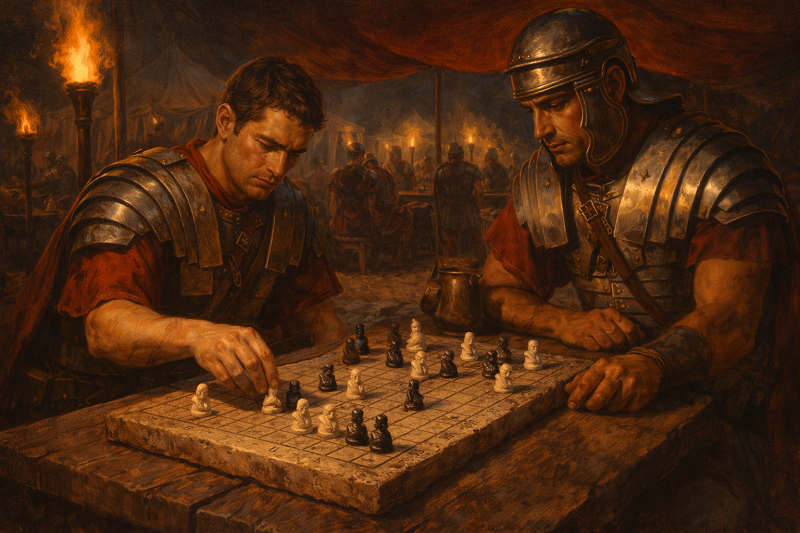
Ludus Latrunculorum: The Roman Evolution
The Romans, ever practical and militaristic in their cultural adaptations, took the Greek Petteia and remade it into Ludus Latrunculorum—a name that reveals much about Roman sensibilities. “Latrones” referred to mercenaries, brigands, or soldier-bandits, giving the game a distinctly martial flavor absent from the more neutral Greek terminology. Alternative names included “Ludus Calculorum” (Game of Pebbles) or simply “Ludus” (The Game), but Latrunculorum became the most common designation, cementing the game’s identity as a miniature war fought on a checkered field.
The Roman version likely emerged in the late Republic or early Imperial period, roughly the 1st century BCE. By the 1st century CE, references to Latrunculi appear regularly in Latin literature. The poet Ovid, writing around the turn of the millennium, mentions the game in his “Ars Amatoria” (The Art of Love), suggesting that proficiency at board games was an attractive quality and that playing Latrunculi could serve as a social occasion for courtship. This indicates that the game had permeated Roman society beyond just military contexts, becoming part of sophisticated urban entertainment.
Marcus Terentius Varro, the great Roman scholar of the 1st century BCE, wrote about Latrunculi in one of his now-lost works, fragments of which survive in later quotations. He apparently described the game’s pieces and some aspects of play. Later writers like Seneca referenced Latrunculi in philosophical writings, using it as a metaphor for life’s struggles and the need for strategic thinking in navigating fortune’s vicissitudes. The 5th-century writer Sidonius Apollinaris, describing a game between two skilled players, spoke of dramatic reversals of fortune, brilliant tactical strikes, and the psychological tension of high-level play—descriptions that suggest a game of considerable depth and excitement.
Archaeological evidence supplements these literary references. Gaming boards that may have been used for Latrunculi have been found at Roman sites across the Empire—from Britain to North Africa, from Spain to Syria. These boards, often carved into stone surfaces or etched into floor tiles, show grid patterns typically ranging from 7×8 to 12×8 squares, though considerable variation exists. Some boards were portable luxury items, fashioned from fine wood or marble with pieces of glass, stone, or precious materials. Others were simply scratched into paving stones by soldiers or common people looking for diversion, much like Nine Men’s Morris boards found carved into medieval church steps.
Reconstructing the Rules: A Scholarly Puzzle
Here lies the great frustration for modern game enthusiasts and historians: despite Latrunculi’s popularity in Roman culture and numerous literary references to it, no complete ancient text describing the full rules has survived. We have descriptions of dramatic moments in games, metaphorical references, and archaeological evidence of boards, but no Roman equivalent of a rulebook. This has forced modern scholars to become detective-archaeologists, piecing together probable rules from fragmentary evidence, comparisons with related games, and logical deduction.
The most authoritative reconstruction work has been conducted by scholars including R.C. Bell, Ulrich Schädler, and others who have combined textual analysis, archaeological study, and game theory to propose plausible rule sets. While uncertainty remains, several core elements seem reasonably well established:
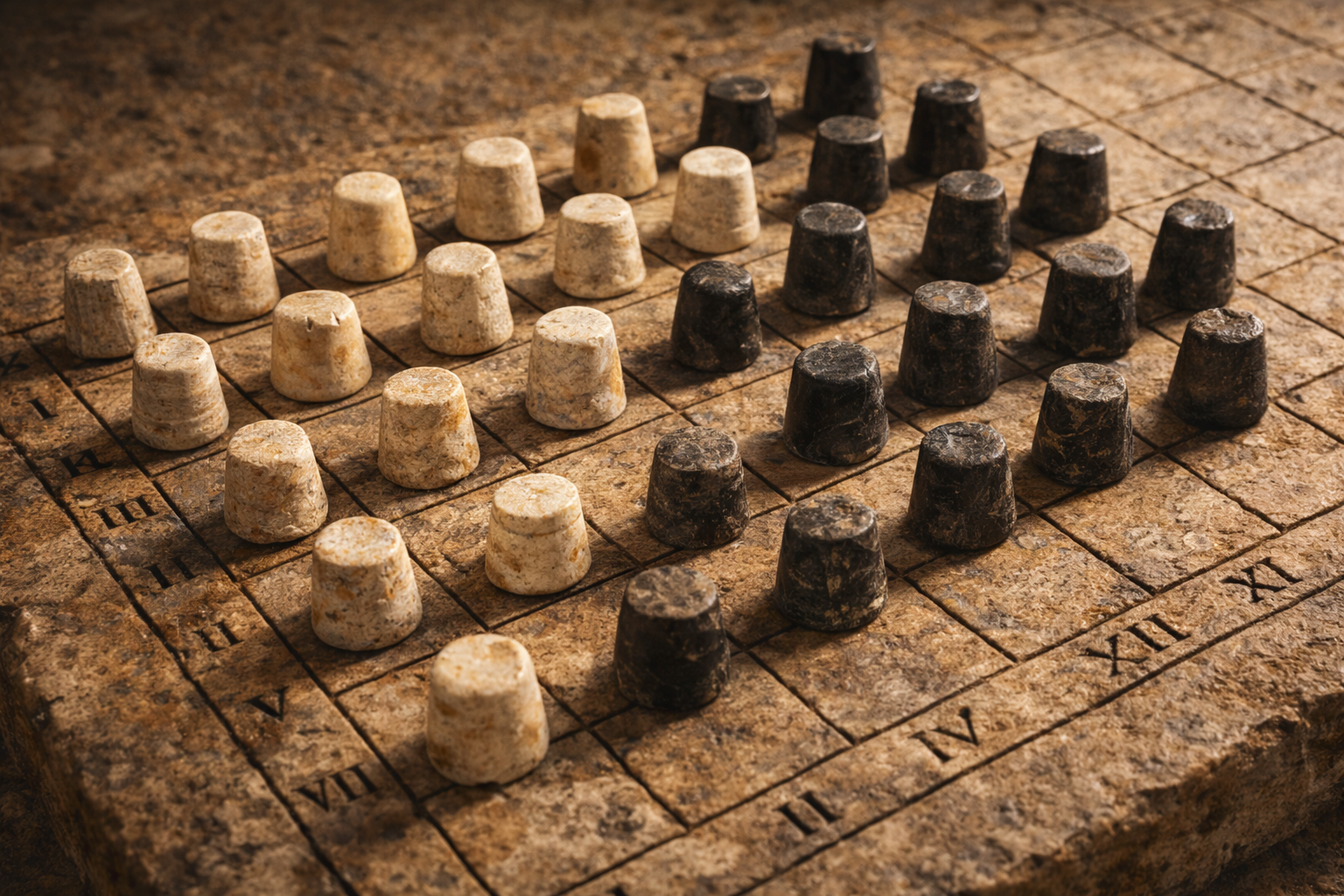
The Board: Latrunculi was played on a rectangular grid board, most commonly with dimensions around 8×8 squares (similar to a chess board) or 12×8 squares (creating a wider battlefield). Unlike chess, pieces moved on the squares themselves rather than on the intersections. The board may have had special marked squares indicating strategic positions, though this is debated.
The Pieces: Each player controlled an equal number of pieces—perhaps 16 or more depending on board size. All pieces were identical in movement and function; there was no king piece or differentiated ranks as in chess. This uniformity was distinctly un-chess-like but characteristic of ancient war games where pieces represented units of soldiers rather than a hierarchical army. Roman sources sometimes refer to the pieces as “calculi” (pebbles) or “latrones” (soldiers), and they were typically white for one player and black or colored for the other. Archaeological finds suggest pieces were often simple discs or cylinders carved from stone, glass, or bone.
Movement: Pieces moved in straight lines—horizontally or vertically (and possibly diagonally in some variants)—across any number of empty squares, much like a rook in chess. This allowed for swift repositioning and the creation of complex tactical situations. Crucially, there were no dice or other randomizing elements; every move was a matter of pure strategic choice.
Capture Mechanism: This is where Latrunculi shows its Greek ancestry and its fundamental difference from chess. Rather than capturing by replacement (moving onto an opponent’s square as in chess), Latrunculi used custodial capture—surrounding an enemy piece between two of your own pieces in a straight line (horizontally or vertically). The trapped piece was then removed from the board. Some reconstructions suggest that multiple pieces could be captured in a single move if they formed a line, and that pieces could move through enemy-occupied squares without being captured unless they ended their turn vulnerable to the flanking position.
Victory Conditions: The game was won when one player captured all or nearly all of the opponent’s pieces, or blocked them so completely that no legal moves remained. Some variations may have included capturing a specific piece (a proto-king) or controlling certain key squares on the board, though evidence for these variants is less certain.
Tactical Depth and Strategic Principles
Based on reconstructed rules, Latrunculi emerges as a game of substantial strategic complexity. The custodial capture mechanism creates unique tactical possibilities and challenges quite different from chess or checkers. Players must constantly balance offense and defense—advancing pieces to threaten captures while ensuring their own pieces remain protected by adjacency to friendly pieces.
Key tactical concepts include:
The Double Attack: Positioning a piece so that it simultaneously threatens to capture two different enemy pieces on the next move, forcing the opponent to sacrifice one. This basic tactic appears in many ancient references as a decisive blow.
The Blockade: Using coordinated pieces to restrict enemy movement, gradually constricting the opponent’s options until capture becomes inevitable. Roman writers described skilled players creating “walls” or “fortifications” of pieces.
The Sacrifice: Deliberately offering a piece for capture in order to lure an opponent into a disadvantageous position, then springing a trap. Sidonius Apollinaris describes exactly this kind of dramatic reversal in his account of a game between two masters.
The Breakthrough: Concentrating forces to overwhelm a section of the opponent’s line, much like a military assault on a fortress wall. Once a breach is created, pieces flood through to attack the vulnerable rear positions.
The absence of a king piece or checkmate condition means that Latrunculi was fundamentally a war of attrition combined with positional maneuvering. Victory came through systematic destruction of enemy forces rather than a single decisive capture. This gave the game a different psychological dynamic from chess—steady pressure and resource management rather than hunt-and-kill targeting of a paramount piece. Some scholars suggest this reflected Roman military doctrine, which emphasized discipline, formation integrity, and methodical conquest rather than the heroic single combat celebrated in Homeric warfare.
The game rewarded long-term planning. A player who thought only one or two moves ahead would find themselves gradually outmaneuvered by an opponent calculating deeper sequences. This intellectual demand made Latrunculi excellent training for military officers—not in the specific tactics of sword and spear, but in the mental habits of strategic thinking: anticipating enemy responses, recognizing patterns, planning multiple moves ahead, and adapting to unexpected developments.
Cultural Context and Social Role
Latrunculi occupied a curious position in Roman society—respected as an intellectual pursuit worthy of educated men, yet also common enough to be played by soldiers and even slaves. This dual nature appears in Roman literature. On one hand, philosophers and moralists approved of Latrunculi as exercising the rational faculties. Unlike dice games, which they condemned as promoting the vice of gambling and reliance on fortune, board games of pure strategy were seen as improving the mind. Pliny the Younger, in his letters, mentions watching games of Latrunculi during leisure hours, treating it as a respectable pastime for a gentleman.
On the other hand, Roman military camps from Britain to Mesopotamia show evidence of soldiers playing board games, almost certainly including Latrunculi. For legionaries on campaign or stationed in remote frontier posts, board games provided crucial entertainment and mental stimulation during the long stretches between battles. The game’s military theme would have resonated with soldiers, and its strategic content may have genuinely contributed to developing tactical thinking in junior officers.
There’s intriguing evidence that Latrunculi may have had a pedagogical role in Roman military training. While explicit documentation is lacking, the correlation between the game’s tactical principles and Roman military organization suggests conscious parallels. Roman warfare emphasized unit cohesion, mutual support between formations, and coordinated maneuvers—exactly the principles rewarded in Latrunculi gameplay. Whether formal or informal, the game likely served as a sandbox for thinking about tactical problems.
Unlike dice gambling which Roman authorities periodically attempted to regulate or prohibit, Latrunculi seems to have been universally acceptable across all social classes and legal contexts. Parents approved of children learning the game. No moral opprobrium attached to playing it, in sharp contrast to the social stigma that could accompany excessive gambling on dice or chariot races. This respectability ensured Latrunculi’s survival and prominence throughout Roman history, from the Republic through the Imperial centuries.
The Game in Roman Literature and Philosophy
Roman and Greek writers employed Latrunculi and Petteia as rich metaphorical resources, using the game to illustrate philosophical and rhetorical points. Plato’s use of the cornered Petteia player as metaphor for a defeated argument has already been mentioned. This metaphorical tradition continued in Roman literature.
Seneca, the Stoic philosopher of the 1st century CE, invoked Latrunculi in his philosophical letters to illustrate points about fate and human agency. In one passage, he compares life to a game of Latrunculi—we don’t control what pieces we’re given or what board we must play on, but we do control how skillfully we play with what fortune provides. This Stoic interpretation—accepting what cannot be changed while exercising wisdom in what can be controlled—found perfect expression in a game where positions might seem hopeless yet clever play could still achieve victory or at least honorable resistance.
Marcus Aurelius, the philosopher-emperor of the 2nd century, referenced board games in his “Meditations,” though not Latrunculi specifically by name. His reflections on accepting circumstances yet applying reason to action echo the Stoic board game metaphor. The game’s complete transparency—all information visible, no hidden cards or secret rolls—made it particularly apt for philosophical illustration of rational decision-making.
Legal and rhetorical writers used Latrunculi terminology as well. Roman legal texts occasionally employ the term “intercludere” (to block or intercept), a Latrunculi term for cutting off enemy pieces, when discussing legal strategies or property disputes. This shows how deeply the game’s vocabulary penetrated educated Roman discourse, becoming part of the shared cultural language for describing strategic interaction and competitive maneuvering of any kind.
Archaeological Evidence Across the Empire
The material remains of Latrunculi are scattered across what was once the Roman world, a testament to the game’s geographic reach and social penetration. Archaeological discoveries include both formal game boards and improvised playing surfaces, revealing the game’s presence at every level of Roman society.
In Britain, at Roman forts along Hadrian’s Wall and at settlements like Vindolanda, archaeologists have found stones with grid patterns carved into them—likely boards for Latrunculi or similar games. These humble artifacts speak to the experience of Roman soldiers stationed at the empire’s cold northern frontier, passing time between patrols by matching wits over a game board. Some of these boards show signs of long use, the carved lines worn smooth by countless games over years or even decades.
In Mediterranean regions, more elaborate examples survive. Roman villas in Italy, North Africa, and the Eastern provinces sometimes featured floor mosaics incorporating game board designs. Some scholars believe these decorative boards were functional, allowing wealthy Romans to play oversized versions of games with large pieces, perhaps as entertainment for guests at banquets. Other mosaic boards were clearly symbolic—displaying the owner’s cultural sophistication and appreciation for strategic games as intellectual pursuits.
Gaming pieces themselves appear in archaeological contexts ranging from military sites to urban homes to burial goods. Small cylindrical or conical pieces of glass, stone, or ceramic—often found in sets with contrasting colors—are regularly identified as probable Latrunculi or dice game pieces. Distinguishing which game a particular piece belonged to can be challenging without context, but finds that include board and pieces together provide more certain identification.
One particularly interesting category of evidence comes from informal game boards scratched into stone surfaces in public spaces. In Roman forums, bathhouses, and amphitheaters, grid patterns etched into steps or pavement stones suggest spontaneous gaming by common people—the Roman equivalent of scratching a tic-tac-toe grid on a napkin. These crude boards show that Latrunculi (or simpler grid games) transcended class boundaries, played by anyone with a few stones or coins and a flat surface.
The Mysterious Disappearance
As the Western Roman Empire declined in the 4th and 5th centuries CE, Latrunculi gradually faded from the historical record. The game that had entertained and challenged Romans for half a millennium effectively vanished, leaving only the fragmentary references and archaeological traces that puzzle us today. Understanding why Latrunculi disappeared requires examining the broader collapse of Roman cultural continuity.
The fall of the Western Empire brought catastrophic disruption to the intellectual and social structures that had sustained Roman gaming culture. Literacy declined precipitously. The network of schools where educated Romans learned rhetoric, philosophy, and cultural practices—including traditional games—collapsed. Urban centers where gaming was a public social activity shrank or were abandoned. The military institution that had been a major venue for Latrunculi gameplay dissolved as Roman legions gave way to barbarian foederati and eventually to the fragmented military structures of early medieval kingdoms.
Simultaneously, new games were entering Europe that would ultimately eclipse the old Roman strategy game. By the 6th century, various forms of Tafl games—including Hnefatafl—had become popular in Germanic and Scandinavian regions. These games bore some conceptual similarities to Latrunculi (asymmetric strategic board games) but had their own distinct mechanics and cultural associations. They filled the niche that Latrunculi had occupied, providing strategic gaming entertainment for the warrior aristocracies of post-Roman Europe.
More significantly, chess was emerging in India as Chaturanga during roughly the same period Latrunculi was fading in the West. By the 7th-8th centuries, chess had spread to Persia and the Islamic world. As it gradually entered medieval Europe in the 10th-11th centuries, chess would become the definitive strategic board game of Western civilization. Chess’s combination of diverse piece types, the checkmate victory condition, and its rich metaphorical association with feudal hierarchy made it perfectly suited to medieval European culture in ways that the uniform-piece, attrition-based Latrunculi was not.
There may also have been an element of cultural rejection. As Christianity became dominant, there was sometimes suspicion of pagan Roman cultural practices. While board games themselves were not rejected (medieval Christians enthusiastically adopted chess and other games), the specific cultural memory and transmission of Latrunculi may have been interrupted by the religious and cultural transformations of late antiquity. The game had no explicit religious significance to preserve it, unlike some ritual games in other cultures.
By the early Middle Ages, Latrunculi had been forgotten. When medieval writers encountered ancient Latin texts mentioning “ludus latrunculorum,” they often misunderstood the references, sometimes confusing it with chess (which didn’t exist in the Roman period) or other games. The specific knowledge of how to play Latrunculi was lost, not to be recovered until modern archaeological and historical scholarship attempted its reconstruction.
Legacy and Modern Reconstructions
Despite its disappearance from living tradition, Latrunculi has experienced a scholarly and enthusiast resurrection in the modern era. Game historians, recognizing the game’s historical importance as Rome’s primary strategy game, have dedicated considerable effort to reconstructing plausible rules from the fragmentary evidence. Several variant reconstructions now exist, each representing different scholarly interpretations of the ancient sources.
R.C. Bell’s influential work “Board and Table Games from Many Civilizations” (1960, revised 1979) included a Latrunculi reconstruction that introduced many modern players to the game. Bell’s version used an 8×7 board and proposed specific rules for movement and capture based on his interpretation of classical sources and comparison with related games. While subsequent scholarship has suggested modifications to some of Bell’s proposals, his work was pioneering in bringing Latrunculi back to public awareness.
More recent reconstructions by Ulrich Schädler and others have refined our understanding, incorporating newer archaeological evidence and more sophisticated analysis of ancient texts. Some reconstructions are more conservative, including only rules for which we have strong evidence, while others speculatively fill gaps to create a more complete gaming experience. This diversity of reconstructions is actually beneficial—it allows modern players to experience different possibilities and develops our intuition about what ancient gameplay might have felt like.
Modern Latrunculi has found several niches. Historical reenactment communities, particularly those focused on Roman military history, often include period games as part of their authenticity efforts. Latrunculi fits perfectly, and reenactors have crafted beautiful reproduction boards and pieces. Educational programs use Latrunculi to engage students with Roman history—playing an actual Roman game creates an experiential connection to the past that pure reading cannot achieve. Strategy gaming enthusiasts interested in historical games have embraced Latrunculi as an intriguing alternative to more familiar games like chess, appreciating its different strategic character.
The game has even found limited representation in digital form. Several computer and mobile implementations of Latrunculi reconstructions exist, allowing players to experiment with the game and play against AI opponents or human competitors online. While these digital versions will never capture the tactile pleasure of moving stone pieces across a carved board, they make the game accessible to a global audience and facilitate the testing of different rule interpretations against each other.
Some game designers have used Latrunculi as inspiration for modern game designs, borrowing the custodial capture mechanic or the uniform-piece tactical warfare concept for new games. In this way, even though the original Latrunculi is lost, its genetic material survives in the DNA of contemporary strategy games.
Latrunculi and the Evolution of Strategy Gaming
From a game design perspective, Latrunculi represents an important evolutionary stage in the development of abstract strategy games. It demonstrates sophisticated game design principles: perfect information, no luck element, tactical depth arising from simple rules, and elegant capture mechanics. These principles would be refined and developed in later games, ultimately influencing the entire tradition of Western strategy gaming.
The custodial capture mechanism, while not unique to Latrunculi (it appears in various ancient games), represents an alternative to replacement capture that creates distinctly different tactical dynamics. In replacement capture games (chess, checkers), pieces are vulnerable when undefended. In custodial capture games, pieces are vulnerable when surrounded. This changes the geometry of safety and danger on the board, encouraging different formation patterns and maneuvers. The fact that this mechanism survived in later games like Hnefatafl and even in distant variants like certain Asian board games suggests it represents a fundamentally successful game design approach.
Latrunculi’s uniform pieces—all pieces moving and capturing identically—contrasts with the differentiated hierarchical armies of chess and Chaturanga. This design choice makes the game more about emergent complexity (complex situations arising from many simple interactions) than about memorizing the specific capabilities of different piece types. Modern game design theory recognizes both approaches as valid, and Latrunculi demonstrates that uniform-piece games can achieve substantial depth without requiring the explicit hierarchy and differentiation that chess employs.
The game’s influence on chess, while often asserted, is probably indirect and minor. Chess evolved from Chaturanga in India, influenced by Persian Shatranj, with minimal input from Roman gaming traditions. However, both games emerged from the same basic human fascination with abstract tactical warfare, and it’s possible that European modifications to chess as it spread westward were unconsciously influenced by half-remembered cultural memories of Roman strategy gaming. The idea of a board game representing military conflict was certainly well-established in European cultural consciousness thanks to games like Latrunculi, potentially smoothing chess’s reception when it arrived.
Conclusion
Ludus Latrunculorum stands as one of the great lost treasures of ancient gaming—a sophisticated strategy game that entertained Romans from senators to soldiers, that challenged the finest minds of antiquity, and that served as metaphor for philosophy and life itself. Though the precise details of its rules vanished with the Roman world, enough evidence survives to reconstruct its essential character: a pure strategy game of tactical warfare, where uniform pieces maneuvered across a checkered battlefield, where captures came through cunning flanking rather than direct assault, and where victory required both calculation and strategic vision.
The game’s Greek origins in Petteia, its Roman adaptation and flourishing, and its eventual disappearance mirror the larger arc of classical civilization itself—born in Greece, perfected in Rome, lost in the chaos of the Migration Period, and rediscovered by modern scholars piecing together fragments. Modern reconstructions allow us to experience something of what a Roman general, a frontier legionary, or a philosophizing patrician might have felt moving calculi across a board two thousand years ago, engaged in intellectual combat governed by reason rather than fortune.
As we place pieces on reconstructed Latrunculi boards today, we connect across the millennia to that fundamentally human drive to test ourselves against worthy opponents, to exercise our rational faculties in competition, and to find meaning in the abstract patterns of strategic games. Latrunculi may have vanished from living tradition, but its rediscovery enriches our understanding of Roman culture and reminds us that the love of strategic gaming is truly ancient—as old as civilization itself, and likely as enduring.
FAQs
- What is Ludus Latrunculorum?
- Ludus Latrunculorum, also called Latrunculi or “the Game of Soldiers,” was ancient Rome’s primary strategic board game. Played on a grid board with uniform pieces, it involved capturing opponent’s pieces through flanking movements rather than direct replacement. The game required pure strategic thinking with no element of chance, making it respected by Roman philosophers and popular among soldiers and civilians alike from the 1st century BCE through the decline of the Western Empire.
- How was Latrunculi different from chess?
- While both are strategic board games, Latrunculi differs fundamentally from chess in several ways: all pieces in Latrunculi were identical (no kings, queens, or differentiated ranks), capture was achieved by surrounding enemy pieces between two of your own (custodial capture) rather than by moving onto their square, and victory came by capturing all or most opponent pieces rather than checkmate. Latrunculi actually predates chess by several centuries and evolved independently from Greek Petteia rather than from the Indian Chaturanga that spawned chess.
- What happened to the rules of Latrunculi?
- The complete rules of Latrunculi were never comprehensively written down in surviving Roman texts, or if they were, those texts have been lost. Ancient references mention the game frequently but only describe moments of play or use it metaphorically rather than explaining full rules. Modern scholars have reconstructed plausible rules by combining fragmentary textual evidence, archaeological findings of game boards, comparison with related games like Greek Petteia, and logical analysis of what would create balanced, engaging gameplay.
- Can you play Latrunculi today?
- Yes, several modern reconstructions of Latrunculi exist based on scholarly research. Game historians like R.C. Bell and Ulrich Schädler have proposed rule sets that can be played on boards with dimensions like 8×8 or 12×8 grids. Historical reenactment groups, educational programs, and strategy game enthusiasts play these reconstructed versions. While we cannot be certain these exactly match ancient Roman play, they provide an authentic experience of the game’s strategic character and allow connection with this lost Roman tradition.
Latrunculi — Frequently Asked Questions
What is Ludus Latrunculorum?
Ludus Latrunculorum (the “game of mercenaries”) was a Roman two-player strategy game played from at least the 1st century BCE. Pieces moved orthogonally on a rectangular grid; opponents’ pieces were captured by being flanked on two sides — a mechanism similar to later games like Hnefatafl and Tablut.
How do you play Latrunculi?
The exact rules are partially reconstructed because no surviving Roman text describes them in full. The consensus reconstruction: each player has equal numbers of pieces (8–17 per side depending on the board), pieces move orthogonally any number of empty squares (like rooks in chess), and a piece is captured when an opponent’s piece flanks it on two opposite sides. The player who eliminates more enemy pieces wins.
How old is Latrunculi?
Latrunculi is documented in Roman literature from the 1st century BCE (mentioned by Varro, Ovid, and Martial), and physical boards have been excavated from across the Roman world — including the famous Stanway Game from a 1st-century CE warrior burial in Britain. The game likely descends from the earlier Greek game of Petteia.
What did the Romans call this game?
Most commonly Ludus Latrunculorum (“game of little soldiers” or “mercenaries”) or simply Latrunculi. Roman writers describe it as a game of strategy, with skilled players celebrated by name.
Who invented Latrunculi?
The Romans inherited it rather than invented it. The most likely root is the ancient Greek game Petteia (πεττεία), which Plato references as a teaching tool for strategy. Petteia itself may descend from earlier Egyptian or Mesopotamian board games.
Can you play Latrunculi today?
Yes — historical reconstructions are widely available, both as physical board sets and as browser/mobile apps. The Stanway Game reconstruction is the most popular set, sold in museum gift shops across Europe.
Hnefatafl: The Viking King’s Game
The Norse descendant of similar flank-capture mechanics.
Tabula and Backgammon
Rome’s other major board-game contribution.
Nine Men’s Morris
The medieval European descendant tradition.